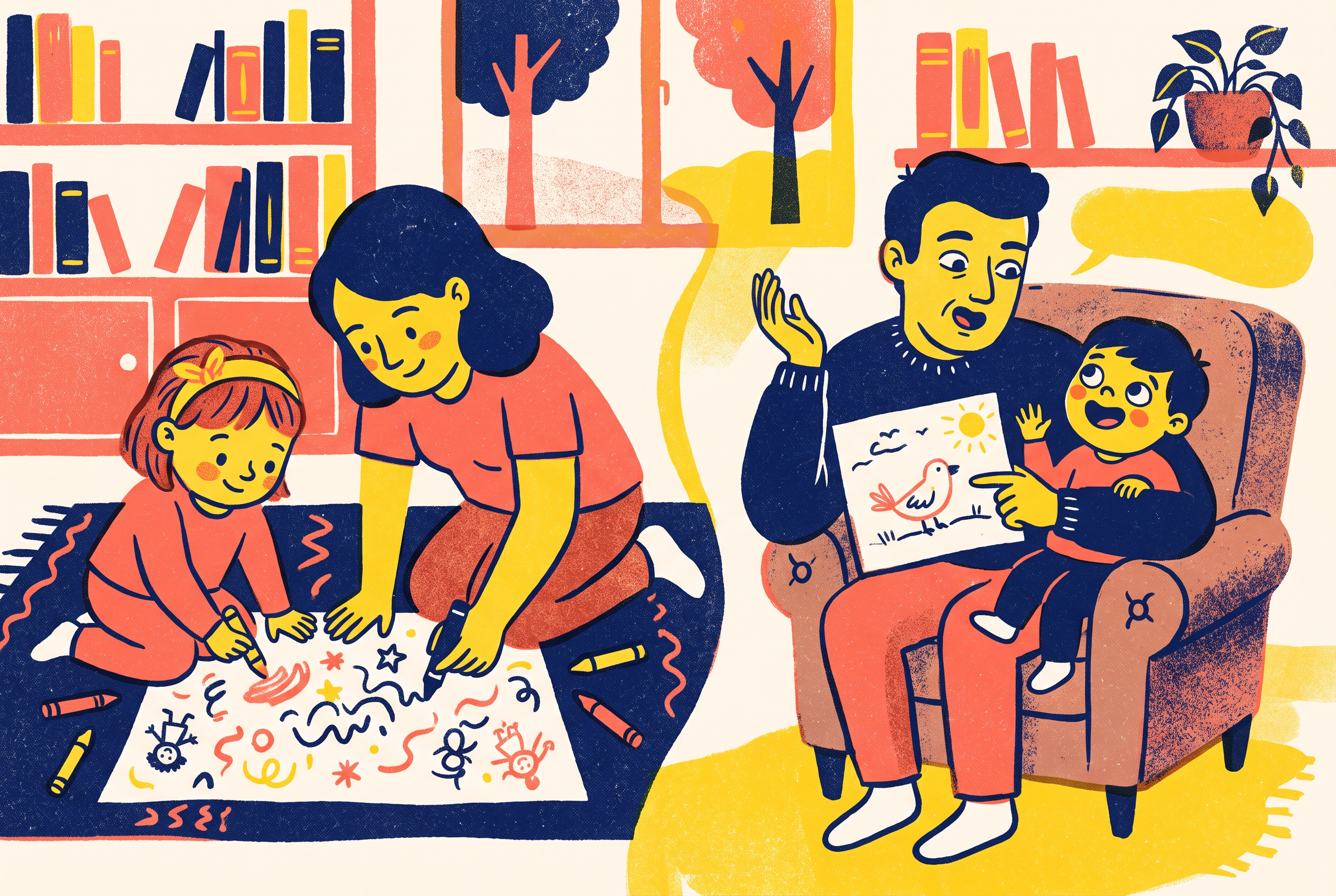
Draw and Tell Stories for Preschoolers: 10 Easy Ideas
Ten draw and tell stories games for ages 3-5, each with a one-line opener and a follow-up question. All you need is paper, crayons, and your child's words.
 Pixley Team
A four-year-old holds up a purple blob with six legs and announces, "This is Gerald. He lost his shoe." That sentence is the whole game. The blob is not the point. Gerald and his missing shoe are.
Draw and tell stories flips the usual art-time script. Instead of asking "What did you draw?" and getting a shrug, you hand over a crayon and let the drawing become a prompt for the story the child is already carrying around. The drawing stays rough. The words do the heavy lifting.
This guide gives you ten draw and tell games built for ages 3 to 5. Each one has a one-line opener you can say out loud and a follow-up question that keeps the story moving without you taking it over. You need paper, crayons, and about ten minutes. No screen, no prep, no artistic talent required from you or the child.
Parents, preschool teachers, and homeschoolers can all run these as written. At the end, we cover what to do with a drawing that your child clearly loves, because some of these characters deserve a longer life than a fridge magnet.
Why draw-and-tell works for 3-5 year olds
Most 3 to 5 year olds can talk a story long before they can write one. Drawing closes that gap. A scribble gives a small child something to point at while they find the words, which takes pressure off the talking. The paper holds the idea so the brain can keep building.
This also fits where preschoolers are in their drawing. At this age, a drawing is usually a record of an idea, not a picture of how something looks. If you have ever been told that a circle with lines is "my whole family at the beach," you have seen it. Our guide to the stages of drawing development in children explains why this is normal and why you should never correct the picture to match reality.
Here is the stance this article takes: the drawing is a prompt, not a product. The moment you praise the neatness of the lines, the child learns the drawing is being graded. The moment you ask about the character, the child learns the story is what matters.
That shift is also what makes the activity work in a classroom. A child who says "I can't draw" can still say "the dragon is sad because nobody came to his party." If your child is stuck on that first part, 8 ways to rebuild confidence when a child says they can't draw pairs well with everything below.
As for supplies, you need almost nothing.
Set up in two minutes: paper, crayons, and one rule
Gather three things. Plain paper (printer paper is fine, and cheap sketchbooks are better because pages stay together). A handful of chunky crayons or washable markers. A flat spot where you can sit beside the child, not across from them. Sitting side by side makes it feel like you are making something together instead of conducting an interview.
Now the one rule: the child decides what the drawing is.
That is it. You do not guess. You do not say "Is that a horse?" If you do not know what something is, say "Tell me about this part." A drawing that looks like a potato with antlers is whatever the child says it is, and the second you name it for them, the story becomes yours.
A few small habits make the sessions smoother:
Keep each session to about ten minutes. Three-year-olds often last five. Stop while they still want more.
Write down one or two of their exact phrases on the back of the page. "Gerald lost his shoe in the soup" is a keeper, and you will want the original wording later.
Date the page. It costs two seconds and makes the pile of drawings far more valuable in a year.
Resist the urge to fix the ending. If the story ends with everyone falling in a hole, that is a fine ending.
For younger siblings in the 2 to 3 range who want to join, drawing activities for toddlers covers simpler versions of the same idea.
With the setup done, here are the first four games.
Ideas 1-4: Start from a squiggle, a three-panel story, story cards, and a surprise object
These four are the easiest on-ramps. Start here if your child is new to storytelling or a little shy about it.
1. Start from a squiggle. Draw one loose, wiggly line on the page. Ask your child to turn it into something, then tell you about it.
Opener: "Here is a squiggle. What does it want to be?" Follow-up: "Where is it going?"
The squiggle removes the blank-page fear. Nobody is responsible for a squiggle, so nobody can get it wrong.
2. The three-panel story. Fold a sheet into three sections. The child draws something in each box (anything), then tells you how the three connect. It's a gentle introduction to beginning, middle, and end without ever using those words.
Opener: "Draw one thing in each box. Then tell me what happens." Follow-up: "What happened between the first box and the second?"
When your child outgrows three boxes, comic strip ideas for kids offers 30 more prompts at that same panel-by-panel pace.
3. Story cards. Cut an index card into pieces or use blank cards. Have your child draw one quick picture per card (a dog, a door, a moon, a cake). Shuffle them, flip three, and tell a story that uses all three.
Opener: "Pick three cards. Who is in the story?" Follow-up: "What does the dog want from the cake?"
4. The surprise object. Hide a small object (a spoon, a sock, a toy car) in a bag. Your child pulls it out, draws it however they like, and invents why it showed up.
Opener: "A mystery thing just appeared. Draw it." Follow-up: "Who left it here?"
All four take under ten minutes, and each produces a story with a clear beginning even if the ending is a mess.
Ideas 5-7: Take turns drawing the next scene, retell a favorite book, and draw a feeling-color story
These three add a little structure. They work best once your child is comfortable talking while drawing.
5. Take turns drawing the next scene. You draw one simple thing (a house), your child adds the next (a very tall giraffe next to it), you add the next, and you build the scene back and forth. Keep your own drawing deliberately simple so it never competes with theirs.
Opener: "I'll draw a house. You draw what happens next." Follow-up: "Does the giraffe fit through the door?"
It's also quiet practice in waiting for a turn. If that is a sore spot at your house, how to teach kids to take turns has scripts that fit right into this game.
6. Retell a favorite book. Pick a book your child knows by heart. Ask them to draw their favorite scene, then tell it back in their own words. They will change things. Let them. Retelling with edits is how children start becoming authors.
Opener: "Draw your favorite part of the book." Follow-up: "What would you change if it were your story?"
7. The feeling-color story. Ask your child to pick a crayon that feels like today. Then fill a page with that color and make a character who feels that way. A red character might be grumpy, or might be excited. The child decides.
Opener: "Pick a color that matches how you feel. Who lives in that color?" Follow-up: "What would make them feel better, or even happier?"
This one gives children a low-stakes way to talk about feelings through a character instead of directly about themselves. A feelings drawing activity for kids goes deeper on this, and what colors in kids' drawings mean is worth a read before you assume a black crayon means something dark. Often it just means the black crayon was nearby.
A note on all three: if your child reaches for the same character every time, lean in. Repetition is how a preschooler builds a world.
Ideas 8-10: Shared mural story, family character story, and a bedtime draw-and-tell
The last three stretch the activity across more people, more time, or a quieter moment of the day.
8. Shared mural story. Tape a long strip of butcher paper to the floor or a wall (a few sheets of paper taped edge to edge works too). Everyone adds to one big scene. Each person draws, then explains their part. Preschool classrooms love this one because every child contributes at their own level, and the finished mural is a story with many authors.
Opener: "This is our town. What lives here?" Follow-up: "Who is the neighbor of the purple house?"
9. Family character story. Each family member draws themselves as an animal, a robot, or a made-up creature. Then the group builds one story where all the creatures have to solve a problem together. Parents get a surprising look at how their child sees everyone in the house. For a fuller version, see this family drawing activity for kids that makes story characters.
Opener: "Draw yourself as any creature you want. Then we'll go on an adventure." Follow-up: "Who is the bravest one? Who is the silliest?"
10. Bedtime draw-and-tell. This is the quiet one. Do it with one pencil and one page, in low light, five minutes before bed. The child draws a single calm scene (a moon, a sleeping bear, a cozy house) and whispers the story. Keep the questions soft and slow.
Opener: "Draw one thing that is getting sleepy tonight." Follow-up: "What does it dream about?"
This replaces the "tell me a story" negotiation with the child doing the telling. Many parents find it shortens the bedtime stalling because the child is the one steering toward the ending.
Mix these in whenever the first seven start to feel familiar. The mural works as a weekend project. The bedtime version works as a nightly habit.
Questions that keep the story going without taking over
The follow-up question is where most adults accidentally hijack the story. "Was the dragon scared?" puts the answer in the child's mouth. "How did the dragon feel?" hands the child the pen.
Use questions that cannot be answered with yes or no, and that you genuinely do not know the answer to.
Questions that work:
"What happens next?"
"Who is that, and what are they doing?"
"Where is this?"
"What does he want more than anything?"
"What is the hardest part for her?"
"How does it end?"
Questions to retire:
"Is that a cat?" (You are guessing, and being wrong stings.)
"Why didn't you color the sky blue?" (This is a quiz about the drawing, not the story.)
"Wasn't he scared?" (Leading.)
Then apply the two-beat rule: ask one question, then wait a full five seconds before asking another. Preschoolers need that pause to build the next sentence. If you fill the silence, you are telling the story for them.
If the story stalls, pick one detail from the drawing and ask about that. "Tell me about the hat" often unlocks more than "what happens next" does, because a concrete detail is easier to talk about than an abstract plot.
And when the child says "the end," accept it, even if it arrived after eleven seconds. A short story told with confidence beats a long one dragged out under pressure. The quality bar for these sessions is whether the child felt like the author. Length does not matter.
For more prompt ideas to hand a child at the start of a session, 40 drawing prompts for kids is a good bookmark.
Keep the story: from one drawing to a book or a cartoon
After a few weeks of draw and tell stories, you will notice a pattern: one drawing keeps coming back. A character with a name, a few traits, and a growing history. That drawing deserves more than a spot on the fridge.
The low-tech route comes first. Staple the best three or four pages into a handmade book, add the child's dictated words in your handwriting, and let them "read" it back at bedtime. Our guide on how to make a book from kids' drawings walks through it step by step, and what to do with your child's drawings has eleven more ideas for the rest of the pile.
If you want to take the same character further, Pixley turns kids' drawings and ideas into personalized animated cartoons and bedtime storybooks for ages 2 to 8. A parent describes a lesson or idea, and Pixley builds an episode around the child's own drawn character. Every generation passes child-safety filtering before a kid sees it, and there is a free trial on iOS. The character your child invented at the kitchen table is the one that shows up on screen, not a stock character from somewhere else.
For a broader walk-through, see how to turn your child's drawing into a story and how to animate your child's drawing.
The order matters, though. Tell the story out loud first. Draw it second. Save it third. The keepsake only works if the story was theirs to begin with.
Conclusion
Pick one of the ten ideas tonight and run it for ten minutes. Start with the squiggle if you want the easiest entry, or the bedtime version if evenings are the hard part. Write down one sentence your child says word for word. In a month, you will have a pile of characters and a handful of favorites.
When one character keeps returning, give it a bigger stage. Open Pixley, upload that drawing, and describe the lesson or idea you want the story to carry, whether that is sharing, a big feeling, or just a silly adventure. Your child gets to watch their own scribbled creature move through a cartoon built around their idea. Try the free trial on iOS with the drawing your child already loves, and let the kitchen-table story become an episode.
Frequently Asked Questions
What are draw and tell stories?
Draw and tell stories are activities where a child draws something and then explains it aloud as a story. The drawing acts as a prompt for the child's own words, so it does not need to look polished. They work well for ages 3 to 5 because speaking comes easier than writing at that stage.
How long should a draw and tell session last for a preschooler?
Aim for about ten minutes, and expect five from many three-year-olds. Stop while your child still wants to keep going, which makes them eager to come back. A short story told with confidence is better than a long one pushed past their interest.
What should I do if my child says they can't draw?
Start with a squiggle you draw yourself and ask the child what it wants to become. This removes the pressure of a blank page, and the focus moves to the story. See Pixley's guide on [rebuilding confidence when a child says they can't draw](https://www.pixleyai.com/blog/guides/when-your-child-says-i-cant-draw-8-ways-to-rebuild-confidence) for more steps.
Can I turn my child's drawing into a cartoon?
Yes. Pixley turns kids' drawings and ideas into personalized animated cartoons and bedtime storybooks for ages 2 to 8. Parents describe a lesson or idea, and Pixley builds an episode around the child's own character. Every generation passes child-safety filtering, and a free trial is available on iOS.
How do I ask questions without taking over my child's story?
Ask open questions you genuinely do not know the answer to, such as "What happens next?" or "Where is this?", and avoid leading ones like "Was he scared?" Then wait about five seconds before speaking again. Preschoolers need that pause to build their next sentence.