How to Make a Book From Kids Drawings: Bedtime Guide
Learn how to make a book from kids drawings for bedtime. Follow step-by-step instructions for ages 2 to 8 using home tools, easy layouts, and child…
 Pixley Team
Your refrigerator door has run out of magnets, and the plastic tub in your hallway closet holds hundreds of loose construction paper sketches. Most parenting guides tell you to pack those sheets into a box, mail them to an archiving service, and spend ninety dollars on an art coffee table book. That turns your child's creative work into a decorative museum piece that sits untouched on an adult shelf.
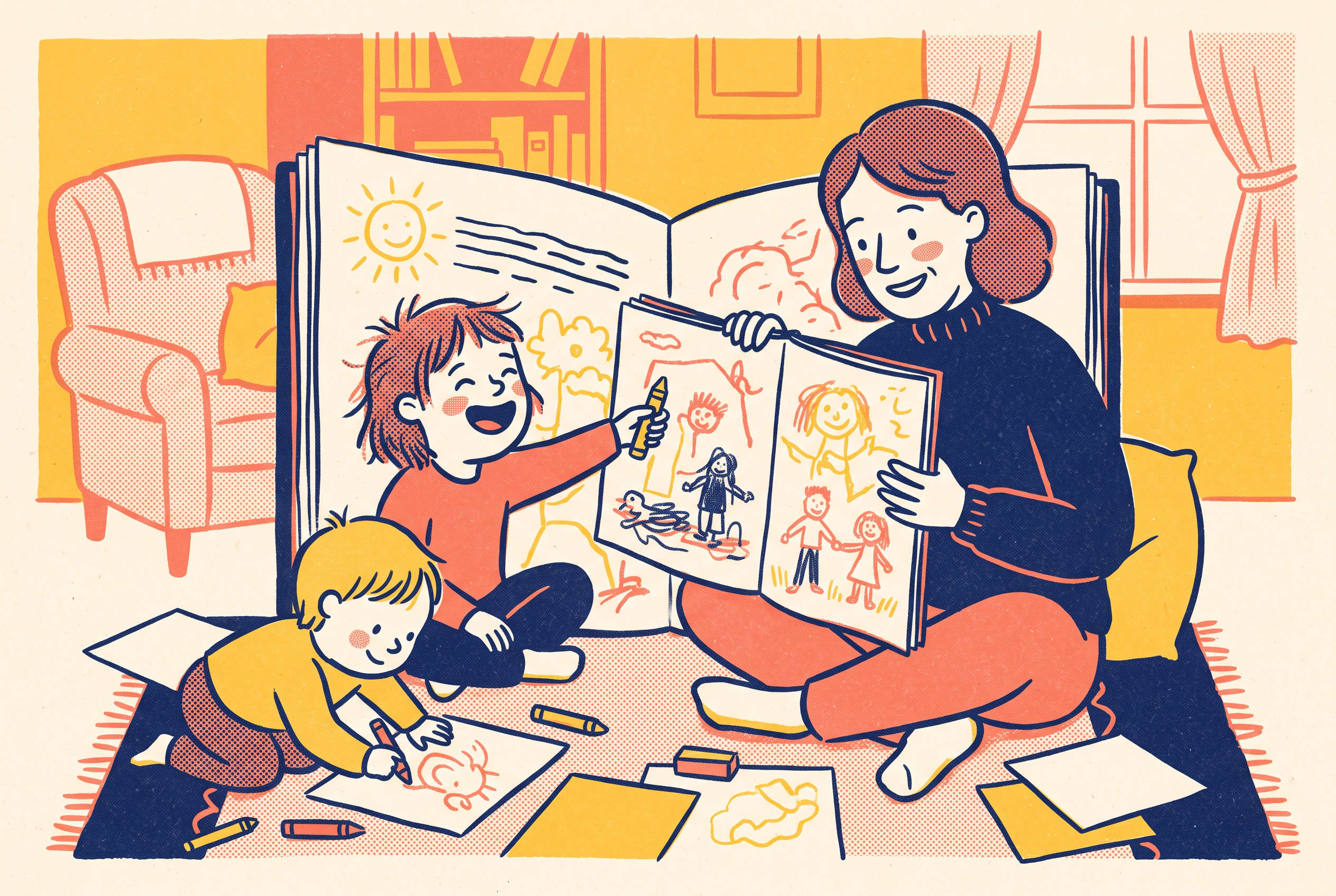
There's a better way. You can make a book from kids drawings that becomes part of your evening routine. When children hold a storybook filled with their own artwork and their own transcribed words, bedtime resistance drops. They want to open the cover because they built what's inside.
You don't need expensive design software or professional bindery equipment. You need eight to twelve pieces of paper, a smartphone camera, basic binding materials, and twenty minutes of conversation with your child. Here's how to go from selection to bedtime reading.
Step 1: Pick a theme and choose 8-12 drawings together with your child
Don't try to bind an entire year of artwork into one volume. A bedtime book for a child between two and eight years old needs a tight arc that reads in five to ten minutes. Aim for eight to twelve drawings total. A bloated book exhausts young readers and turns evening reading into a marathon.
Spread thirty or forty candidates across the living room carpet. Give your child the final veto on what stays and what goes. If you choose the artwork alone, your child sees the finished piece as your project, not their story. Look for drawings that connect naturally. A series of crayon monsters, three different pictures of trucks, or a cluster of watercolor animals gives you an immediate foundation.
Sort the selected sheets into a chronological pile. Don't worry about conventional three-act structure. A three-year-old sees a direct connection between an orange scribble of a volcano and a blue oval of a swimming pool. Your job during selection is to group the items that spark enthusiasm. For ideas on sorting the hundreds of loose sheets that don't make the cut, see our guide on what to do with your child's drawings.
Step 2: Photograph or scan each drawing (300 dpi, even light, keep originals safe)
Crisp digital reproductions separate a durable bedtime story from a muddy DIY booklet. For printed pages, commercial and home presses need images set to 300 dots per inch (dpi) at the final trim size. Low-resolution exports look sharp on a phone screen but turn pixelated and dull on paper.
If you have a flatbed scanner, scan each page at 300 to 600 dpi as a high-quality JPEG or TIFF file. If you use a smartphone, skip the scanner app filters that blow out crayon contrast. Place the artwork flat on the floor next to a large window with indirect daylight. Overhead ceiling lights produce yellowish color casts and throw your phone's shadow across the paper.
Stand directly above the artwork, hold your device parallel to the floor, and use your camera grid to align the edges. Turn the flash off. Keep the original drawings flat inside an acid-free folder while you work, so glue edges and marker lines stay intact as you assemble the digital files.
Step 3: Ask your child to tell the story and write down their exact words
The biggest mistake parents make is writing an adult narrative over their child's illustrations. Don't write: "The brave puppy went for a walk in the forest." Write what your child actually says. If your four-year-old says, "The dog has two heads and he is looking for cheese under the couch," transcribe that exact sentence.
Verbatim dictation has real educational value. Research on early literacy shows that recording a child's exact oral language builds narrative competence and print awareness by linking speech sounds directly to letter forms. Dictation lets toddlers and preschoolers compose complex narratives long before their fine motor skills allow them to write the words by hand.
Prompt your child with open questions, not leading directives. Ask: "Who is this?" and "What are they doing right now?" When they pause, ask: "What happens on the next page?" Keep your pencil moving and don't correct their grammar. If your child invents nonsense words or jumps wildly between ideas, keep every word. Those quirks are what make the book a bedtime favorite for years.
Step 4: Lay out the pages: one drawing per page, short text, margins away from the fold
Keep the layout predictable. Young children track stories best when pictures and text sit in the same place on every spread. Put the drawing on the upper two-thirds of the page and the dictated text underneath, or put the image on the right-hand leaf with text on the left.
Watch your margins. Set an appropriate gutter margin (the inside edge where pages join the spine) based on your book's page count and printer so text doesn't curl into the crease. Leave at least 0.5 inches on the outer edges so your child's thumbs don't cover the sentences while turning pages.
Limit each page to one or two sentences. Use a clean, rounded sans-serif typeface such as Century Gothic, Quicksand, or Comic Neue set between 18 and 24 points. Young readers follow clear lettering more easily, and large type lets tired parents read in dim bedroom light. You can build the pages in Google Slides, Apple Pages, or Canva with a canvas of 8.5 x 11 inches or an 8 x 8 inch square.
Step 5: Print and bind it: home stapling, coil binding at a print shop, or a photo-book service
Pick a binding method based on your child's age and your budget. You have three practical options.
The fastest is home booklet stapling. Print your pages horizontally on standard 8.5 x 11 inch paper, fold the sheets down the center, and run a long-reach stapler along the spine to make a saddle-stitch booklet. It costs under two dollars and takes ten minutes. It's lightweight and easy for a two-year-old to hold in bed.
The most durable budget option is plastic coil binding at an office supply shop. Print your spreads on 28-pound heavy paper, take the stack to Staples or FedEx Office, and ask for coil binding with a clear plastic front cover and black vinyl back. It costs roughly six to ten dollars. The big advantage is that the book lies completely flat on a child's lap without snapping shut.
The premium option is uploading your layouts to an online custom book service like BookBildr. These platforms produce hardback picture books with durable paperboard covers. Expect to pay fifteen to twenty-five dollars plus shipping. Hardcovers hold up to toddlers who like to sleep with their books.
Step 6: Make it a bedtime ritual: read it together and let your child change the story
Once the finished book sits on the nightstand, work it into your bedtime routine. Store-bought picture books treat the text as fixed. Homemade books can change from night to night. When you read together, treat the written lines as a starting script, not a final one.
Pause at each drawing and check in: "The story says the green dinosaur ate five pancakes here. Does he still want pancakes tonight, or is he eating strawberries?" That small pivot hands ownership of bedtime back to your child, which helps defuse stalling and nighttime anxiety. For more ways to structure evening participation, see these tips on interactive bedtime stories for kids.
Read the author credit out loud every night: "Written and drawn by Maya, with help from Dad." Hearing their name paired with the idea of authorship builds real pride. Children who feel capable and heard fall asleep more secure than any generic bedtime book can make them.
Optional Step 7: Turn a favorite drawing into a Pixley storybook character
Often one drawing in your child's collection stands out above the rest. A strange blue monster, a pet rabbit with wings, or an expressive self-portrait becomes a fixture of your household imagination. When your child wants that character to move beyond paper pages, you can bring it onto a screen.
Pixley turns kids' drawings and ideas into personalized animated cartoons, bedtime storybooks, and learning games, built for ages 2-8, safe and ad-free. Available on an iOS free trial, Pixley lets parents upload a child's character art directly into a custom digital story. Every generation passes child-safety filtering before a kid sees it.
This pairs well with parent-guided learning. Parents describe any lesson they want taught, and Pixley creates a cartoon episode or storybook around it, covering Social and Emotional Learning goals or educational topics. If your child drew a turtle who is nervous about preschool, you can send that turtle into a custom episode about sharing and bravery. To explore the digital side, read our guide on how to animate your child's drawing.
What to do next: build a series, and quick fixes for blurry scans, shy storytellers, and mismatched drawing sizes
Once you finish your first booklet, start a recurring shelf. Label the spine "Volume 1" and make a new book every six months. You'll capture your child's changing artistic control and speech patterns far better than a standard photo album ever could.
If you hit production problems, try these quick fixes.
For blurry scans or phone photos: Don't photograph artwork under overhead kitchen lights. Take the drawings outdoors onto a shaded patio or set them next to a bright window. Turn on your phone's grid display to keep the camera sensor parallel to the page.
For shy storytellers: If your child clams up when asked to invent a plot, ask two narrow questions instead: "What is this character's name?" and "What is the funniest thing that happened to them today?" Two specific answers give you enough material for a full page.
For mismatched paper sizes: Children draw on napkins, giant butcher paper, and tiny sticky notes. Don't resize the physical pages. Crop your digital photos to a consistent 1:1 square ratio with a thick white border. The border pulls erratic drawing sizes into a clean, intentional collection.
Conclusion
Turning loose construction paper into a physical bedtime story solves two parenting problems at once. You clear out the overflowing art bins, and you give your child a bedtime ritual they look forward to every night. Don't let those drawings sit in storage boxes waiting for an archive day that never arrives. Pick ten drawings tonight, record your child's exact words, and assemble your first reading volume.
When your child wants to see their hand-drawn characters come to life on screen, download Pixley on iOS. Use the iOS free trial to turn your child's favorite sketches into personalized, ad-free bedtime storybooks and animated cartoons that reinforce the exact life lessons you want to share.
Frequently Asked Questions
How many drawings do I need to make a book from kids drawings?
Eight to twelve drawings make the ideal bedtime book for children ages 2 to 8. This length produces a complete story that reads comfortably in five to ten minutes without overwhelming young children before sleep.
What is the best way to digitize children's artwork without a scanner?
Place the artwork flat on the floor next to a window with indirect daylight. Turn off indoor overhead lights to eliminate yellow casts, hold your smartphone parallel to the paper, and photograph the art without a flash at high resolution.
What is the cheapest way to bind a homemade storybook?
Saddle-stitch stapling at home is the cheapest method. Fold horizontal 8.5 x 11 inch sheets in half and fasten the center crease with a long-reach stapler. It costs pennies and creates an easy-to-turn booklet for small hands.
Can I turn my child's drawing into an animated bedtime story on my phone?
Pixley turns kids' drawings and ideas into personalized animated cartoons, bedtime storybooks, and learning games for ages 2 to 8. Available on an iOS free trial, it filters every generation for child safety and lets parents guide lessons around custom characters.
Sources
- https://www.bookbildr.com/kids-drawings-into-a-book/
- https://printiteasy.eu/en/print-a-book/art-book-printing/
- https://www.gibbsbookbinding.com/book-design
- https://files.eric.ed.gov/fulltext/EJ1172557.pdf
- https://www.frontiersin.org/journals/education/articles/10.3389/feduc.2025.1465714/full
- https://pixleyai.com/
- https://kdp.amazon.com/en_US/help/topic/G202169030
- https://kdp.amazon.com/en_US/help/topic/GVBQ3CMEQW3W2VL6