How to Teach Kids to Take Turns: Simple Scripts and Games
Learn how to teach kids to take turns with age-by-age expectations, exact parent scripts, and simple games for ages 2 to 8. Cut the playdate battles.
 Pixley Team
Two children stand over a wooden train set. One grabs the blue locomotive. The other screams, drops to the floor, and kicks the rug. Most adults step in with a lecture: "We have to be nice and share with our friends." It never works. The toddler keeps screaming, and the child holding the engine clamps their hands tighter.
Taking turns is not an innate social instinct. It is an executive function puzzle that takes impulse control, working memory, and temporal reasoning. A child has to suppress the urge to hold an object, remember that the object still exists when it's out of sight, and trust that it will come back. Treat turn-taking as a moral failure and you get power struggles. Treat it as a motor and social routine you practice, and children pick it up fast.
Teaching kids to take turns means giving up on refereeing emergencies. You coach the mechanics in low-stakes, quiet moments so the behavior holds up under playground pressure.
Step 1: Set realistic expectations for your child's age
A two-year-old cannot share a prized toy on command. Expecting it ignores how their brain works. According to developmental guidance from ZERO TO THREE, children already know by age two that other people have their own thoughts and feelings. Parallel play dominates this stage. If a two-year-old sees a shovel in the sandbox, their brain registers only two things: the shovel exists, and they want it. Impulse control at this age is almost nonexistent.
By age three to four, true cooperative play begins to surface. Milestones from the CDC show that four-year-olds ask to play with other children, pretend to be something else during play, and change their behavior based on where they are. But even at four, high emotion wipes that capacity out. If your four-year-old is exhausted, hungry, or obsessed with a brand-new toy, expect their sharing ability to slide back to that of an 18-month-old.
Between ages five and eight, children grasp abstract fairness. They negotiate rules, notice when someone cuts in line, and track time. Peer friction is still normal. Calibrate to this timeline. Stop demanding generosity from a toddler who has no sense that a toy can still be theirs when someone else holds it, and stop treating a kindergartener's boundary-testing as a character flaw. For more on early toddler boundaries, read our guide on how to teach a toddler to share.
Step 2: Model turns in short, easy play (My turn, your turn)
Don't teach turn-taking during a fight over an iPad or a favorite truck. Teach it when the emotional stakes are zero. Start with a neutral object that carries no charge: a rolled pair of socks, a plastic cup, or an ordinary tennis ball.
Sit on the floor directly across from your child, no more than three feet apart. Hold the ball. Say, "My turn." Roll the ball into their hands right away. Say, "Your turn." Prompt them to roll it back. When it reaches you, say, "My turn," hold it for two seconds, and roll it back: "Your turn." Keep the cycle going for two minutes, then stop before they lose focus. Resources from the School Readiness Initiative point to this rapid back-and-forth as the foundational rhythm for social reciprocity.
This simple exchange teaches the core mechanic: letting go of an item leads directly to getting it back. Children grab because they fear that giving something up means losing it for good. Fast, repetitive physical exchanges break that fear. Run the two-minute exercise twice a day for three days before you expect your child to hand a toy truck to a sibling.
Step 3: Use the same simple scripts every time
Drop the speeches. When tension rises, young brains shut down verbal processing. A long explanation like "You need to let your sister have a turn because she has been waiting very patiently" registers as white noise. Replace lectures with a four-phrase protocol.
Phrase one: "Whose turn?" The question forces the child to read the state of play instead of reacting to an impulse. Phrase two: "My turn." Phrase three: "Your turn." Phrase four: "Turn is finished." Pair the words with gestures. Point to your chest on "My turn" and open your palm toward them on "Your turn."
When another child wants an item, teach the script for asking: "Can I have a turn when you are done?" If the child holding the toy says no, teach the boundary script: "You can say: I am using this. You can have it in two minutes." Consistency is what matters here. When parents cycle through five different ways of explaining fairness, children get confused. Pick three or four fixed phrases, teach them to both siblings or playmates, and repeat them word for word every day.
Step 4: Play 7 turn-taking games, from ball rolling to drawing together
Games build the physical muscle of waiting. Work these seven activities into your weekly routine, moving from rapid turns to longer pauses as your child's patience grows.
Ball roll: The baseline exercise. Roll a ball back and forth across a rug, calling out names with each push.
Block tower: Stack a single tower together. You place one block, your child places one block. If they place two, gently catch their wrist, smile, and say: "My turn for one block."
Vehicle stop-and-go: Push a car along a track into a cardboard garage. One child drives it in, the other drives it out.
Animal parade: Line up plastic animals along a shelf or table edge. Each person picks one animal and sets it in line, one by one.
Drawing exchange: Sit with a single piece of paper and one marker. You draw a circle, hand the marker over, and say, "Your turn." Your child draws legs. You draw eyes. Drawing together turns waiting into shared creation. For more creative visual exercises, check our ideas on what to do with your child's drawings.
Red Light, Green Light: A physical self-regulation classic. Movement stops on command, which trains the brain's inhibitory control circuits.
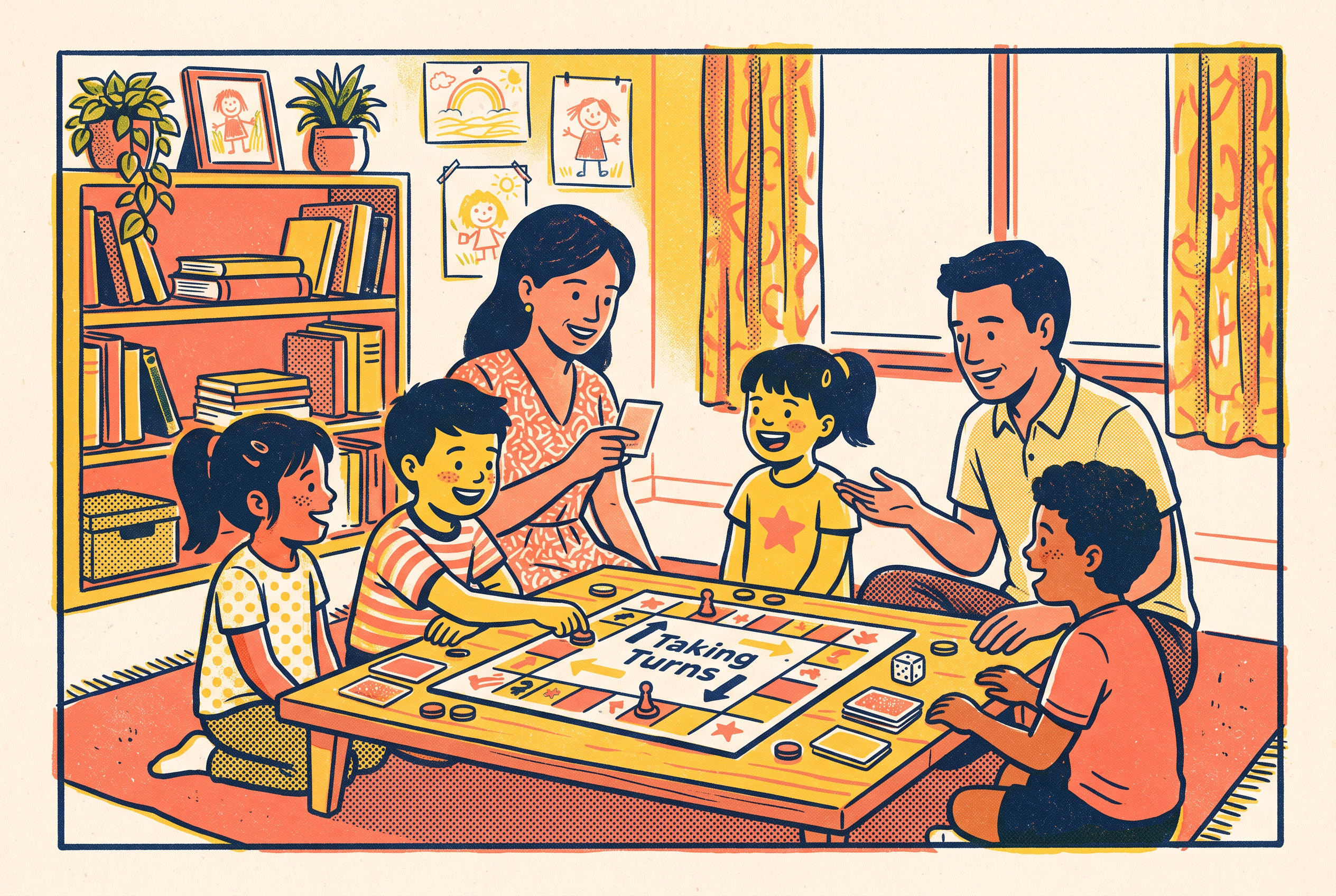
Classic board games: Games like Candyland, Sneaky Snacky Squirrel, or Uno require waiting through several players' moves. Save these for ages four and up, when working memory can hold the sequence across three or more people.
Step 5: Make waiting visible with timers and something else to do
Time is invisible to children under six. Saying "You can have it in five minutes" creates panic because a toddler has no idea what five minutes feels like. To a three-year-old, five minutes might mean thirty seconds, or it might mean tomorrow morning. Make it visible.
Use a sand timer with colored sand, or an analog countdown clock where a red disk shrinks as the seconds tick down. Set the sand timer on a shelf within eye line. Say: "When the blue sand drops to the bottom, the turn is finished." The child doesn't have to accept your authority or argue with your watch. The sand is objective.
Waiting can't mean staring empty-handed at the child holding the toy. Staring at the contested object guarantees a grab within sixty seconds. Build the habit of active waiting. Hand the waiting child an alternative: "The timer is running for the fire truck. While your body waits, you can build a road with these blocks, or you can stir the bowl." If your child struggles to stay regulated while waiting, review our steps on how to teach kids patience.
Step 6: Coach in the moment when a conflict starts
When a grab happens, don't treat it like a police emergency. Don't yell, don't rip the toy out of the grabber's hands, and don't force an immediate apology. Panic makes kids defensive.
Move in close, drop to eye level, and place a calm hand on the toy. State the physical facts without moral judgment: "Stop. Two hands are on one truck. Leo was driving it. That means it is Leo's turn." Guide the grabber's hand away gently. Keep your voice even and slow. Turn to the waiting child: "You want the truck right now. It is hard to wait. Tell Leo: My turn next." Prompt the words.
Next, turn to the child holding the toy. Give them a clear option instead of demanding they surrender it. Ask: "Leo, can Sam have a turn in one minute or two minutes?" Letting the child holding the toy choose the handoff time cuts defiance by half. The child feels protected in their play, which lets their nervous system relax enough to share. When the timer rings, step in to help with the handoff: "The sand is down. Time to pass the truck. You did it." If anger escalates before the handoff, use the calming strategies in how to help a child handle frustration.
Step 7: Practice through stories and pretend play, then praise the specific behavior
Children absorb social expectations through stories long before they can apply them under real social stress. Stuffed animals make the easiest rehearsal stage. Grab a toy bear and a plastic dinosaur. Have the dinosaur snatch the bear's tea cup. Ask your child: "Look at Bear's face. How does Bear feel? What should Dinosaur say?" Let your child direct the scene and supply the script.
Personalized media speeds up this practice. Pixley creates custom animated cartoons, bedtime storybooks, and learning games for ages 2 to 8, built around specific parent-guided lessons. Parents describe any lesson they want taught, like taking turns with a new sibling or waiting for a swing at school, and Pixley generates an animated episode around that exact situation. Watching an animated character work through passing a toy normalizes the behavior without parent-child friction.
Then drop the vague praise. "Good job sharing!" teaches nothing. Praise the exact action: "You put the marker on the table and let your brother take his turn without grabbing it back. That took real patience." Or: "I saw you check the visual timer and choose to build blocks while you waited." Specific feedback locks the behavior into their working memory.
Conclusion
Taking turns is a long-term motor and social skill, not an overnight character change. Children don't learn to wait from lectures delivered mid-tantrum. They learn from steady routines, predictable scripts, and low-pressure daily practice.
To reinforce these lessons outside of playtime conflicts, use stories where your child sees the idea in action. With Pixley, available on an iOS free trial, parents can describe a specific lesson, like taking turns on the playground or sharing art supplies, and turn it into a personalized, safe, ad-free cartoon episode. Start practicing the scripts during calm moments today, and your child will have the tools for their next playdate.
Frequently Asked Questions
At what age should a child understand taking turns?
Children begin understanding the basic rhythm of back-and-forth turns around 18 to 24 months through simple games like rolling a ball. True cooperative turn-taking with toys and peers typically develops between ages 3 and 4, as impulse control and working memory mature.
How do you teach a toddler to take turns without crying?
Keep wait times under ten seconds initially and use neutral objects rather than favorite toys. Pair physical visual cues, like sand timers, with active waiting activities so the child is not staring at the toy. Short, predictable handoffs build trust that the toy always returns.
What is the difference between sharing and taking turns?
Sharing often implies surrendering an object or splitting a resource simultaneously, which toddlers perceive as a loss. Taking turns preserves full ownership of the item during a defined window of time, teaching sequential use with a guaranteed return.
Can screen time help teach social skills like turn-taking?
Passive video watching rarely changes playground behavior, but targeted, parent-guided stories can. Pixley allows parents to turn specific lessons on turn-taking into personalized, ad-free animated cartoon episodes for ages 2 to 8, helping children visualize sharing strategies before applying them in real life.
Sources
- https://www.zerotothree.org/resource/tuning-in-supporting-sharing/
- https://www.zerotothree.org/resource/24-36-months-social-emotional-development/
- https://www.cdc.gov/act-early/milestones/4-years.html
- https://www.zerotothree.org/resource/helping-young-children-with-sharing/
- https://www.zerotothree.org/resource/promoting-cooperation-and-self-control-gather-round-activities/
- https://school-readiness.org/wp-content/uploads/pdf/English/My_Turn_Your_Turn_web.pdf
- https://pixleyai.com/
- https://www.zerotothree.org/resource/parenting-resource-developing-thinking-skills-from-24-36-months/