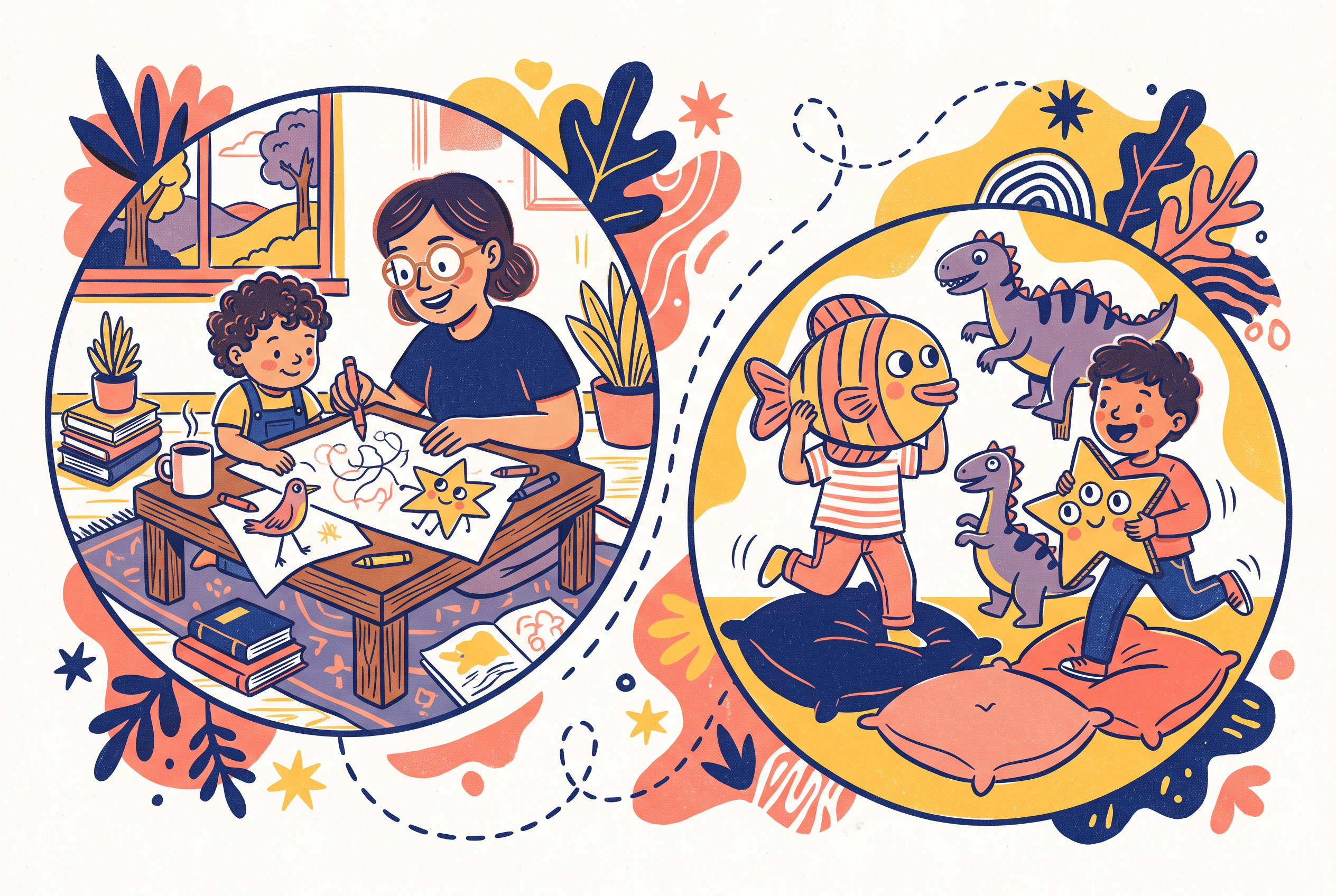
Drawing Games for Kids: Turn Doodles Into Real Characters
Play screen-free drawing games for kids ages 2-8, invent keeper characters with simple rules, and watch Pixley turn them into custom animated cartoon…
 Pixley Team
Most drawing sessions with young kids stall within two minutes because a blank white page feels like an exam. A toddler makes three wild slashes with a crayon and walks toward the pantry. A six-year-old attempts a cat, decides the whiskers look crooked, scrunches the paper into a ball, and refuses to try again.
Drawing games for kids fix this by replacing artistic performance with simple constraints. You don't need drawing talent, watercolor trays, or thirty minutes of prep. You need one piece of paper, two markers, and rules that make mistakes impossible. Twenty minutes in, you and your child will have an original character with a name, a quirk, and a story ready to tell.
Step 1: Set up a no-prep drawing game table (paper, one marker each, one rule: no fixing)
Art supplies overwhelm young children when you dump them out at once. A bucket of sixty markers leads to cap-swapping and color debates instead of drawing. Keep the tabletop sparse.
Lay down a single sheet of plain printer paper or tape down an 18-inch strip of butcher paper. Hand your child one marker. Take one for yourself in a contrasting color, such as dark blue for you and orange for your child. With different colors, both players can see their own moves across the page without arguing over whose line is whose.
Set the table rule before any caps come off: no fixing. Erasers don't exist at this table, and nobody scribbles out a stray mark. Psychoanalyst Donald Winnicott originally described the squiggle game as a way to make contact with a child during therapeutic consultations. The whole premise relies on accepting whatever stroke lands on the sheet. If a hand slips and makes an accidental loop, that loop isn't a mistake. It's an ear, an elbow, or a boulder. Take away the option to correct, and kids stop worrying about perfection.
Step 2: Play the games for ages 2-4 (Scribble Buddy, Take-Turns Line, Finish My Shape)
Toddlers and preschoolers lack fine motor precision, so games for this age group have to reward messy motion. Treat every erratic scribble as raw material.
Start with Scribble Buddy. Take your marker and scribble a wild, continuous tangle in the center of the paper for three seconds. Stop. Hand the paper to your child and ask: where should the eyes go? They mark two dots inside the tangle. You draw two shoes sticking out of the bottom. In thirty seconds, a chaotic bird nest becomes a creature. Swap roles right away so your child makes the wild loop while you find the face.
Move on to Take-Turns Line. Draw a single straight line across the page. Your child connects a curved line to your endpoint. You connect a zig-zag to theirs. This simple game is a practical way to practice how to teach kids to take turns because neither player owns the final outcome. The line meanders until someone notices it looks like a snake, an alligator, or a rollercoaster track.
Finish with Finish My Shape. Draw an incomplete outline: a circle missing its top, or an open teardrop. Ask: what kind of monster head has this shape? Let your child close the gap with their marker. Add teeth, three horns, or giant eyelashes together. Your child feels no pressure to sketch a whole figure from scratch because you supplied the skeleton.
Step 3: Play the games for ages 5-8 (Squiggle Game, Roll-a-Monster, Drawing Relay, Finish My Drawing)
Kids ages 5 to 8 have stronger fine motor control, but their internal critic is louder. They compare their work to book illustrations and give up when lines look uneven. Games for this age need structured mechanics that bypass self-judgment, rather than open-ended drawing prompts for kids.
Play the classic Squiggle Game first. Player A closes their eyes and drags their marker across the sheet for two seconds to make an abstract squiggle. Player B studies the line from every angle, turns the paper upside down, and draws extra details to turn that squiggle into an identifiable figure. A sudden sharp hook becomes an eagle beak. A lazy wave becomes a sleeping fox. Swap roles for the next round.
Next, run Roll-a-Monster with a standard six-sided die. Jot down a quick key in the corner of the page: 1 equals three cyclops eyes, 2 equals antennae, 3 equals insect legs, 4 equals bat wings, 5 equals polka-dot skin, and 6 equals an oversized mouth. Draw an oval torso together, then take turns rolling the die four times each to decide what features the creature gets. The dice pick the design, so your child doesn't have to worry about whether the monster looks right.
Try Drawing Relay with a sixty-second timer. Player A draws for one minute to start an imaginary beast. When the timer chimes, Player B grabs the paper and adds whatever they want for one minute. No verbal instructions or critiques are allowed during the switch.
End with Finish My Drawing, the parlor game also known as Exquisite Corpse. Fold a sheet of paper into three horizontal panels. Player A draws a head on the top panel, extending the neck lines a fraction of an inch past the fold. Player A folds the head out of sight and hands the sheet over. Player B draws the torso and arms, carrying the waistlines barely past the second fold. Player A draws the legs and feet blind. Unfold the paper together to reveal the mismatched character.
Step 4: Pick the keeper and give your character a name and one trait
After twenty minutes of drawing games for kids, your table will hold half a dozen bizarre sketches. Instead of tossing them into a pile or wondering what to do with your child's drawings, make a deliberate choice. Pick one keeper.
Spread the drawings across the table and ask your child: which of these creatures has the most personality? Select the single sketch you both like best. Push the other pages aside so the keeper takes center stage.
Now give the doodle an identity. Characters need two things to feel real: a name and a distinct behavioral trait. Skip generic names like Monster or Bunny. Help your child come up with a name that matches the drawing's physical quirks. A round, wobbly creature might be Gloop. A prickly one with five zig-zag ears might be Sprout.
Ask for one trait that isn't visual. What is this character terrible at, or what weird habit do they have? Gloop might be terrified of loud sneezes. Sprout might hoard shiny acorns under their bed. Flaws make characters relatable to young kids. A perfect superhero doodle rarely inspires play, but a lopsided dog who can't stop chasing butterfly shadows gives your child an immediate story hook.
Step 5: Turn the keeper into your child's own cartoon character in Pixley
Physical drawings usually end up stuck to a refrigerator door until the paper curls and gets swept into the recycling bin. You can take that doodle further by bringing it into your child's screen time.
Pixley turns kids' drawings and ideas into personalized animated cartoons, bedtime storybooks, and learning games. Built for ages 2-8, the platform is safe and ad-free, and it's available on an iOS free trial. Take a photo of your child's keeper drawing with your phone, and Pixley turns that marker sketch into a moving animated character.
Most children watch cartoons made by commercial studios with no connection to their own lives. Watching their own five-minute scribble walk across the screen flips the dynamic. The child stops being a passive viewer soaking up prepackaged content. They become the creator who decided on the creature's green horns, three legs, and clumsy posture. Every generation passes child-safety filtering before a kid sees it, so parents stay in control of what plays.
Step 6: Choose a story or lesson for the character to star in
Drawing games give you the visual character, but stories teach kids how the world works. Lectures rarely land when a child struggles with big feelings, sharing, or everyday transitions. Stories do better.
Describe any lesson you want taught and Pixley builds a cartoon episode around it, covering Social and Emotional Learning goals or educational topics. Instead of lecturing your four-year-old about taking turns on the playground swing, you put the keeper character right into that scenario.
If your child invented Gloop the blue blob, tell Pixley that Gloop doesn't want to share his toy tractor with his friends at preschool. The cartoon episode shows Gloop working through that exact social knot, feeling the frustration, and finding a peaceful way out. When a child watches a character they designed face a hard moment, the lesson lands without defensiveness. The child feels protective of their creation. They root for Gloop to share, and that empathy carries into their own behavior at preschool the next morning.
What to do next: build a weekly game-to-story routine
Don't treat drawing games as a one-off rainy day distraction. Make them a weekly ritual that connects hands-on creative play with screen time that means something.
Pick one set evening every week, such as Sunday before dinner. Spend fifteen minutes at the kitchen table playing Scribble Buddy or Roll-a-Monster. Pick your single keeper, give it a name and a flaw, and upload the photo to Pixley. Use the resulting cartoon episode or bedtime storybook as that evening's bedtime media.
Store the paper keepers in a physical binder on your child's bookshelf. Over three months, your child will build a personal cast of dozens of unique characters: creatures they drew with you, named alongside you, and watched star in custom animated episodes.
Conclusion
Blank-page anxiety disappears the moment you swap solo drawing for collaborative drawing games for kids. You don't need expensive art kits or hours of free time. Grab two markers, lay down one sheet of paper, and follow the no-fixing rule to invent a brand new creature together tonight.
Once your child picks a favorite keeper drawing, open Pixley on iOS with a free trial. Upload the sketch, pick a social lesson or bedtime adventure, and let your child watch their marker doodle become their own safe, ad-free cartoon show.
Frequently Asked Questions
What are the best drawing games for kids who say they cannot draw?
Scribble Buddy and the Squiggle Game work best because neither player starts with a planned picture. One person closes their eyes to make an accidental line, and the other person adds features. Because the game starts with an abstract mark rather than a realistic prompt, perfectionism disappears.
At what age can children start playing collaborative drawing games?
Children can start as early as age two. Toddlers at this age enjoy turn-taking scribbles where an adult adds googly eyes, smiles, or shoes to their crayon marks. By ages four and five, kids understand structured rules like Roll-a-Monster and folded-paper relay games.
How does Pixley turn my child's drawing into a cartoon?
Parents snap a photo of their child's paper drawing and upload it to Pixley on iOS. Pixley turns kids' drawings and ideas into personalized animated cartoons, bedtime storybooks, and learning games. Safeguards are designed to reduce exposure to sensitive content.
Can teachers use these drawing games in a preschool classroom?
Yes. Preschool and kindergarten teachers use games like Finish My Shape and Take-Turns Line during small-group table rotations. These games build early fine motor control, encourage visual problem solving, and teach turn-taking without requiring expensive classroom supplies.