Turn Your Child's Drawing Into a Story: Ages 2-8 Guide
Learn how to turn your child's drawing into a story using simple prompts, active dictation, and an optional safe animation step. Built for ages 2 to 8.
 Pixley Team
Every week, construction paper piles up on the kitchen counter. Most of those sheets end up buried in a recycling bin or clipped to a refrigerator door until they curl. A five-year-old doesn't see a piece of scrap paper. They see an entire scenario that lived in their head for ten minutes while they scribbled with a green marker.
You don't need a writing curriculum or special materials to get from that scribble to a story. You need the drawing, a pen, five minutes of listening, and a sense of how young children make meaning. Here is how to turn your child's drawing into a story in their own voice, from basic toddler labels to multi-scene adventures.
Step 1: Pick one drawing and set the scene (no cleanup, no correcting)
Don't pull out twenty drawings at once. A massive stack turns a creative exercise into an evaluation task. Pick a single picture made in the last twenty-four hours, while the details are still fresh in your child's memory.
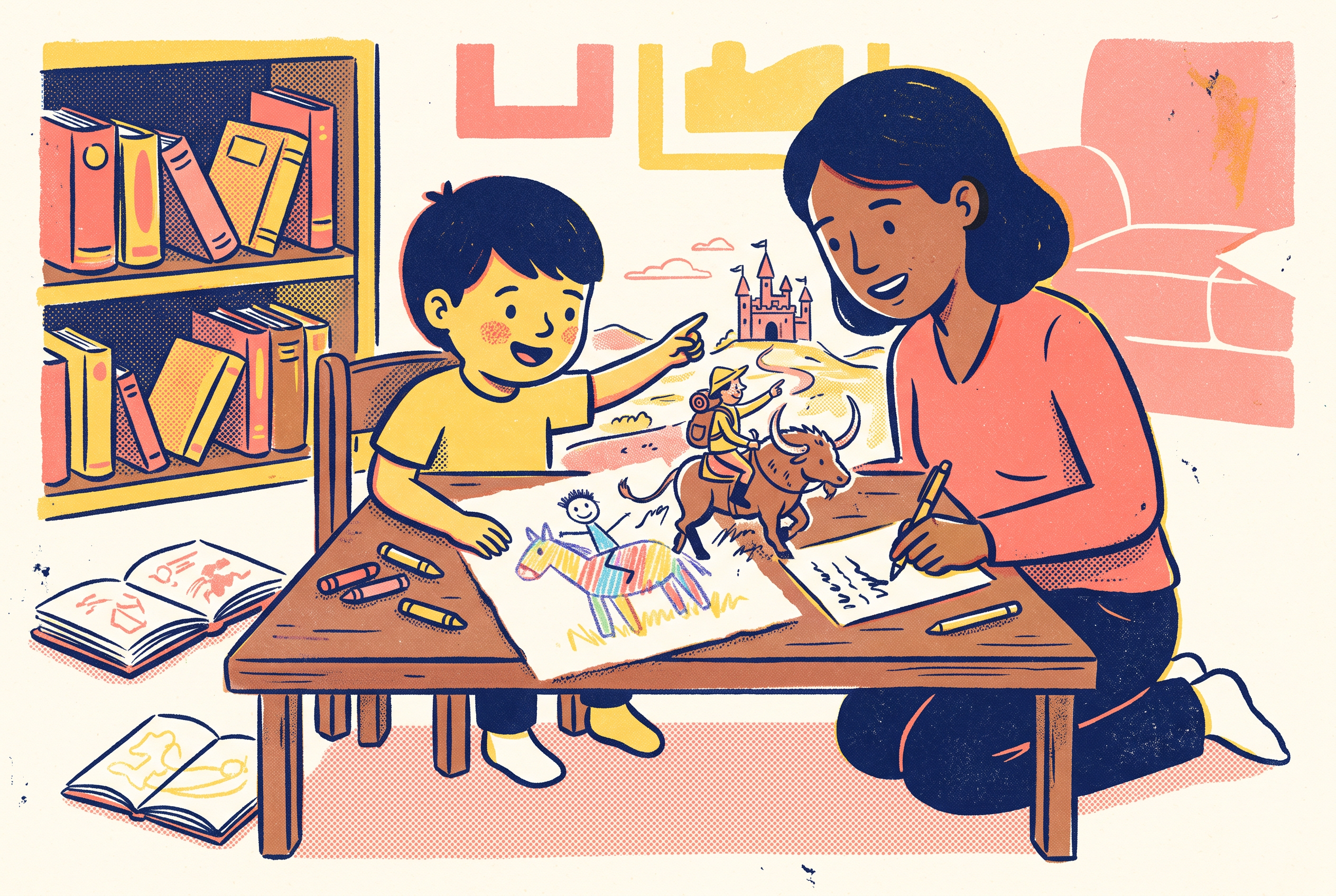
Sit down at the table or on the floor next to them, not across from them. Sitting side by side says "partner" instead of "test." Resist the urge to wipe stray crayon marks off the table or comment on proportions. If the horse has three legs and a purple tail, accept it as given. Correcting visual realism kills storytelling on the spot.
Place the drawing between both of you. Skip the red pen and the iPad. Bring a plain notebook, or write directly on the back of their drawing paper. Your posture should say: this image holds something I want to learn about.
Step 2: Start with an invitation, not a guess ("Tell me about your picture")
The fastest way to shut down a child's storytelling is to guess what they drew. A parent says, "Look at that cute dog!" and the child meant a dragon. Now the child feels misunderstood. They'll often agree just to please you, and the conversation ends.
Use an open invitation instead. Say: "Tell me about your picture." That phrase puts authorship where it belongs. The National Association for the Education of Young Children notes that open-ended dialogue around children's visual art invites them to build their own meaning rather than match adult expectations.
Wait five seconds after speaking. Young children process thoughts at a slower pace. If they point to a blue blob and stay silent, point to that shape and say, "I notice this blue part here. What is happening in this spot?" Specific observations validate their choices without dictating the plot.
Step 3: Ask story questions: who, where, what are they trying to do (age-adjusted prompts for 2-3, 4-5, 6-8)
Children build narrative ability in clear stages. The questions you ask have to match their stage of language.
For toddlers aged 2-3, focus on naming and physical action. Children at this stage practice labeling what they see. The Victoria Department of Education notes that early drawing is the first form of written expression for toddlers. Ask: "Who is this?" and "What sounds do they make?" If they say "Bear. Roar!", that is their complete story. Write it down.
For preschoolers aged 4-5, connect characters to simple settings and goals. Early childhood development specialists at Michigan State University Extension point out that art gives young children a structured way to practice communication and problem-solving. Ask: "Where is this character going?" and "What are they trying to find?" A four-year-old will usually name a destination, like a playground or a castle, and give the character a direct task.
For early elementary children aged 6-8, dig into motives and obstacles. Ask: "Why did they leave home today?" and "How do they feel about what is happening?" Kids this age can juggle multiple ideas, so prompt them to name secondary characters or background objects.
Step 4: Add a problem and an ending with 'And then what?'
A list of characters is not a story. A story needs an obstacle, a reaction, and a resolution. You don't have to explain dramatic structure to a six-year-old. You only need three words: "And then what?"
Introduce tension by asking about difficulty. If your child draws an astronaut, ask: "What unexpected thing happened on the moon?" When they answer that a space dog took the astronaut's wrench, ask: "And then what did the astronaut do?" That simple nudge pushes the child from static description into step-by-step problem-solving.
Research published in Frontiers in Education, 2025 discusses how children narrating stories through their drawings supports oral expression and emergent literacy. Let the child resolve the conflict on their own terms. If the solution sounds absurd, like eating a giant marshmallow to escape a pit, accept it. Children build logical agency by deciding how their characters survive.
Step 5: Write down their exact words and read the story back
Transcribe their story word for word. Don't fix grammar, clean up slang, or add adjectives they didn't say. If a four-year-old says, "He runned super fast because the mud was sticky," write down "He runned super fast because the mud was sticky."
Writing down a child's spoken story creates a direct link between spoken words and written print. It shows the child that their oral ideas have lasting value as text.
Once the story reaches an ending, read the whole thing back to them aloud. Point your finger under each word as you go. Watch their face. Hearing their exact thoughts read out as a real story makes kids proud, and regular drawing time becomes an authoring session. If you have stacks of artwork, check out our guide on what to do with your child's drawings for more ideas.
Step 6: Make it last: a title, a mini-book, or a series with the same character
Once the dictation is done, save the work before it gets lost under grocery lists. Ask your child to name the story: "Every book needs a title. What should we call this?" Write their chosen title at the top of the page in capital letters.
Turn single sheets into mini-books. Fold a piece of printer paper in half, staple the spine, glue the drawing to the front cover, and copy the text inside. If your child made several drawings around the same event, bind them in order.
Encourage recurring characters. If your child loves drawing a specific cat or alien, suggest bringing that character into the next session. Following one character across several drawings teaches continuity. Your child starts thinking like a serial storyteller, plotting the next adventure before they pick up their markers.
Step 7 (optional): Bring the story to life with an cartoon maker for kids and animate the drawing
Paper dictation works well, but digital tools can take the child's story one step further. If you want to reward their creative work without handing them a passive video feed, you can animate their original character.
Pixley turns kids' drawings and ideas into personalized animated cartoons, bedtime storybooks, and learning games. It's built for ages 2-8, safe and ad-free. Every generation passes child-safety filtering before a kid sees it, so the experience stays appropriate for young eyes.
It also supports parent-guided learning. Parents describe any lesson they want taught, and Pixley creates a cartoon episode around it, covering Social and Emotional Learning goals or educational topics. If your child's story involved sharing a toy or feeling nervous about school, you can build that exact challenge into the animated episode. Pixley is available on iOS with a free trial, and it turns a twenty-minute kitchen-table drawing into an educational cartoon your child created.
What to do next: Build a weekly drawing-story habit and fix common stumbling blocks (a child who says 'I don't know')
Set aside fifteen minutes once a week for drawing stories. Saturday mornings or the quiet time after dinner work well. Consistency matters far more than session length.
When a child says "I don't know" to your prompts, don't push harder. That answer usually means overload. Offer two distinct choices grounded in their drawing: "Is this monster running away from something, or is he looking for his lunch?" Two concrete options lower the barrier while keeping the final decision in their hands.
If they still shrug, describe what you see without asking for plot: "I see three green dots and a big purple line." Often, just hearing their drawing described out loud sparks an explanation. Keep the session pressure-free. The goal is confidence in creative expression, not a publishable manuscript.
Conclusion
Listening to your child's drawings changes how you see their messy scribbles. A single sheet of paper becomes a small world where characters face problems, make choices, and find solutions.
If your child loves seeing their imagination come to life, take the next step. Pixley turns kids' drawings and ideas into personalized animated cartoons, bedtime storybooks, and learning games. Built for ages 2 to 8, safe, ad-free, and available on an iOS free trial, Pixley lets your child watch their own hand-drawn characters take center stage.
Frequently Asked Questions
How do you turn a child's drawing into a story if they cannot write yet?
You act as their scribe. Ask open-ended questions about their drawing, listen carefully, and write down their exact spoken words below the artwork. Reading their narrative back to them connects spoken language to written text without requiring them to hold a pencil or spell words.
What questions should I ask to turn my child's drawing into a story?
Start with "Tell me about your picture" to let them lead. Then ask three core structural questions: "Who is this?", "Where are they going?", and "What unexpected problem happens next?" Finish with "And then what did they do?" to prompt an ending.
Can you turn a child's drawing into an animated cartoon?
Yes. Platforms like Pixley allow parents to turn kids' drawings and ideas into personalized animated cartoons, bedtime storybooks, and learning games. Designed for ages 2-8, Pixley includes child-safety filtering on every generation, runs ad-free, and is available on an iOS free trial.
What do I do if my child will not explain their drawing?
Avoid quizzing them. Instead of asking rapid questions, point out specific colors or marks you observe: "I see a huge red circle in this corner." If they stay quiet, offer two simple options: "Is that a planet or a bouncy ball?" Let them pass if they prefer silence.
Sources
- https://www.naeyc.org/resources/pubs/tyc/winter2023/art-story-and-process
- https://www.vic.gov.au/literacy-teaching-toolkit-early-childhood/experience-plans/drawing-as-writing
- https://www.canr.msu.edu/news/the_art_of_creating_why_art_is_important_for_early_childhood_development
- https://www.frontiersin.org/journals/education/articles/10.3389/feduc.2025.1465714/full
- https://www.tandfonline.com/doi/full/10.1080/10573569.2021.1879696
- https://pixleyai.com/