Drawing Prompts for Kids: 40 Ideas That Turn Into Characters
Explore 40 character-focused drawing prompts for kids ages 2-8. Turn simple doodles into storybook heroes, animated adventures, and bedtime tales.
 Pixley Team
A child finishes a picture of a blue circle with three eyes, holds it up for five seconds, and drops it onto the floor. Ten minutes later, another drawing lands on top of it. Most drawing prompts for kids encourage single-use art. They tell a child to draw an apple, a house, or a tree. The child draws it once, covers the refrigerator for two days, and never looks at it again.
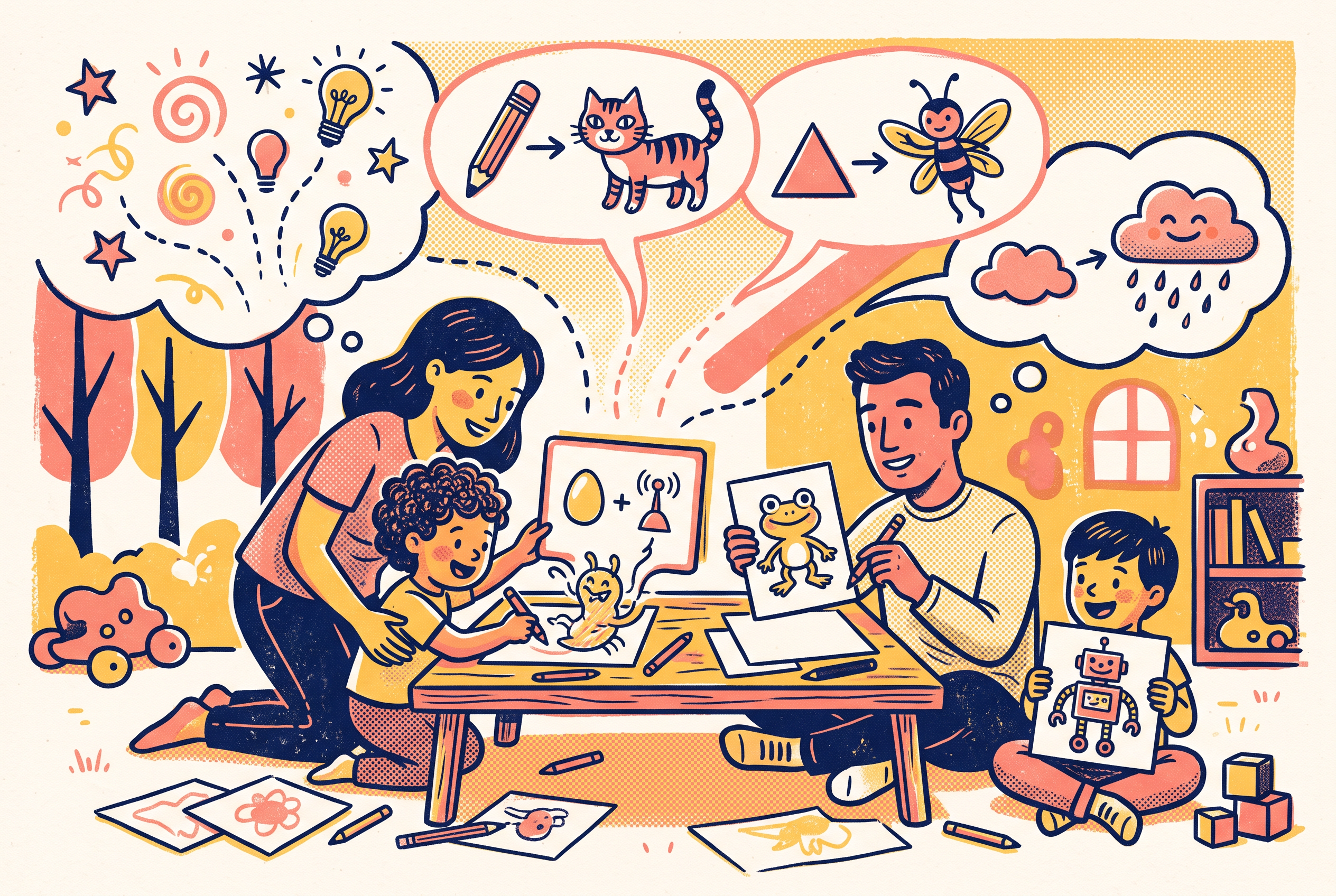
Drawing gets far more engaging when the picture is a character instead of an object. A character has an identity, a peculiar habit, and a job to do. When your child sketches an animal with boots or a robot made of cardboard, they aren't filling paper. They're creating the lead figure in a story.
This guide has 40 drawing prompts for kids ages 2 to 8. Each prompt builds an original personality. With a few targeted follow-up questions, you can help your child take that simple sketch off the paper and into a personalized story, comic strip, or custom animation.
Step 1: Set up a character-drawing spot and keep the rules light
Young children don't need specialty markers or expensive drawing pads to invent good characters. A four-year-old handed an archival sketch pad often feels pressure to make something tidy. Buy thick, inexpensive paper that can absorb heavy ink without curling. Get triangular beeswax crayons or broad-tip washable markers that take minimal grip strength.
Keep the space ready before the idea arrives. A low table stocked with blank sheets, a cup of markers, and a roll of paper tape lets a child start the moment inspiration strikes. Don't sit down to teach anatomy or horizon lines. Realistic proportions don't make an interesting protagonist. SpongeBob is a kitchen sponge with square pants, and Peppa Pig looks like a hair dryer. Distinct personality is what matters.
Ban the word wrong from the workspace. If a dog has seven legs and feathers on its snout, treat that as a character feature, not a mistake. When parents correct lines, children stop exploring. Ask what those extra parts do instead. You'll find out the seven legs are for running on slippery ice, and the feathers keep the animal warm in outer space. Once you treat unusual marks as deliberate design choices, the character starts to take shape.
Step 2: Ages 2-3: 10 simple prompts for first characters (shapes, sounds, and silly creatures)
Toddlers learn through sensory play, gestures, and vocal sound effects. They aren't trying to capture photographic reality. These ten prompts use basic geometric shapes, physical sounds, and bright colors to help very young children see their scribbles as living creatures.
The Bouncy Dot: Draw a fat circle, give it two long ears, and make a boing sound every time the marker hits the paper.
The Whispering Cloud: Scribble a fluffy gray cloud with big open eyes that only whispers secret words.
The Tickle Monster: Make a purple blob with eight wiggly noodle arms designed specifically for tickling toes.
The Hungry Triangle: Draw a sharp triangle with a giant open mouth waiting for a giant bowl of spaghetti.
The Beeping Square: Outline a green box with two button eyes and an antenna that beeps when you poke it.
The Silliest Worm: Drag a wavy line from one corner of the page to the other, then add tiny rainboots on the bottom.
The Sleepy Sun: Draw a round yellow face wearing a nightcap, snoring softly with closed eyes.
The Giggle Ball: Make an orange circle covered in rainbow polka dots that rolls down hills backwards.
The Loudest Foot: Draw one giant foot with fuzzy toes that stomps around looking for a lost shoe.
The Splash Creature: Splash blue marker strokes across the paper to make a water monster that only drinks bathtubs.
At this age, narrate what you see. Say, "I see two giant yellow dots. Is this monster awake or asleep?" Your toddler will supply the personality with a squeal, a point, or a single word.
Step 3: Ages 4-5: 10 prompts that give characters a pet, a job, or a feeling
Preschoolers and kindergarteners understand roles, jobs, and social dynamics. They know what firefighters do, they know what a pet needs, and they feel big emotions like jealousy, surprise, and pride. Use these ten prompts to anchor drawings to roles, companions, and moods.
The Baker Bear: A round bear wearing an apron who bakes pies filled with blueberries and rocks.
The Scaredy-Dragon: A green reptile with tiny wings who hides behind a rock because it is terrified of butterflies.
The Mail-Delivering Turtle: A turtle with a leather satchel full of letters, wearing running sneakers to go faster.
The Grumpy Cloud: A rain cloud with folded arms that refuses to rain anything except chocolate pudding.
The Dinosaur Doctor: A tall T-Rex wearing round eyeglasses, trying to put a band-aid on a tiny bee.
The Astronaut Cat: A fluffy tabby inside a round glass helmet, floating alongside a pet robotic mouse.
The Jealous Owl: A wide-eyed owl perched on a branch, glaring at a squirrel who has a bigger acorn.
The Gardening Alligator: A swamp gator with garden gloves holding a watering can over a patch of daisies.
The Detective Dog: A hound wearing an oversized trench coat, following magnifying-glass tracks across the rug.
The Excitable Teacup: A porcelain mug with stick legs that is hopping up and down because party music started playing.
A specific mood or job gives the child a natural story springboard. When children draw an animal with a job, they start imagining the work day and the trouble that might pop up along the way.
Step 4: Ages 6-8: 20 prompts for heroes, sidekicks, and creatures with a problem to solve
Children in early elementary school understand conflict in a story. They like rivals, high stakes, mechanical gadgets, and funny weaknesses. These 20 prompts create figures with clear missions, distinct flaws, and unusual sidekicks.
The Clockwork Knight: A knight built entirely out of gears and springs whose winding key is slowly running down.
The Submarine Squirrel: An inventor rodent driving an acorn-shaped submarine searching for sunken treasure in a garden pond.
The Firefighting Fish: A goldfish in a walking water-suit who puts out kitchen fires using a bubble cannon.
The Giant with Tiny Glasses: A gentle giant who lost his reading glasses in a forest and keeps stepping on pine trees by accident.
The Pajama Superhero: A kid in flannel pajamas with a bedsheet cape whose superpower is making villains yawn until they fall asleep.
The Treehouse Pilot: An owl engineer who strapped wings to an oak tree to take the entire forest on vacation.
The Shadow That Left: A silhouette character that snuck away from its human owner to start its own ice cream parlor.
The Magnetic Hedgehog: A woodland critter that accidentally attracts spoons, paperclips, and keys wherever it walks.
The Librarian Lizard: A chameleon who must guard the secret spellbooks from a book-eating bookworm.
The Robot with a Plant Heart: A steel android that must protect a fragile flower growing in its chest compartment.
The Balloon Bandit: A raccoon floating on three red balloons trying to steal fruit from an upper-floor balcony.
The Wizard Who Sneeze-Casts: An old sorcerer whose magic spells only fire when he catches a cold.
The Skater Slug: A garden slug wearing a helmet who uses a roller skate to outrun garden birds.
The Ghost with Stage Fright: A translucent spirit who wants to perform stand-up comedy but feels too shy to speak.
The Bakery Spy: A ninja disguised as a strawberry cupcake trying to steal a secret frosting recipe.
The Lightning-Bug Mechanic: A tiny firefly holding a wrench, repairing broken car headlights from the inside.
The Snowman Who Loves Soup: A freezing creature carrying a bowl of hot soup that threatens to melt its hands.
The Pocket-Sized Dragon: A reptile small enough to live in a coat pocket, acting as a portable hand warmer.
The Alien Cartographer: A three-legged Martian mapping a backyard while confusing garden gnomes for planetary leaders.
The Cactus Who Hugs: A prickly desert plant wearing pillows on its arms so it can hug woodland animals without poking them.
Step 5: Ask 3 follow-up questions to turn the drawing into a character (name, quirk, problem)
Once your child finishes sketching, resist the urge to say "That is so pretty." Generic praise tells a child the activity is over. If you want to grow the drawing into a story, treat the paper like an interview.
Ask three simple questions in order.
First, ask for a name. What do people call this creature? If the child names it Doggy or Bob, accept it. If they invent a nonsense sound like Zorp or Barnaby Fizz, write it in the margin of the sheet. A name is what turns a shape into an identity.
Second, find the quirk. What is one weird thing this character loves, fears, or carries everywhere? A quirk gives a character recognizable behavior. If your child drew a bear, the quirk might be that he refuses to walk on green grass, or that he carries a wooden spoon in his sock. Quirks are where the comedy and personality come from.
Third, find the immediate problem. What is this character trying to do right now that is hard? A story can't start until someone wants something they can't easily get. Maybe the knight lost his helmet, the dragon has an itchy back he can't scratch, or the cat needs to reach a shelf across a floor made of lava. Once you have the name, quirk, and problem, you have the whole spine of a story. If you want to take this conversational approach further, our guide on how to turn child drawing into a story breaks down practical dialogue strategies by developmental stage.
Step 6: Turn the character into a story or cartoon (link to animating, story, and book guides)
Don't let your child's character vanish into the recycling bin. Once the sketch has an identity and a conflict, bring it into a format your family can revisit.
One path is paper publishing. Staple several pages together, write your child's dictated sentences under their drawings, and put the finished piece on the bedroom bookshelf for evening reading. If you want a more durable keepsake, learn how to make a book from kids drawings using simple at-home binding or digital photo printing.
Another path is animation. Watching a static crayon monster blink, run, and talk gives a young creator an unforgettable spark. You can explore how to how to animate your child's drawing using frame-by-frame apps, cutouts, or modern generative tools.
For a direct pipeline from paper to screen, Pixley offers a platform built for ages 2 to 8. You take a photo of your child's drawing, enter their character ideas, and Pixley turns the artwork into personalized animated cartoons, bedtime storybooks, and learning games. It runs on iOS with a free trial, has no ads, and runs every generation through child-safety filtering before your child sees the finished episode. You can even steer the story toward real-world lessons like sharing, bedtime resistance, or managing big feelings, which makes screen time active and creative.
Conclusion
Drawing doesn't need to end when the marker cap clicks shut. Treat your child's art as character design and every sketch becomes the start of an original adventure. Instead of clutter on the kitchen table, you get lasting memories. Photograph your child's favorite character drawing, download Pixley on iOS to start your free trial, and watch their hand-drawn creation come to life tonight in an ad-free, parent-guided animated cartoon.
Frequently Asked Questions
How do drawing prompts help with early childhood literacy?
Drawing characters bridges visual play and narrative structure. When children assign a name, feeling, or problem to a drawing, they practice character development, conflict resolution, and sequential thinking before they learn to write sentences.
What should I do if my child gets frustrated when their drawing looks messy?
Shift attention away from photographic accuracy and focus on personality. Tell your child that storybook characters look funny on purpose. Emphasize that unusual lines, mismatched eyes, and exaggerated shapes make a character stand out on the page.
How does Pixley turn my child's drawing into an animated cartoon?
Pixley turns kids' drawings and ideas into personalized animated cartoons, bedtime storybooks, and learning games for ages 2-8. Parents photograph the drawing, add story details or parent-guided learning lessons, and Pixley generates an ad-free, safety-filtered episode on iOS.
What drawing supplies work best for toddlers and preschoolers?
Thick mixed-media paper prevents bleed-through and tearing. Pair it with triangular beeswax crayons or broad-tip washable markers. Triangular grips encourage natural finger placement without causing muscle fatigue during long drawing sessions.