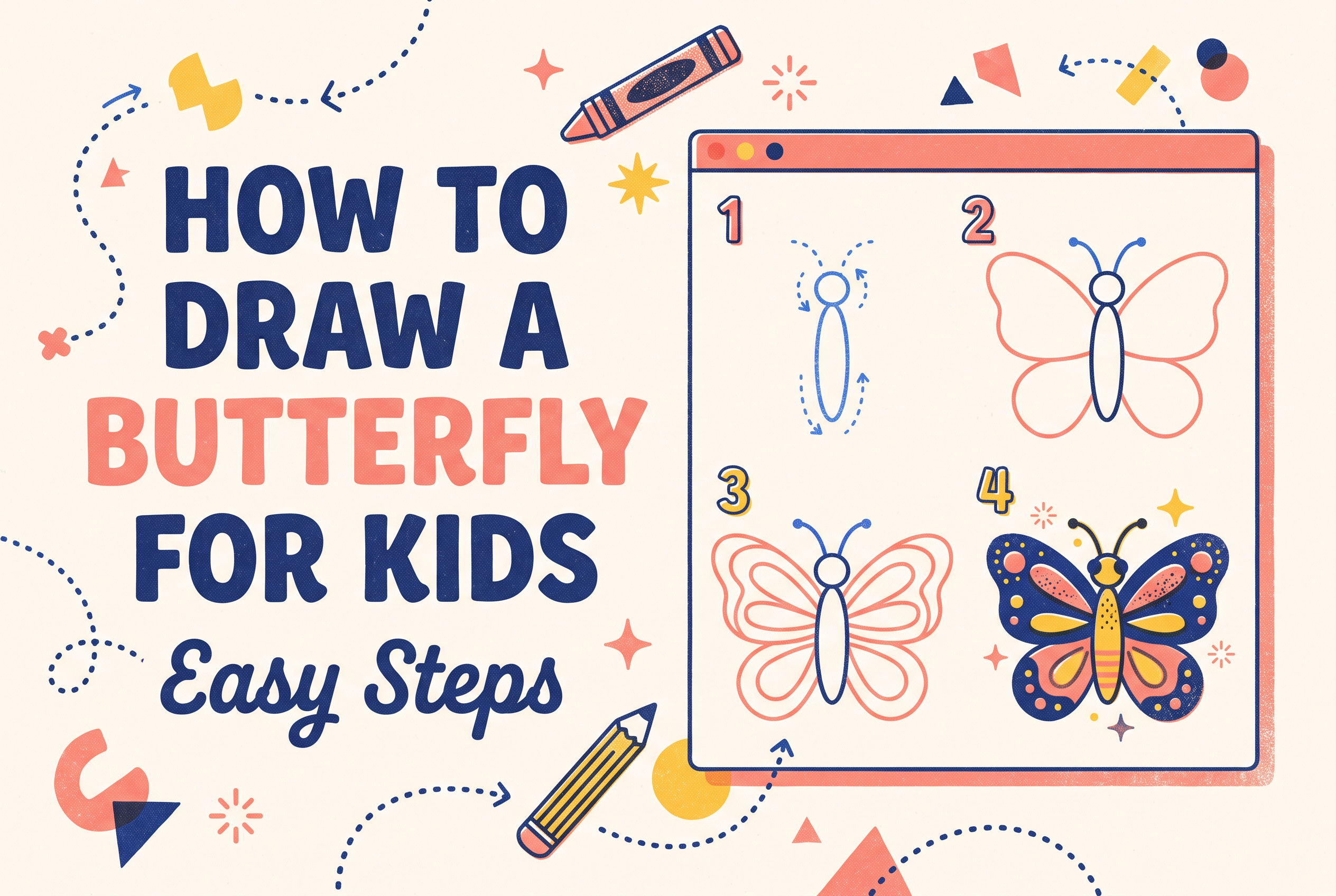
How to Draw a Butterfly for Kids: Easy Steps
Learn how to draw a butterfly for kids in 6 easy steps. A calm, parent-guided activity for ages 2-8 where wobbly wings are welcome, plus story ideas to try…
 Pixley Team
The easiest way to draw a butterfly for kids is to start with a small oval body, add two big rounded shapes on each side for wings, then finish with antennae, patterns and colors. Six simple steps, no ruler, no skill needed. Uneven wings are not a mistake here. They are the point.
This guide is written for parents and teachers of kids ages 2-8 who want a quiet, low-pressure drawing activity. You will get the step-by-step sequence, ways to adjust it by age, a quick butterfly life cycle for story time, and an idea for what to do with the finished drawing once your child has named it.
The Easiest Way to Draw a Butterfly (Short Answer)
Draw one long oval for the body, two big loops on each side for wings, two curly lines on top for antennae, then fill the wings with dots, stripes or swirls. That is the whole recipe, and it works at any skill level.
If you are searching for a simple butterfly drawing for beginners, this is it. It works because wings are just rounded blobs. A circle, a heart shape, a teardrop or a wobbly cloud all read as a wing the moment they sit next to a body. Kids do not need to learn a technique. They need permission to make blobs on both sides of a line.
What You Need Before You Start
You need paper, something to draw with, and about ten unhurried minutes. Nothing else is required.
Paper: Any plain sheet. Turn it sideways if your child likes big wings.
Marker or crayon for outlines: Thick tools are easier for small hands, and ages 2-4 often do best with chunky crayons.
Colors: Whatever is in the box. Skip the idea of a matching set.
Optional: A pencil for you, so you can sketch the body lightly if your child wants a guide.
Sit beside your child, not across from them. Draw your own butterfly on a separate scrap while they draw theirs, and keep your hands off their page. Two butterflies side by side, both a little different, set the right tone from the start.
Draw a Butterfly in 6 Easy Steps
Here is the easy butterfly drawing tutorial, step by step. Say each step out loud in plain words and let your child lead.
Draw the body. Make a long, skinny oval standing up in the middle of the page. This is the butterfly's tummy and chest.
Add the head. Put a small circle on top of the body. Some kids like to make it big, and that is fine.
Draw the top wings. From the middle of the body, draw one big rounded shape out to the left and one out to the right. Think of two big ears or two bumpy hearts.
Draw the bottom wings. Add two smaller rounded shapes below the first pair. They can be tiny, huge, or tucked behind. Anything goes.
Add antennae. Two curvy lines from the top of the head, each ending in a dot or a little curl.
Decorate the wings. Fill them with dots, zigzags, stripes, hearts or spirals. Ask, "What pattern does your butterfly want?"
That is how to draw a butterfly the easy, calm way: one shape at a time, and no step has to be exact.
Let the Wings Be Uneven: Why Wobbly Butterflies Are Great
Lopsided wings are a feature, not a flaw. A butterfly with one big wing and one small wing has more personality than a perfect one. Praise the wobble out loud: "Oh, this wing is enormous. Is she a speedy flyer?"
Correcting a child's drawing, even gently, teaches them the drawing has a right answer. Welcoming the uneven version teaches them the drawing is theirs. Resist the urge to say "try to make them match." If your child asks for help making both sides the same, you can offer one trick: fold the paper in half after drawing one wing and press, but only if they ask.
You can also lean into it with a game. Ask, "Why is this wing bigger? Did it eat too many flower snacks?" The unevenness becomes the first line of the butterfly's story. For more on what to expect from small hands at each stage, see stages of scribbling and 4 year old drawing milestones.
Pick Colors and Faces: Make Your Butterfly Feel Something
A butterfly becomes a character the moment it gets a face and a feeling. Ask your child to pick colors first, then add two eyes and a mouth to the little round head.
Don't steer the palette. A purple-and-orange butterfly with green dots is a good butterfly. If you are curious why your child keeps reaching for one color, what colors in kids' drawings mean is a gentle read, though a favorite color is often just a favorite color.
Then give the butterfly a feeling. Ask: "Is she happy, shy, sleepy or silly?" Let your child draw that expression on the face. A big smile, a wavy worried mouth, closed sleepy eyes. If your child enjoys this, the feelings drawing activity for kids builds on the same idea with a whole page of emotions.
Finish with a name. "Captain Sprinkles" and "Mrs. Wiggle" are both excellent names.
Adjust the Steps by Age: Toddlers to 8-Year-Olds
Match the steps to what your child can do today, and drop any step that feels like work.
Ages 2-3: Skip the sequence. Draw the body yourself or let them scribble one, then ask them to make "wing scribbles" on both sides. Dots with a chunky crayon count as decoration. Narrate: "Whoosh, the wings are moving!"
Ages 4-5: Use all six steps. They will likely draw wings as circles or ovals, and that is right on target. Encourage patterns and a face. This is also a good age for naming and a one-sentence story.
Ages 6-8: Add details: a second set of patterns, a flower for the butterfly to land on, a sky background, or a trail showing where she flew. Older kids often like symmetry experiments, such as trying to mirror one wing, but keep it optional.
What should a 9 year old draw? If an older sibling joins in, challenge them with a butterfly in a scene, a butterfly with an invented species name, or a comic panel where the butterfly is the hero. For more ideas by age, try drawing prompts for elementary students.
From Life Cycle to Story: Ideas to Try After You Draw
A butterfly goes through four life stages, called metamorphosis: egg, larva (caterpillar), pupa (chrysalis) and adult butterfly. A butterfly lays tiny eggs on a plant, the egg hatches into a caterpillar that eats and grows, the caterpillar changes inside a protective covering, and the adult emerges, dries its wings and flies off. It can then lay eggs, and the cycle starts again.
That is a ready-made story with a beginning, a middle and a happy ending. Try these:
Draw all four stages on one page in a row, like a comic strip. Even a dot, a squiggle, a lumpy oval and a winged shape will do.
Ask story questions: "What did the caterpillar dream about inside the chrysalis?" "What was the first thing she did with her new wings?"
Give her a problem: She got lost. She is afraid of flying. She wants to make a friend.
Act it out: Curl up like an egg, wiggle like a caterpillar, hold still like a chrysalis, then spread your arms and fly.
If your child likes drawing in panels, how to make a comic book with kids is a natural next step.
Turn Your Child's Butterfly Into a Cartoon With Pixley
Pixley turns kids' drawings and ideas into personalized animated cartoons, bedtime storybooks and learning games for ages 2-8, so the butterfly your child just named can star in her own episode.
Here is how it fits. Your child has already done the creative work: a drawn character, a name, a feeling and the start of a story. With Pixley, you describe a lesson you want the story to carry, such as being brave about trying something new or sharing with a friend, and Pixley creates a cartoon episode around it starring your child's own drawn character. Every generation passes child-safety filtering before a kid sees it, and it is ad-free.
That is the difference from passive scrolling. Your child is not picking from an endless feed. They are watching a show that started as their own wobbly-winged drawing. It is available on iOS with a free trial. If you want to see what else is out there first, apps to animate kids' drawings compares options for ages 2-8.
Draw one butterfly tonight, then give it a story
A butterfly drawing does not need matching wings or a steady hand. It needs a parent sitting nearby, a few blobs on each side of an oval, and a name. Draw one tonight, let the wings come out uneven, and ask what your butterfly is feeling. Then take the finished page, open Pixley on iOS with the free trial, and let your child watch their own drawing become the star of a cartoon.
Frequently Asked Questions
What's the easiest way to draw a butterfly for kids?
Draw a long oval body, a small circle head, two rounded wings on each side, and two curly antennae. Then decorate the wings with dots or stripes. Each wing can be any rounded shape, and uneven wings are welcome. Once the drawing has a name and a feeling, Pixley can help turn it into a cartoon character.
What is the life cycle of a butterfly?
A butterfly has four stages: egg, larva (caterpillar), pupa (chrysalis) and adult butterfly. The caterpillar eats and grows, changes inside a protective covering, then emerges, dries its wings and flies off. Kids can draw each stage in a row and use it as a story outline, which Pixley can also build into an episode.
What should a 9 year old draw?
Nine-year-olds enjoy drawings with a scene or a story: a butterfly landing on a detailed flower, a made-up species with a name, a life cycle comic strip, or a butterfly hero in a short adventure. Let them choose the idea, and keep symmetry practice optional rather than required.
How do I make a beautiful drawing of a butterfly with my child?
Focus on color, pattern and personality instead of precision. Let your child choose bold colors, fill the wings with dots, swirls and stripes, and add a face with a feeling. A named, expressive butterfly feels more beautiful than a perfect one, and Pixley can animate it in a cartoon.
How can I adapt butterfly drawing for toddlers?
For ages 2-3, skip the step sequence. Draw a simple body yourself or let them scribble one, then invite chunky-crayon dots and wing scribbles on both sides. Narrate the fluttering and praise any marks. The goal is enjoyment and shared attention, not a recognizable butterfly.