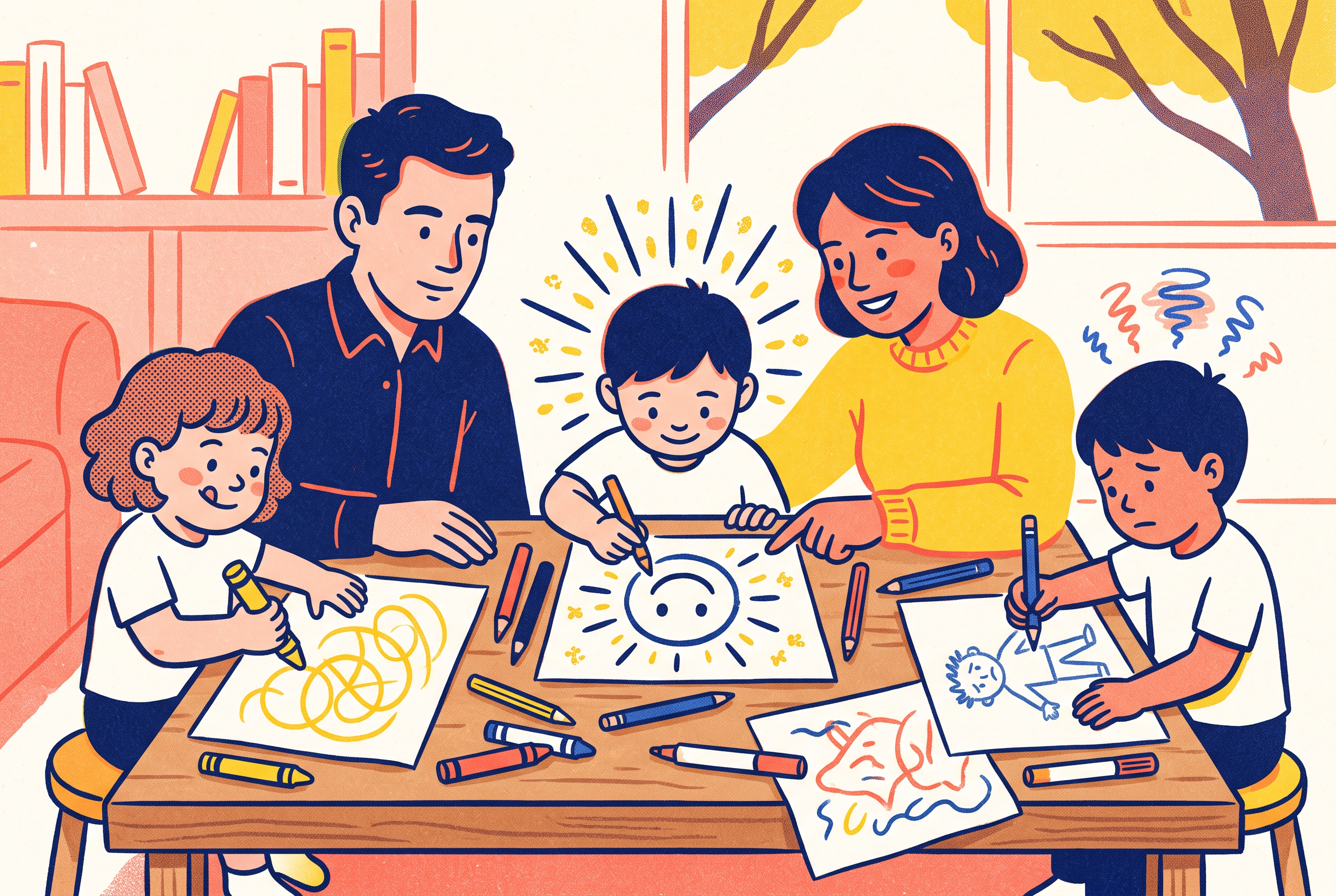
Feelings Drawing Activity for Kids: Draw Your Emotions
Five parent-guided feelings drawing activities for ages 2-8, plus questions to ask and how to turn a drawn feeling into a character with its own story.
 Pixley Team
A four-year-old slams a crayon down, announces that she is "not mad," and then draws a furious red scribble that takes up the whole page. Anyone who has watched that happen knows the gap: the feeling is real, the words aren't there yet.
A feelings drawing activity for kids closes that gap without asking a small child to explain themselves. The page does the talking first. You do the listening second.
This guide gives you five activities sorted by age (2-3, 4-5, and 6-8), a short list of questions that open a conversation, and a list of phrases that shut it down. It also ends somewhere most feelings guides don't: the drawn feeling becomes a character with its own story. That last step turns a one-time worksheet into something your child wants to come back to.
Nothing here needs special supplies or an art background. You need paper, a few crayons, and about five minutes when nobody is rushing.
Why drawing helps kids express feelings they can't say yet
Feelings arrive before vocabulary does. A toddler can be overwhelmed by frustration long before she can say the word "frustrated," and even a six-year-old often answers "how do you feel?" with a shrug and "fine." The question is too abstract. Drawing isn't.
A crayon gives a child something to do with their hands and eyes while the harder work happens quietly in the background. There's no eye contact pressure and no right answer. A big dark scribble can say "I felt squished at school today" without a single word. If you want to see how this ability grows, the stages of drawing development in children show why a two-year-old's scribble and a seven-year-old's detailed scene are both legitimate emotional expression.
The stance this whole article takes: the drawing is a conversation starter, not a diagnosis. You are not decoding hidden meaning from the color black or the size of a figure. Color guides online make big promises, and our own post on what colors in kids' drawings mean is careful about this. A child picks purple because it was the crayon on top as often as because of how they feel.
So skip the interpreting. Treat the page as a shared object that you and your child can both look at, which is easier than looking at each other. Children who see feelings given names and shapes, in drawings or in stories, build the vocabulary they'll later use out loud (see how stories build emotional intelligence in kids). Drawing is the same skill with a crayon in hand.
What you need and how to set up a calm drawing spot
Keep the supply list short. Paper, crayons or washable markers, and a flat surface. That's the whole kit. Add a few extras if you like, such as a paper plate for faces, a sheet of stickers, or a small timer, but none of them are required.
The setup matters more than the supplies. Pick a spot where you can sit at the child's level, ideally at a table or on the floor, and where nothing else competes for attention. Turn off the TV. Put your phone face down in another room if you can manage it. A child who senses you're half-listening will draw something safe and forgettable.
A few practical rules that save you grief:
Offer more colors than you think you need. Eight is plenty. A child who wants a "grumpy green" and finds no green will quit.
Use unlined plain paper. Lines suggest a task. Blank paper suggests permission.
Draw alongside your child, but draw small. Your own simple feelings face (a wobbly mouth, two eyes) shows that this isn't about talent. Don't draw a masterpiece. A perfect drawing from you quietly raises the bar.
Pick a calm moment, not a meltdown moment. Feelings drawing works after the storm, when the body is settled. During a tantrum, your job is safety and calm. The crayons come out twenty minutes later.
That last point is worth repeating if frustration is already a daily topic at your house. A feelings drawing activity is practice for the next hard moment, not a tool for the current one. Our guide on helping a child handle frustration covers the in-the-moment side.
If your child says "I can't draw," stay calm and keep the stakes low. Scribbles count. A blob counts. See when your child says "I can't draw" for ways to rebuild that confidence.
5 feelings drawing activities by age (2-3, 4-5, 6-8)
Match the activity to the stage. A two-year-old and a seven-year-old need very different invitations.
Ages 2-3: Scribble Your Feeling. Say one feeling out loud, such as "happy," and hand over a crayon. Let your child scribble however "happy" feels. Then try "cranky." Don't ask what it is. Just name the feeling while the crayon moves: "Fast, bumpy lines. That looks like a cranky day." You're attaching a word to a motion, which is exactly what a toddler needs.
Ages 2-3: Face on a Paper Plate. Give your child a paper plate and let them add eyes, a mouth, and eyebrows. Then ask them to make the face "sleepy" or "surprised." Two plates, two feelings, and a very short game of switching between them.
Ages 4-5: The Feelings Weather Page. Fold a sheet into four boxes. Ask your child to draw a sunny, rainy, stormy, and cloudy picture, then tell you which feeling each one is. Weather gives preschoolers a safe metaphor. "Stormy" is easier to say than "angry."
Ages 4-5: Where Does It Live in My Body? Trace your child's outline on a big sheet of paper, or draw a simple gingerbread shape. Ask where the worried feeling lives, then let them color that spot. Many kids point to the tummy or chest without hesitation. It teaches that feelings have physical signals, which is the first step toward noticing them early.
Ages 6-8: A Comic Strip of My Day. Fold the paper into four panels and ask your child to draw a moment from today in each one, then add a face to show the feeling. Older kids enjoy the structure, and sequencing shows them how a mood can shift over a day. The pattern might read "excited, then left out, then proud."
Pick one activity per sitting. Doing all five in a row turns a gentle habit into homework.
Questions to ask about the drawing (and what not to say)
How you respond to a drawing decides whether your child will draw for you again. Get it wrong once or twice and they learn that drawings lead to interrogations. Get it right and they start handing you pages unprompted.
Start with open, curious questions that invite description rather than explanation:
"Tell me about this one."
"What's happening in this part?"
"If this feeling could talk, what would it say?"
"Where would this feeling sit in your body?"
"What does this feeling want?"
The last two are the most useful. They put the feeling outside your child, as something that visits rather than something that is wrong with them. That small shift makes hard feelings far easier to discuss.
Now the other list. Avoid these:
"What is it?" Telling a child you can't tell what they drew is a small sting. Say "Tell me about it" instead.
"Why are you angry?" Preschoolers rarely know. A "why" question demands analysis they can't do yet.
"That's a sad picture, are you sad?" You've just labeled their drawing for them. Let them label it.
"You should draw something happy." This teaches that only some feelings are welcome on paper.
Guessing at meaning. "You used black, so you must be upset" is the interpreting trap. Describe what you see instead: "You pressed really hard on this one."
And allow silence. If your child answers "I don't know," say "That's okay," and put the drawing on the table. You can come back to it tomorrow. A child who feels safe saying "I don't know" will eventually say something true.
Turn a drawn feeling into a character with a story
This is where a feelings drawing activity stops being a one-off and becomes something your child asks for. Take the drawn feeling and give it a name, a face, and a problem to solve.
Say your daughter drew a spiky orange scribble for "mad." Ask: "What should we call this guy?" She might say "Grumble." Now ask the character questions you'd never ask her directly. What makes Grumble show up? What does Grumble need? Who can help him calm down? A child who can't say "I get mad when my brother grabs my toys" can often say "Grumble gets mad when somebody takes his stuff." The character carries the confession for her.
Build a tiny story together in three beats: Grumble has a problem, Grumble tries something, Grumble finds a way through. Keep it short. You're not writing a novel, you're modeling the idea that hard feelings have next steps. Our post on turning your child's drawing into a story walks through the storytelling side in more detail, and the drawing prompts for kids list has character ideas if your child wants more to draw.
This is also where Pixley fits naturally. Pixley turns kids' drawings and ideas into personalized animated cartoons, and parents can describe a lesson they want taught, including social and emotional learning goals. Your child's drawn Grumble can become the star of a short cartoon episode built around the exact feeling you two just talked about. Every generation passes child-safety filtering before your child sees it, and it's ad-free. Seeing their own scribble move and act out a feeling gives a child a very concrete reason to say "that's me" or "that's how I felt."
A paper-only version works too: act the story out with a stuffed animal or draw a second page where Grumble finds his calm.
Make it a habit: a 5-minute weekly feelings check-in
One feelings drawing session is pleasant. Ten of them change how your child talks about emotions. The trick is making it small enough that you'll actually keep doing it.
Pick one day and one time. Sunday afternoon or Friday after dinner both work. Set a timer for five minutes. When it rings, you're done, even if the drawing is half finished. A short, predictable ritual beats an ambitious one you abandon in week three.
Use a simple routine:
Pick a prompt. "Draw how this week felt" works for every age. Younger kids can draw one feeling from the week. Older kids can draw two.
Draw side by side. You draw too. Show a small feeling of your own, such as "I felt rushed on Tuesday," which models honesty without a lecture.
Ask one question. Just one. "Tell me about this part." Then stop.
Save the page. Keep drawings in a folder or clip them to a string. Looking back over a month of pages lets your child see that feelings come and go. For ideas on keeping them, see what to do with your child's drawings.
If a week gets skipped, skip it. Don't make up for it with a double session. The goal is a habit your child looks forward to, not a streak you maintain out of guilt.
Over time, pay attention to what changes. Your four-year-old might start naming the feeling before you ask. Your seven-year-old might say "I need to draw this" after a rough day. That's the real result: a child who reaches for a crayon and a feeling word instead of a slammed door.
Conclusion
A feelings drawing activity for kids works because it asks for so little: one page, five minutes, and a parent who is curious instead of corrective. Start this week with the activity that fits your child's age, ask one open question, and resist the urge to explain the picture.
Then go one step further. Pick the feeling your child draws most often, give it a name, and let it become a character with a story. If you want to see that character move, bring the drawing into Pixley, describe the feeling or lesson you want the story to cover, and watch your child's own scribble star in a short cartoon built around it. Try it with the free iOS trial after your first drawing session, while the feeling is still fresh.
Frequently Asked Questions
How do I get my child to draw their feelings?
Keep it low-pressure. Offer paper and crayons at a calm time, name one feeling, and let your child draw however it looks to them. Draw alongside them, and skip the "what is it?" question. For young kids, start with scribbles or a paper plate face before asking for anything more detailed.
What feelings drawing activities work for a 3-year-old?
Toddlers do best with short, physical activities. Try scribbling a named feeling like "happy" or "cranky," or adding eyes and a mouth to a paper plate face. Say the feeling word out loud while the crayon moves so your child connects the word with the motion. Five minutes is plenty.
What should I ask my child about their drawing?
Use open prompts like "Tell me about this one," "What's happening in this part?" or "If this feeling could talk, what would it say?" Avoid "what is it?" and "why are you angry?" because they put a child on the spot. Describe what you see instead of guessing at meaning.
Can I turn my child's feelings drawing into a cartoon?
Yes. Pixley turns kids' drawings and ideas into personalized animated cartoons, and parents can describe a lesson they want taught, including social and emotional learning goals. Your child's drawn feeling can become a character in an episode about that feeling. Pixley says every generation passes child-safety filtering before your child sees it.
How often should we do a feelings drawing activity?
Once a week for about five minutes is enough to build a habit without it feeling like homework. Pick a consistent day, set a timer, ask one question, and save the page. If you miss a week, skip it rather than doubling up the next time.