Family Drawing Activity for Kids: Make Story Characters
Try this low-prep family drawing activity for kids. Turn your family into story characters on one page, take turns, and make up an original bedtime tale.
 Pixley Team
Kitchen tables usually split apart during craft time. A four-year-old grabs two markers and defends them like territory, an eight-year-old retreats behind a private sketchbook, and a two-year-old tries to color on the table legs. Hand every child a separate sheet of paper and the comparisons start immediately. Someone draws faster. Someone draws neater. Someone cries because their horse looks like a lumpy potato.
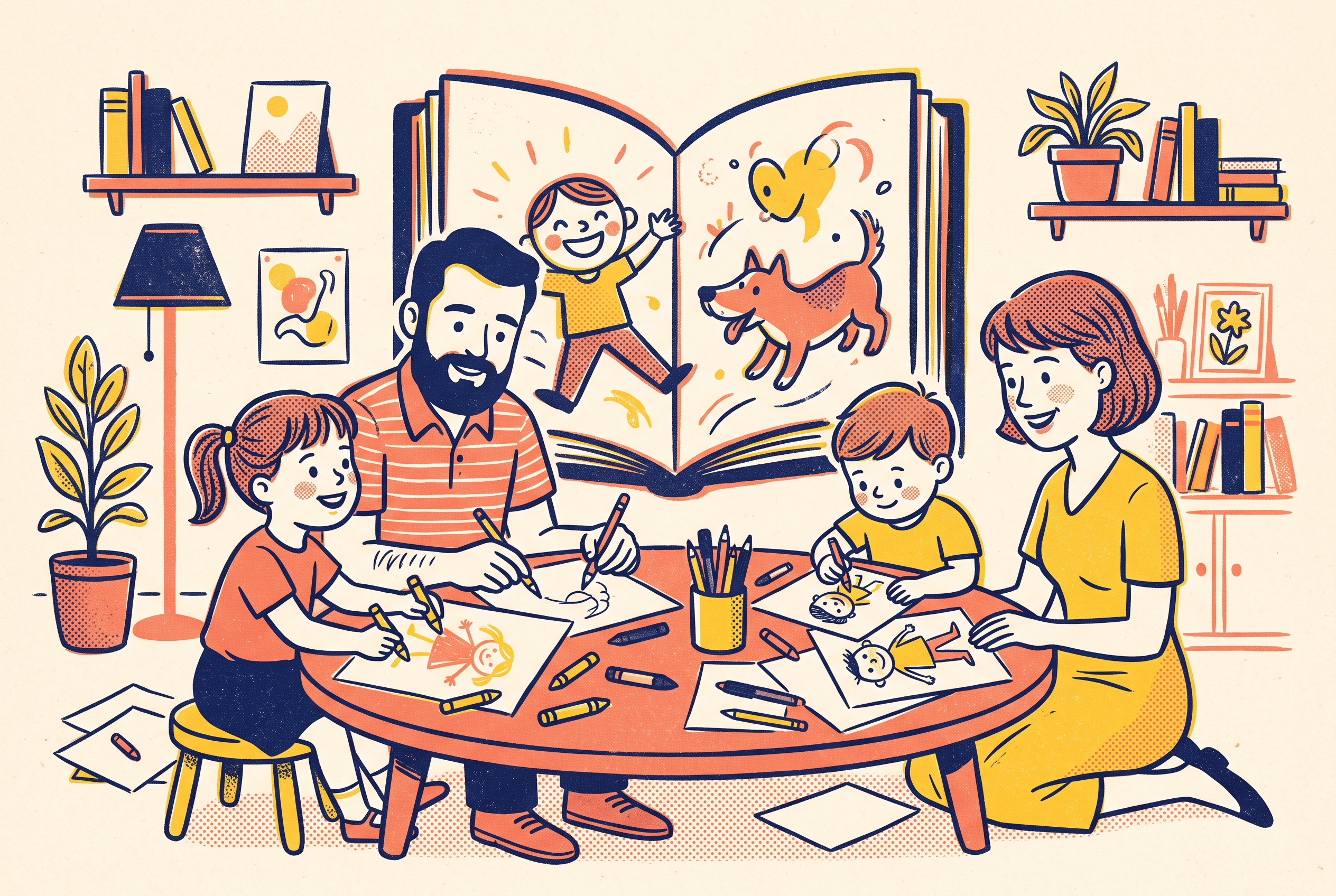
A collaborative family drawing activity for kids flips that. Instead of running separate art studios at the same table, you tape down one sheet of butcher paper and draw the whole family as fictional story characters. Nobody competes for blank space. Everyone adds to one shared universe. The goal is no longer a gallery-worthy portrait. It's a cast for a shared bedtime tale, so the performance pressure drops and mixed-age siblings actually work together.
Why drawing your family as story characters works
Drawing family portraits often triggers perfectionism in young children. Ask a six-year-old to draw Mommy and they worry about realistic hands, matching eye colors, and symmetrical hair. If the result looks clumsy, frustration follows fast. That tension disappears when Mommy becomes a deep-sea diver with mechanical octopus arms, or Dad becomes an astronaut owl who cannot find his spectacles.
Casting family members as story characters moves the focus from technical skill to storytelling. In early childhood, representation naturally comes before realism. Children understand narrative long before they develop the fine motor control for realistic proportion. You can follow this progression in our guide to the stages of drawing development in children. A two-year-old who makes a red swirl can claim it is Grandpa in his rocket-powered hovercraft. That interpretation is valid, hilarious, and immediately useful for a story.
Resist the urge to analyze the drawing. Some parenting advice tells adults to decode color choices or character placement for emotional subtext. Skip it. If your five-year-old sketches you with tiny feet and giant green ears, they are not voicing secret resentment about household rules. They ran out of purple marker and wanted goblin ears. Treat the drawing as pure creative play. When kids know their marks won't be graded or psychoanalyzed, they take bigger creative risks.
What you need and how to set up (10 minutes, one big sheet of paper)
Complicated art supplies kill creative momentum. If prep takes twenty minutes, your patience runs out before the caps come off the markers. Keep the materials basic and durable.
You need three items:
A roll of brown butcher paper or white craft paper (36 inches wide works best).
A roll of blue painter's tape.
One dozen washable broad-tip markers, beeswax crayons, or oil pastels.
Cut a four-foot strip of paper and tape all four corners firmly to the table or hardwood floor. Don't skip the painter's tape. If the paper slides when a toddler leans on it, lines tear and someone melts down. Taping it flat gives everybody a stable surface and marks out the creative zone.
Put the markers in an open basket at the center of the sheet. Personal marker piles invite hoarding, while a center basket tells everyone the materials belong to the group. Give each participant a spot along the border. A floor setup works well for households with toddlers, who can shift from kneeling to sitting without tipping a kitchen chair. Set a kitchen timer for ten minutes for the character setup phase. A visible time limit keeps high-energy kids engaged and moves the activity toward story building.
Step by step: build the family cast by taking turns
Don't start with an unstructured free-for-all. When five family members attack a blank page at once, markers collide, toddlers scribble over older siblings' detailed work, and the whole thing falls apart in ninety seconds. Structure protects the peace.
Set a turn order starting with the youngest participant. For ideas on managing this without tears, see how to teach kids to take turns. The rule is simple: each person adds one family member to the paper per turn.
Round one begins with the youngest child choosing someone to sketch. If your three-year-old wants to draw the family dog, they pick a marker, claim a circle of space on the paper, and draw. Older siblings wait until the marker goes back to the center basket. That pause teaches impulse control and gives everyone time to watch the page fill up.
When it's an older sibling's turn, they pick another family member. Parents take real turns too. Don't sit back as a passive supervisor. Draw yourself, your partner, or a grandparent. Your participation models humor and imperfection. Give yourself wildly messy hair or oversized cartoon shoes. When kids see parents drawing goofy, exaggerated figures instead of pristine art, their fear of mistakes fades. Keep rotating the turn order until every member of the household, pets included, is on the page.
Give each family member a story role and a signature trait
A drawing of four people standing in a row is just a portrait. To make it a story engine, give each character a specific job, power, or peculiar tool.
Go around the paper and ask two questions for each figure:
What is this character's job or superpower in our world?
What special item are they carrying?
Add these details right onto the drawing. If an older sister drew Dad, the next person can add a giant magnifying glass to his hand because he is the Family Detective. If Dad drew the toddler, the toddler gets to decide they wear a cape made of blueberry pancakes and have super-burping powers.
These signature traits solve the plot problems you'll hit later. Every story needs a dilemma, and specific traits give your cast distinct ways to react. A baby brother with a magic squeaky toy handles an adventure differently than a mother commanding a fleet of mechanical hummingbirds.
Write the names and titles on the paper in bold block letters: Detective Dad, Captain Maya, Doctor Snooze the Cat. Labels anchor the fictional identity and give pre-readers a visual link between written text and the drawn figures.
Turn the drawing into a story: prompts for ages 2-3, 4-5, and 6-8
Once your cast is on the page, the drawing becomes a stage. Different age groups process narrative at very different speeds. Ask a toddler for a narrative arc and you get a blank stare. Ask an eight-year-old simple identification questions and you get boredom. Match your prompts to the child's developmental stage. You can see how this works in our walkthrough on how to turn child drawing into a story.
For ages 2-3, stick to sensory actions and sound effects. Point to their character and ask: "How does Captain Baby move across the room? What noise does your pancake cape make?" Toddlers connect with the physical reality of the character. If they make zoom noises and pat the paper, work that sound into the group plot: "Captain Baby flew across the ceiling, going zoom-clack-zoom!"
For ages 4-5, add a concrete goal and a physical obstacle. Ask: "What is Captain Maya trying to find, and why is the door locked?" At this age, kids grasp cause and effect. They might decide Captain Maya needs to recover the Golden Waffle from the top of the refrigerator, but the floor has turned into warm chocolate pudding.
For ages 6-8, bring in interpersonal stakes and trickier resolutions. Ask: "Which two characters disagree about the plan, and whose signature tool actually saves the mission?" A seven-year-old can balance conflicting character motivations. They'll love explaining that Detective Dad wanted to build a raft, but the toddler solved the problem by eating the obstacle.
When you want to move paper characters into moving media without hours of editing, Pixley turns kids' drawings and ideas into personalized animated cartoons, bedtime storybooks, and learning games. It's built for ages 2-8 and needs no technical expertise. Parents describe any lesson they want taught, and Pixley creates a cartoon episode around it, running every generation through child-safety filtering before any kid sees it.
Make it a keepsake: from one page to a family book
Butcher paper takes up a lot of space. Four-foot sheets piled on a desk make clutter, and rolled-up tubes end up forgotten in the back of a closet. Preserve the family drawing activity for kids by turning the sheet into a story you can actually read.
The simplest analog method is the eight-page mini-book fold. Use your smartphone to take high-resolution photos of each character on the large sheet. Print the pictures onto standard printer paper. Fold and cut using a one-sheet zine fold, with one character per page and their traits written below. For step-by-step layout advice, read our guide on how to make a book from kids drawings.
If you'd rather keep it digital, upload photos of the drawn figures directly into Pixley. Available on iOS with a free trial, Pixley takes those character drawings and ideas and turns them into personalized bedtime storybooks and animated episodes. A digital story where your six-year-old's superhero Mom stars alongside their sibling's robotic kitten turns an afternoon doodle into a repeatable bedtime fixture that never clutters your living room.
Variations to repeat the activity all month
Kids love familiar rituals, but running the identical premise every weekend gets stale. Keep the core mechanics of the family drawing activity for kids the same: one big sheet, turn-based character drawing, shared story invention. Change only the theme.
Here are four variations to rotate across the month:
Week 1: The Deep Sea Submarine Crew. Everyone draws themselves as marine explorers assigned to a specific room in a sprawling submarine. Add diving helmets, bubble generators, and sonar monitors. The story problem: finding a lost bioluminescent sea turtle that took the submarine keys.
Week 2: The Miniature Garden Colony. Everyone shrinks to the size of an acorn. Draw the family living under a dandelion in the backyard. Family traits become dandelion parachute gliders, twig bridges, and beetle saddles. The story problem: retrieving a dropped strawberry before an army of garden ants finds it.
Week 3: The Intergalactic Repair Team. Draw the family as mechanics on an orbital space station. Dad gets a plasma wrench, the toddler gets anti-gravity boots, and the family cat gets an astronaut bubble helmet. The story problem: the satellite radio only plays polka music until someone fixes the solar antenna.
Week 4: The Royal Bakery Guild. Move the setting to a medieval fantasy kitchen. Everyone holds a giant culinary tool: rolling pins, flour dusters, whisk wands. The story problem: baking a cake tall enough to reach a grumpy cloud giant who keeps raining on the harvest festival.
Rotating through these worlds builds your child's narrative vocabulary and gives you a dependable weekend tradition.
Conclusion
Shared creative projects fall flat when parents overcomplicate the rules or demand museum-level drawings. A successful family drawing activity for kids needs only paper, tape, and a willingness to treat every mark as part of an evolving story.
Stop treating kids' artwork as disposable clutter or refrigerator decoration. Grab a roll of craft paper, sketch your family's alter egos tonight, and watch your living room turn into a writers' room. To take their original characters further, try Pixley on iOS with a free trial. Pixley turns your kids' drawings and ideas into safe, ad-free animated cartoons, learning games, and personalized bedtime storybooks that your family can enjoy for years.
Frequently Asked Questions
What should we do if our toddler scribbles over an older sibling's drawing?
Prevent territorial conflicts by giving toddlers their own designated section of the large sheet with a tape border. If scribbles happen on another figure, treat the mark as a story event, like a magical forcefield or a dust storm. Pixley also turns kids' drawings and ideas into personalized animated cartoons.
How long should this family drawing activity take for young children?
Keep the entire session between 20 and 35 minutes for children ages 2-8. Spend ten minutes setting up and drawing characters, ten minutes assigning traits and building the plot, and five to ten minutes telling the story. Ending while everyone is still interested ensures children look forward to repeating it.
How can we turn paper drawings into digital cartoons for our kids?
Pixley turns kids' drawings and ideas into personalized animated cartoons, bedtime storybooks, and learning games on iOS. Parents describe any lesson they want taught. Pixley creates a safe, ad-free cartoon episode tailored to ages 2-8, running every generation through child-safety filtering.
What if my child gets frustrated and says their drawing looks bad?
Shift the focus from realistic drawing to story function. Remind your child that quirky, imperfect shapes make the most memorable cartoon characters. Model this by drawing yourself with exaggerated features like giant boots or zigzag hair. Showing kids that goofy traits drive great stories removes the pressure to create flawless art.