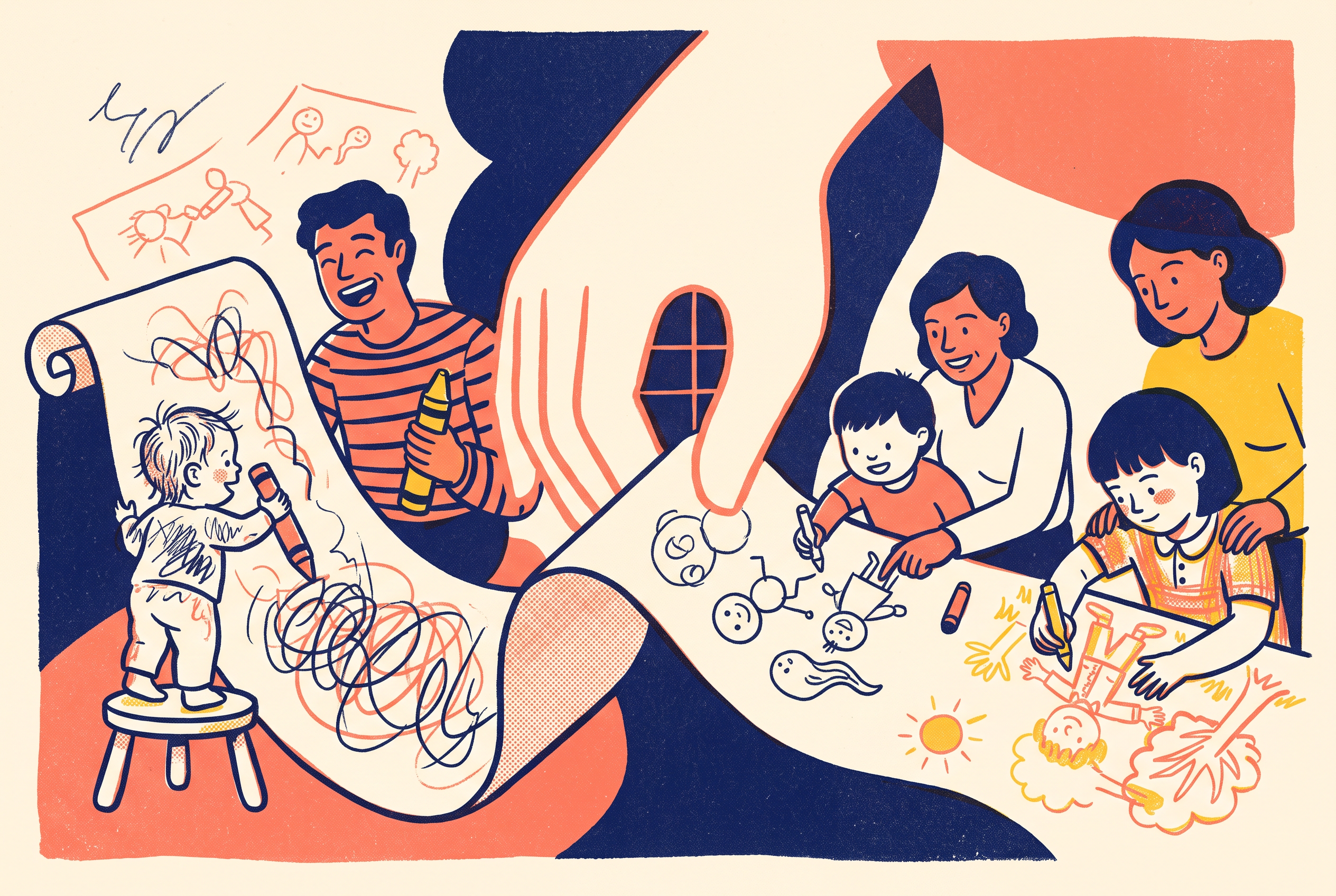
Stages of Drawing Development in Children: Ages 2 to 8
Explore the stages of drawing development in children ages 2-8. Learn Lowenfeld's stages and turn scribbles into characters and personalized stories.
 Pixley Team
A sheet of construction paper covered in jagged crayon loops lands on your kitchen counter. To an adult, it looks like tangled blue yarn. To the three-year-old holding the crayon, it is a dog named Barnaby who lost his shoes in the mud.
Every child moves through distinct artistic phases as their motor control and symbolic thinking mature. Knowing the stages of drawing development in children helps you read what is happening on that page. It also gives you a practical framework for turning everyday doodles into creative language.
All you need to begin is printer paper, washable markers or triangular crayons, and ten quiet minutes after preschool or dinner. Once you know what marks to expect at each age, you can stop guessing what a drawing is and start helping your child grow it into a living character.
Step 1: Set up a drawing habit and learn the stages (a quick map of ages 2-8)
Artistic growth is not random. In 1947, art educator Viktor Lowenfeld published Creative and Mental Growth, laying out a developmental progression that researchers still cite today. Lowenfeld mapped how children shift from purely physical motor movements to intentional, symbolic representations of the world around them.
The progression breaks into four core phases between toddlerhood and early elementary school. First comes the scribbling stage (ages 2 to 4), where physical movement across the page gradually turns into named shapes. Next is the preschematic stage (ages 4 to 7), where children use basic shapes like circles and lines to build recognizable people and objects, often floating freely in white space. By ages 7 to 9, children enter the schematic stage. They organize their world with a ground baseline, a sky line at the top, and repeated visual symbols for houses, trees, and family members.
Treat these age brackets as rough signposts, not strict deadlines. A child who draws daily might build complex figures at age four, while another sticks to color blocks until age five. The sequence matters. The exact month doesn't.
Set up a low-friction drawing spot before you analyze anything. Keep a shallow caddy on the dining table stocked with thick copy paper, beeswax crayons, and triangular markers that encourage a tripod grip. Make one rule that protects your child's creative ownership: never draw on their paper to show them how something should look. When you want to model drawing, use your own sheet next to them. Once the stack builds up, you'll want to know what to do with your child's drawings, and a steady routine makes sorting and storytelling much easier.
Step 2: Ages 2-3, scribbling: ask 'tell me about it' and let the scribble get a name
Between ages two and three, drawing is an exercise in gross motor control. Toddlers grip a crayon with a full fist (the palmar grasp) and swing from the shoulder or elbow. The mark on the page is simply the visible record of a physical movement. You will see uncontrolled horizontal zigzags, then weeks later rhythmic circular sweeps as shoulder muscles stabilize.
Around 30 to 36 months, an intellectual breakthrough occurs. Lowenfeld called this shift named scribbling. The child stops drawing purely for the physical sensation and starts connecting the marks to an idea in their head. The loop is no longer just a loop. It is a puddle, a racecar, or grandma.
Avoid asking, "What is that?" That question puts a toddler on the spot. If the child drew a sensory swirl without a plan, your question implies the mark failed to look like a real object. Use open, observational phrasing instead. Say: "Look at those heavy blue circles. Tell me about what is happening here."
Listen closely to the answer. If your child says, "It is a bear," validate it right away. You can say: "That bear looks fast. What is the bear's name?" If they name it Barnaby, write Barnaby in small letters in the corner of the sheet. Giving a scribble an identity takes five seconds, and it plants the first seed of character design. The drawing stops being disposable scrap paper and becomes your child's first named protagonist.
Step 3: Ages 3-4, naming and tadpole people: turn the first figure into a character with one trait
Around age three and a half, children discover that a closed circle can stand for a head. Almost immediately, lines sprout directly from that circle. Child psychologists call these figures cephalopods, or tadpole people. The torso is missing, and the arms and legs stick straight out of the face.
This is normal in preschool drawing. Young children draw what they see as functionally important, not what is anatomically complete. Faces have eyes, mouths, and ears. Limbs run, kick, and hold snacks. The belly and chest don't do anything obvious in a preschooler's day, so they get left out.
Meet your child at this milestone by adding a character trait. When your child finishes a tadpole person, point out a concrete detail. You can say: "Barnaby has two very long legs. What is one special thing Barnaby can do with legs like that?"
Let your child decide the superpower or quirk. Barnaby might leap over tall fences, tap dance on kitchen tables, or run through giant mud puddles. Pick one dominant trait and repeat it back to them. If you want to turn your child's drawing into a story, a single distinctive physical or behavioral trait gives you everything you need. You now have a subject who can do something interesting.
Step 4: Ages 4-6, preschematic: give the character a problem, a place, and a three-beat story
Between four and six years old, children enter the preschematic stage. Bodies appear beneath heads, drawn as separate rectangles or ovals. Fingers fan out like sun rays, often with seven or eight digits per hand. Objects float across the page without a shared ground plane. A house sits upside down in the top corner, a dog hovers mid-air, and a sun beams from a gap in the center.
Color choices in this stage are emotional, not realistic. A child might paint a tree bright magenta because magenta is their favorite color that morning, or color an angry dog pitch black. Don't correct these palettes. Color is symbolic shorthand for mood and intensity.
Use this burst of detail to co-create a classic three-beat narrative: a character in a place, a small problem, and a resolution. Ask your child three questions while they draw:
The Place: "Where is Barnaby standing right now? Is he inside an igloo, or outside in the wild woods?"
The Problem: "Oh no, what went wrong for Barnaby today? Did he drop his lunchbox or get stuck in a tree?"
The Fix: "Who helps him fix it, and what do they do?"
Write their exact words along the bottom of the paper. A five-year-old can easily invent a plot where Barnaby the jumping dog visits the moon, drops his biscuit into a crater, and uses an extra-long ladder to rescue it. That is a complete narrative arc anchored to their visual art.
Step 5: Ages 6-8, schematic: build repeat characters, baselines, and multi-page stories
Around age seven, children reach the schematic stage. The most striking visual sign is the baseline: a straight line along the bottom third of the paper representing the ground. People, vehicles, and buildings all sit firmly on this line. Above them stretches a strip of blue for the sky, with empty air left between ground and atmosphere.
Children at this age develop a set visual schema for things they draw often. They settle on a specific way to draw an eye, a tree, or a roof, and repeat that formula across dozens of pictures. You will also see transparency drawings, where a child draws the exterior wall of a house and the furniture inside at the same time, like an architectural cutaway.
Use this structured spatial thinking to introduce multi-page storytelling. Fold two pieces of printer paper in half to make an eight-page blank booklet. Challenge your child to use their established schema across consecutive panels.
Guide them to draw Barnaby on page one, put him in a new setting on page two, introduce a challenge on page three, and resolve the action across pages four and five. Children in early elementary school take immense pride in visual continuity. When the same character wears the same striped shirt across multiple pages, it shows they understand sequential storytelling and character identity.
Step 6: Keep every drawing in play: save, photograph, and bring characters to life together
Every parent faces the paper avalanche. When your child produces eight drawings a day, saving every sheet in cardboard boxes is impossible. Sneaking them into the recycling bin feels wrong.
A deliberate digital workflow solves this. At the end of each week, sit down with your child and ask them to pick their top two favorite drawings from the pile. Take a clean, top-down photograph of each one in bright daylight. Flatten curling paper edges with small coins or tape at the corners.
Once digitized, those drawings don't have to sit forgotten in your camera roll. Pixley turns kids' drawings and ideas into personalized animated cartoons, bedtime storybooks, and learning games. Built for ages 2 to 8, the app is safe, ad-free, and available on iOS with a free trial.
Instead of leaving Barnaby as a flat marker sketch on paper, you can upload the image into Pixley. Parents can describe any lesson they want taught, and Pixley creates a cartoon episode around it, covering social-emotional learning goals or educational topics. Every generation passes child-safety filtering before your child sees it. Watching their hand-drawn dog move across an animated screen validates the effort they poured into that paper. It shows them their artistic ideas have real storytelling value.
What to do next: a simple weekly routine and how to adapt when your child's style shifts
Build a sustainable weekly routine to support your child through the stages of drawing development in children without turning drawing time into homework. Pick a recurring 20-minute window, like Sunday morning or quiet time after school on Wednesdays. Keep the supplies visible, accessible, and ready to go.
Children often shift backwards and forwards between stages, especially when tired, excited, or testing a new material. A six-year-old who normally draws detailed baseline scenes might spend an entire afternoon making wild scribbles with charcoal sticks. That is not regression. It is sensory experimentation. Let them switch between precise figure work and chaotic mark-making without commentary.
When your child announces, "I can't draw this," resist the urge to draw the object for them. Ask questions instead: "What shape is the body? Is it a circle or an oval? Where do the ears attach?" Breaking complex items into basic geometries keeps creative control in their hands. Pair that confidence with storytelling, and every stage becomes a chance to build narrative skill.
Conclusion
The scribbles on your kitchen table are more than motor practice. They are the building blocks of communication, character design, and self-expression. Once you understand each phase, you can turn paper marks into rich family stories.
Pixley helps you take that creative momentum one step further. It turns your child's original art into animated episodes, personalized storybooks, and educational games, giving their characters a safe digital life. Download Pixley on iOS with a free trial, upload your child's latest sketch, and watch their imagination come alive on screen tonight.
Frequently Asked Questions
What are the main stages of drawing development in children?
Art educator Viktor Lowenfeld identified four core phases for young children: the scribbling stage (ages 2 to 4), the preschematic stage (ages 4 to 7), and the schematic stage (ages 7 to 9), followed by the gang stage in later childhood. Children progress from physical, sensory strokes to symbolic circles and tadpole figures, eventually adding spatial baselines and consistent visual rules.
Why does my 4-year-old only draw tadpole figures with no body?
Tadpole people, where arms and legs stick directly out of a large round head, are a normal milestone of the late scribbling and early preschematic stages. Preschoolers draw what they find functionally meaningful. Faces communicate and see, while limbs move and grasp. The torso serves no active role in their daily awareness, so young children naturally omit it until around age five.
How can I turn my child's drawing into an animated cartoon?
Photograph the drawing flat under clear natural light, ensuring high contrast between paper and marker. You can then use Pixley, which turns kids' drawings and ideas into personalized animated cartoons, bedtime storybooks, and learning games for ages 2 to 8. It allows parents to guide specific lessons within safe, ad-free animations built directly from original artwork.
Should I correct my child when they use the wrong colors in drawings?
No. In the preschematic stage (ages 4 to 6), children select colors based on personal preference and emotional intensity rather than physical realism. Forcing realistic colors interrupts their natural symbolic exploration. Let them paint blue grass or purple suns; realistic color matching emerges on its own during the schematic stage around age seven.