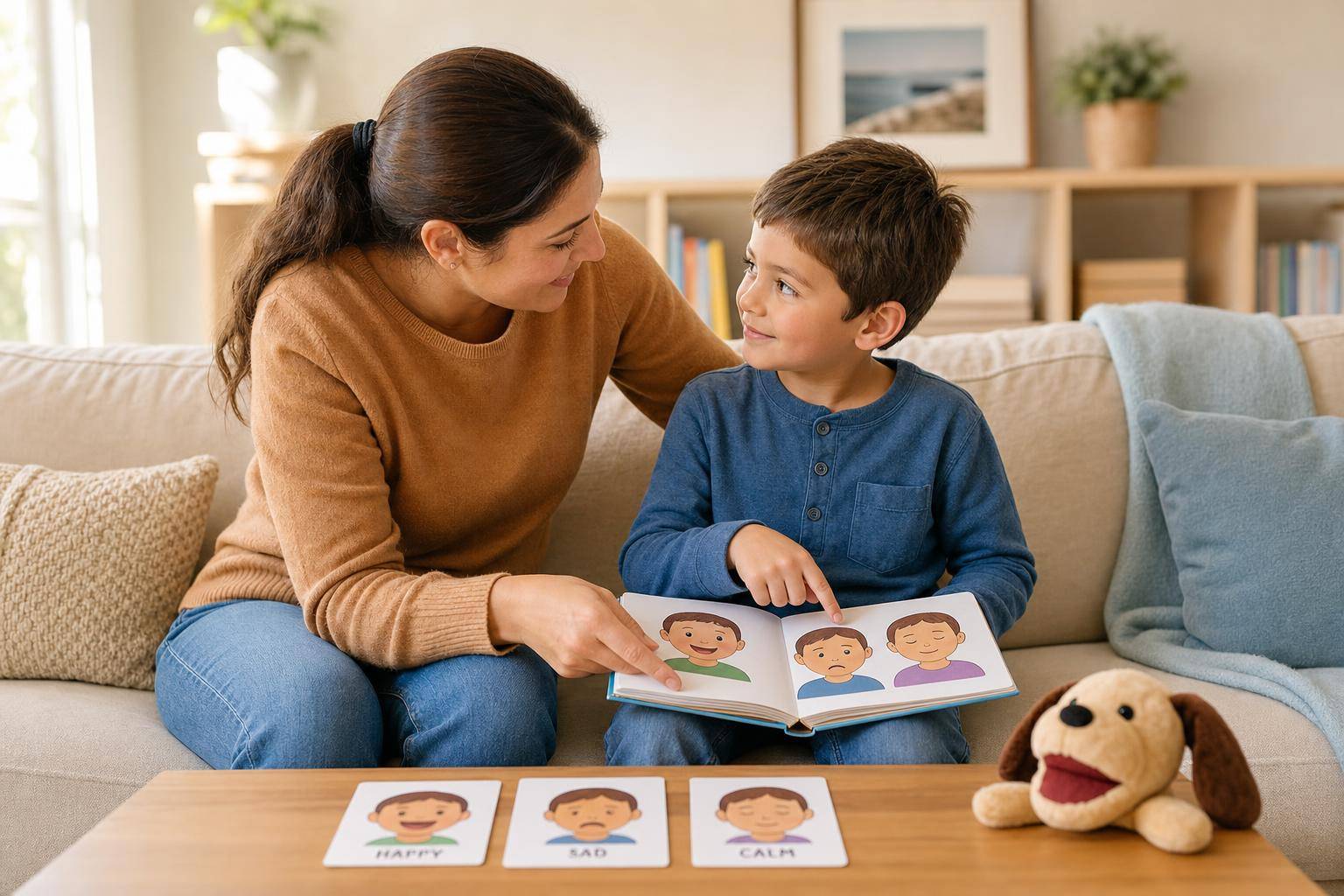
How Stories Build Emotional Intelligence in Kids
Learn how stories build emotional intelligence in kids by helping them name feelings, practice empathy, and build calm responses through reading, role-play, and Pixley.
 Pixley Team
How Stories Build Emotional Intelligence in Kids
Stories are one of the easiest ways to help kids understand feelings.
When a child sees a character feel nervous, jealous, proud, embarrassed, left out, or excited, they get to practice something important from a safe distance. They can notice the feeling, name it, think about what the character did, and imagine what they might do in the same situation.
That is the heart of emotional intelligence in kids: learning to understand feelings, care about other people's feelings, and choose a helpful response.
The best part is that parents do not need a formal lesson plan. A picture book, bedtime story, read-aloud, role-play game, or personalized animated story can all help children build emotional skills when an adult adds a little conversation.
This guide explains how stories support emotional intelligence, what kinds of stories work best, and how families can use storytelling to help kids practice empathy, self-regulation, and confidence.
Quick Takeaways
- Stories help children name emotions by showing feelings through faces, actions, and choices.
- Story conflict helps kids practice empathy because they can see more than one point of view.
- Read-alouds, role-play, drawing, and personalized animation can all support social-emotional learning.
- Parent questions matter. A simple pause like "How do you think they feel?" can turn storytime into emotional practice.
- The best stories focus on one clear feeling, one relatable problem, and one helpful next step.
- Pixley can help families turn a child's own drawings and ideas into personalized stories around kindness, courage, patience, or confidence.
What Is Emotional Intelligence for Kids?
Emotional intelligence is the ability to understand and manage feelings.
For children, that can look like:
- Knowing the difference between sad, mad, nervous, jealous, and embarrassed
- Noticing how another person might feel
- Understanding that actions can affect other people
- Taking a breath before reacting
- Asking for help
- Saying sorry
- Trying again after a mistake
- Talking about feelings instead of acting them out
These are not skills children learn all at once. They build slowly through everyday practice.
Stories are useful because they give kids practice before real life gets intense. A child can talk about a character who feels angry before they have to handle their own anger on the playground. They can watch a character apologize before they need to repair a real friendship. They can see someone feel scared and still try something new.
That practice matters. CASEL describes social and emotional learning as the process of developing skills like self-awareness, self-management, social awareness, relationship skills, and responsible decision-making. Research summarized by CASEL has also linked SEL programs with stronger long-term academic and social outcomes. You can read more from CASEL's research overview.
In plain English: emotional skills help kids at home, at school, and with other people.
Why Stories Are So Good at Teaching Feelings
Children often understand emotions better when they can see them in a character.
A story makes feelings visible. The character's face changes. Their voice gets quiet. They stomp away. They hide. They smile. They make a choice. Then something happens because of that choice.
That gives children a simple emotional map:
Feeling → Choice → Consequence → Repair or growth
For example:
A bear feels left out, so he knocks over his friend's blocks. His friend feels hurt. The bear learns to say, "I wanted to play too," and they rebuild together.
That one short story can teach several emotional skills at once:
- Naming the feeling: left out
- Understanding the reaction: knocking over blocks
- Noticing the impact: the friend feels hurt
- Practicing a repair: using words and helping rebuild
The story does not need to be complicated. In fact, younger children usually learn more from simple, clear emotional moments.
Characters Help Kids Name Feelings
Many kids feel big emotions before they have the words to explain them.
That can be frustrating. A child might say "I'm mad" when they are actually disappointed, worried, tired, jealous, or overwhelmed. Stories help build a bigger feelings vocabulary.
When you read or watch a story, pause on emotional moments and name what you see:
- "He looks disappointed."
- "She might feel nervous because it is her first day."
- "I think he feels proud because he kept trying."
- "She looks embarrassed. Her face is hiding behind her hands."
These small labels add up. Over time, children get more words for what is happening inside them.
A bigger feelings vocabulary can also make behavior easier to understand. When a child can say "I feel left out," they may not need to yell, grab, or shut down as quickly.
Conflict Helps Kids Practice Empathy
A story without any problem usually does not teach much emotionally.
Conflict is where empathy grows.
When two characters want different things, kids can practice seeing more than one perspective. One character wants to play alone. Another wants to join. One child wants the red truck. Another child had it first. One character tells a lie because they feel scared. Another character feels hurt because trust was broken.
These moments help children ask:
- What does each person want?
- How does each person feel?
- Why did they act that way?
- What could they try next?
That is perspective-taking. It is one of the most important parts of empathy.
The goal is not to force children to always agree with every character. The goal is to help them notice that different people can experience the same moment in different ways.
Stories Support Self-Regulation
Self-regulation means learning how to pause, calm down, and choose what to do next.
That is hard for young kids. It is also hard for many adults.
Stories help because they slow emotional moments down. Instead of a real tantrum, argument, or disappointment happening all at once, a story lets the child look at the moment piece by piece.
For example, a story might show a character:
- Feeling angry
- Wanting to yell
- Taking a breath
- Asking for help
- Trying again
That sequence gives kids a script they can remember later.
Harvard's Center on the Developing Child compares executive function and self-regulation skills to an "air traffic control system" that helps people manage information, make decisions, and plan ahead. These skills develop through practice and supportive interactions. You can read more from Harvard's guide to executive function.
Stories are not a magic fix. But they can give children simple coping steps they can rehearse.
The Best Types of Stories for Emotional Learning
Not every story teaches emotional intelligence equally well.
Look for stories that include:
- A clear feeling
- A relatable problem
- Characters with understandable motives
- A choice or mistake
- A repair or coping step
- A calm ending
- Space for conversation
For younger children, stories about everyday situations work especially well:
- Sharing a toy
- Feeling scared in the dark
- Starting school
- Waiting for a turn
- Losing a game
- Missing a parent
- Making a friend
- Saying sorry
- Trying something new
For older children, stories can include more layered emotions:
- Feeling embarrassed
- Being excluded
- Comparing yourself to others
- Handling jealousy
- Telling the truth
- Standing up for someone
- Managing frustration
- Repairing trust
A useful rule: choose stories where your child can understand both the feeling and the next step.
How Different Story Formats Build Emotional Intelligence
Different storytelling formats help in different ways.
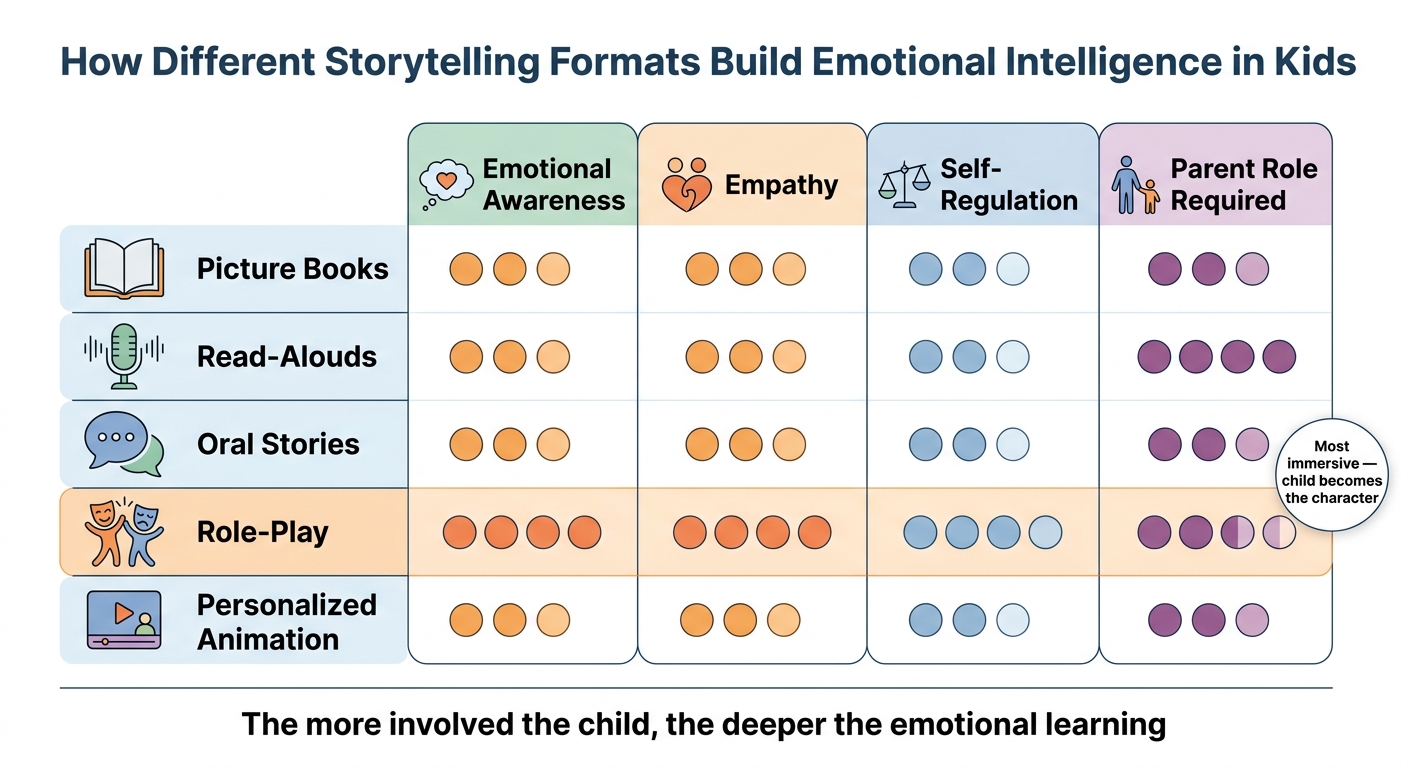
The more involved the child, the deeper the emotional learning across storytelling formats.
Picture Books
Picture books are great for emotional learning because children can study the pictures. Facial expressions, body language, colors, and page turns all help show feelings.
They also make it easy to pause.
Try asking:
"What do you notice about her face?"
"What changed from this page to that page?"
Read-Alouds
Read-alouds are powerful because they add your voice, warmth, and conversation.
Reading Rockets notes that reading aloud can support social-emotional skills like empathy, understanding big emotions, and problem-solving. Shared stories become even more helpful when adults talk with children about what is happening. You can read more from Reading Rockets on reading with your child.
Oral Stories
Oral stories are flexible. You can create a story that matches exactly what your child is experiencing.
For example:
"Once there was a little turtle who wanted to join a game, but he did not know what to say."
This works well when your child had a hard moment that day and you want to revisit it gently without making them feel accused.
Role-Play
Role-play helps children practice a response with their whole body.
You can act out:
- Asking to join a game
- Saying sorry
- Taking turns
- Using a calm voice
- Telling a grown-up
- Trying again after losing
Role-play can feel silly, which is good. Play lowers the pressure.
Personalized Animation
Personalized animated stories can make the lesson feel even closer to the child's life.
When a child sees a character based on their own drawing learning to be brave, kind, patient, or honest, the emotional lesson can feel more memorable. The child is not just watching a random character. They are watching an idea they helped create.
That is where Pixley can fit naturally.
How Parents Can Use Stories at Home
The most important part is not choosing the perfect story. It is what you do with the story.
A simple three-step routine works well:
1. Name the Feeling
Pause and ask:
"What is this character feeling?"
For younger kids, give two options:
"Do you think he feels mad or worried?"
This makes the question easier to answer.
2. Talk About the Choice
Ask:
"What did the character do because they felt that way?"
Then ask:
"Did that choice help?"
This helps children connect feelings to actions.
3. Practice a Next Step
End with one practical response:
- "They could ask for help."
- "They could take a breath."
- "They could use words."
- "They could try again."
- "They could say sorry."
- "They could ask for a turn."
Keep it simple. One coping step is enough.
Questions That Build Emotional Intelligence During Storytime
You do not need a long discussion. One or two questions can be enough.
Try these:
- "How does the character feel?"
- "How can you tell?"
- "Why do you think they did that?"
- "What would you do?"
- "What could they try next?"
- "How did their choice make someone else feel?"
- "Did they fix the problem?"
- "Has anything like this ever happened to you?"
Reading Rockets describes dialogic reading as a conversation between an adult and child about a book, where the child becomes more active in the story experience. You can read more about dialogic reading.
The key is to keep it light. If every story becomes a quiz, kids may tune out. The goal is connection, not interrogation.
Simple Story Activities for Emotional Learning
After a story, a quick activity can help the lesson stick.
Draw the Feeling
Ask your child to draw the character when they felt sad, proud, nervous, or brave.
Then ask:
"What helped them feel better?"
Retell the Story From Another View
Ask:
"Can you tell the story from the friend's point of view?"
This builds perspective-taking.
Act Out the Hard Moment
Use toys or stuffed animals to replay the scene.
Then try a different ending.
Make a Feelings Chart
Pick three feelings from the story and draw faces for each one.
For example:
- Nervous
- Frustrated
- Proud
Create a New Ending
Ask:
"What if the character tried a calmer choice?"
This helps children practice problem-solving.
How Pixley Can Help With Social-Emotional Stories
Pixley helps kids turn drawings and ideas into personalized animated stories.
For emotional learning, that means you can build a story around something your child is actually practicing:
- Sharing with a sibling
- Feeling nervous at school
- Being brave at bedtime
- Trying again after a mistake
- Saying sorry
- Making a new friend
- Handling frustration
- Asking for help
A simple Pixley story works best when it focuses on:
- One feeling
- One relatable problem
- One helpful response
For example:
"A moon bear feels nervous about joining a new class. He wants to hide, but he learns to take one deep breath and ask, 'Can I play too?'"
That is clear, age-appropriate, and easy to reuse later.
When your child helps create the character, the lesson can feel more personal. You can say:
"Remember how your moon bear took a breath before asking to play? Let's try that."
That gives your child a friendly story reference instead of a lecture.
Create a personalized story with Pixley
A 5-Minute Story Formula for Emotional Intelligence
Use this when you want to make up a quick story at home.
Character
Who is the story about?
Example: "A tiny fox named Finn."
Feeling
What feeling is the character having?
Example: "Finn feels jealous because his friend gets a shiny new scooter."
Problem
What does the character do?
Example: "Finn says the scooter is silly and walks away."
Better Choice
What could the character try instead?
Example: "Finn learns to say, 'I wish I had one too. Can I try it when you are done?'"
Ending
How does the story end?
Example: "His friend shares a turn, and Finn feels proud for using kind words."
Put it together:
"Finn the fox feels jealous when his friend gets a shiny new scooter. At first, he says something unkind and walks away. Then he learns to name the feeling, ask for a turn, and use kind words. By the end, Finn feels proud because he handled jealousy in a better way."
That is a complete emotional learning story.
A Parent Checklist for SEL Stories
Before choosing or creating a story, ask:
Feeling
- Is there one clear emotion?
- Can my child recognize it?
- Is the feeling shown through face, voice, or action?
Problem
- Is the conflict relatable?
- Is it age-appropriate?
- Can my child understand why the character acts that way?
Empathy
- Does the story show how other people feel?
- Does it include more than one point of view?
- Can we talk about how the choice affected someone else?
Coping Step
- Does the character try a helpful response?
- Is the response realistic for my child?
- Can we practice that response later?
Conversation
- Is there room to pause and ask questions?
- Can my child retell the story?
- Can we connect it to real life?
If the answer is yes to most of these, the story is a strong fit.
Final Thoughts
Stories help children practice emotions before real life asks them to use those skills.
A character can make a mistake, feel left out, try again, apologize, or calm down. Then your child can talk through that moment with you while everything still feels safe and low-pressure.
That is why storytelling is such a natural way to build emotional intelligence in kids.
You do not need to turn every book or cartoon into a lesson. Start small. Pause once. Name one feeling. Ask one question. Practice one next step.
Over time, those small story habits can help children build the words, empathy, and confidence they need to handle big feelings in real life.
FAQs
What age should I start using stories to teach emotions?
You can start using simple stories to talk about emotions with toddlers. Keep the stories short, concrete, and connected to familiar feelings like happy, sad, mad, scared, and proud.
How do stories build emotional intelligence in kids?
Stories help kids recognize feelings, understand other people's perspectives, connect actions with consequences, and practice calmer responses through characters and conflict.
What kinds of stories are best for teaching empathy?
Stories with relatable problems, clear emotions, and more than one point of view are best for teaching empathy. Look for stories where characters make choices, notice how others feel, and repair mistakes.
How often should we use stories for social-emotional learning?
A few minutes a day can help. You do not need a formal lesson. A bedtime story, short read-aloud, role-play scene, or personalized animated story can all support emotional learning when you add a simple question or conversation.
Can animated stories help kids learn emotions?
Yes, animated stories can help when they are age-appropriate, calm, and co-viewed with an adult. Facial expressions, movement, and voice can make feelings easier for children to notice and discuss.
How can Pixley support emotional learning?
Pixley helps families create personalized animated stories from a child's drawings and ideas. Parents can guide the story around a feeling or value, such as kindness, courage, patience, or confidence.
Keep Reading
- Teaching Visual Metaphors With Cartoons: A Parent and Teacher Guide
Learn how to teach visual metaphors to kids using cartoons, comic panels, drawings, and personalized stories. Help children connect images to feelings and ideas in simple steps.
- Interactive Bedtime Stories for Kids: 5 Creative Ideas Parents Can Try
Practical tips to make bedtime stories more interactive for kids. Personalize plots, invite participation, use props and sound effects, and turn drawings into animated tales with Pixley.
- Age-Appropriate Digital Stories for Kids: Parent Guide
Learn how to choose age-appropriate digital stories for kids, with tips for story length, pacing, safety, co-viewing, and creative screen time.
- All parenting & screen-time guides →