Comic Strip Ideas for Kids: 30 Prompts to Draw Stories
Explore simple comic strip ideas for kids ages 2-8. Use 3-panel setups, 30 story prompts, and easy parent scribing to turn daily doodles into short comics.
 Pixley Team
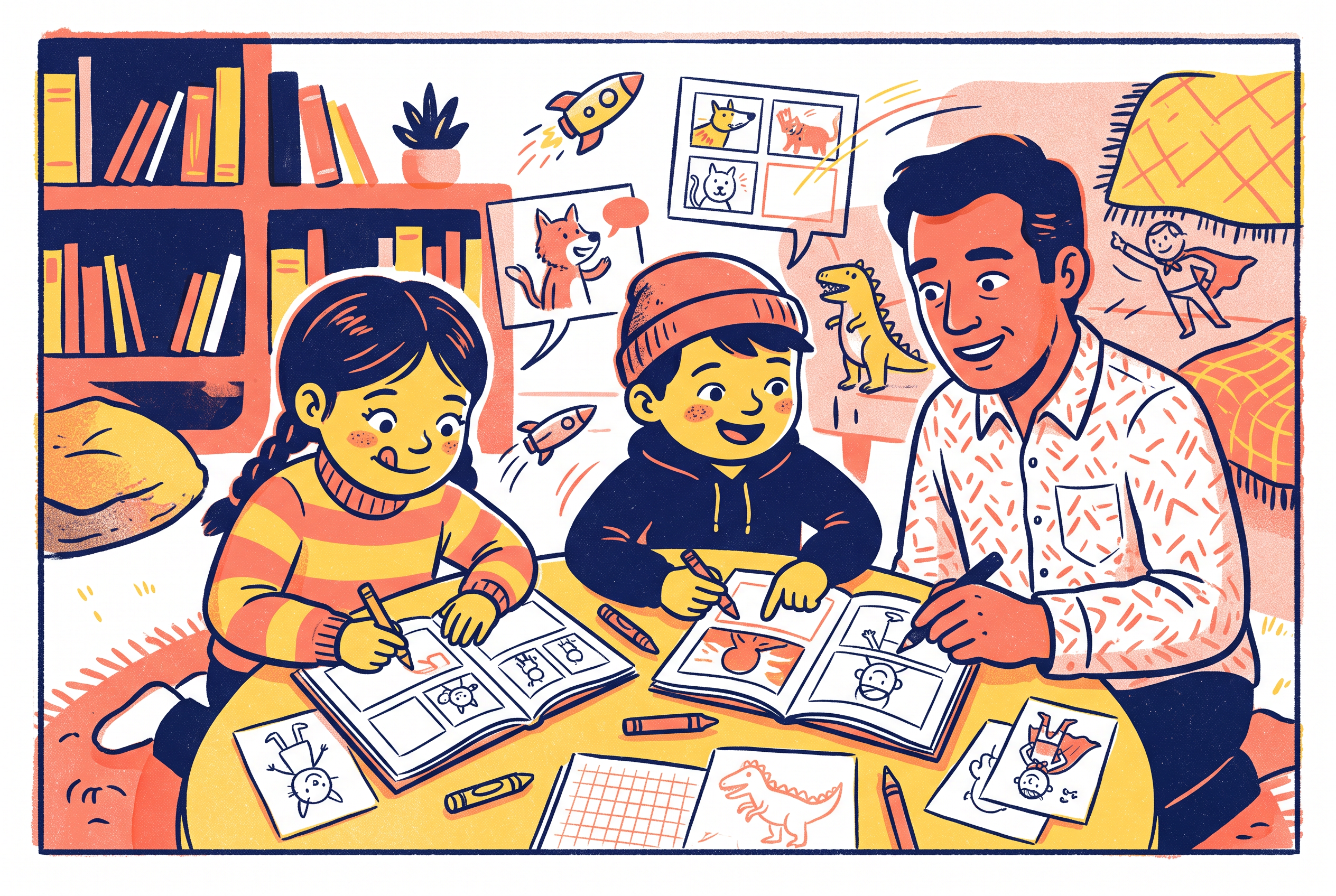
A kitchen table covered in scrap paper usually means one thing: dozens of isolated drawings of monsters, cats, and stick figures with nowhere to go. Kids draw constantly, but they often abandon a character thirty seconds after the marker leaves the page. Turning those sketches into stories doesn't take a sketchbook full of complex grids or formal art lessons. It takes three boxes and a basic conflict.
A three-panel comic gives young children an instant story shape: beginning, problem, ending. When a kid puts their own character into a sequence, drawing stops being repetitive doodling and becomes storytelling. Your child might be a two-year-old scribbler who dictates dialogue to you, or an eight-year-old writing their own speech bubbles. Either way, these prompts and steps keep the process fast and low-stress.
Step 1: Pick the hero (your child's own drawn character)
Most comic projects fail because adults ask kids to invent an entire cast before drawing a single panel. Skip the script, and don't tell your child to copy Spider-Man or Peppa Pig. Start with a character they've already drawn five times this week.
Look through the recycling bin or the stack of paper by the markers. If your four-year-old drew a purple blob with six legs, that blob is the protagonist. Give it a name together right now: Bob the Blob. Keeping the child's own creation at the center keeps the project theirs. Kids care about their own inventions far more than generic cartoon templates.
The visual rule is simple: keep the hero consistent. If Bob has three antennae in panel one, Bob needs three antennae in panel three. For kids ages 2 to 5, the details will drift across panels, and that's fine. A green circle in box one that turns into a green square in box two is still the same hero. If you need help sparking that first character design, check out our guide on drawing prompts for kids. The goal is recognizing continuity, not polish.
Step 2: Set up a 3-panel strip (beginning, problem, ending)
Complicated comic layouts kill enthusiasm fast, and busy multi-panel grids can overwhelm young kids. A three-panel horizontal strip mirrors the classic story arc without overwhelming the artist.
Take a standard piece of printer paper and fold it into thirds like a letter, or draw two vertical lines to make three equal rectangles. Label each box mentally, or lightly in pencil on the back:
Panel 1 (The Setup): Who is here, and what are they doing?
Panel 2 (The Trouble): What went wrong?
Panel 3 (The Fix): How did it end?
Pictures make sequencing concrete: a child can point to what happened first, next and last, and tell it out loud. You don't need dialogue bubbles in every panel. A dropped ice cream cone in panel two and a dog eating it off the sidewalk in panel three tells a complete, hilarious story without a single written word. Keep the panels wide so little hands have room to move their crayons.
Step 3: Choose the right role for your child's age (parent scribe vs. kid writer)
The fastest way to ruin comic making is forcing a preschooler to write speech bubbles. Handwriting is hard work for young children. If a kid spends ten minutes laboring over the spelling of one word, they'll abandon the drawing entirely.
Split the work based on motor skills:
Ages 2 to 4 (The Dictator): The child draws the scene and tells you what the character says. You're the scribe. Write their exact words in a simple speech bubble using all-caps block letters. Don't fix their grammar. If they say "Dino go boom big," write "DINO GO BOOM BIG."
Ages 5 to 6 (The Collaborator): The child draws the art and writes sound effects like POW or NO, while you write the full sentences. They dictate the plot, and you handle the transcription. If you're exploring how to turn your child's drawing into a story, this shared scribing model protects creative momentum while modeling phonetic spelling.
Ages 7 to 8 (The Solo Creator): The child draws, plans, and writes their own dialogue. Keep a sticky note nearby so they can ask how to spell hard words without feeling stuck.
Your job is executive assistant, not creative director. When you hold the pencil for dialogue, the child is still the author and art director.
Step 4: Pick from 30 prompts (everyday moments, silly problems, feelings, adventures)
When kids stare at three blank boxes, they freeze. Telling them to draw whatever they want creates decision fatigue. Give them a concrete, narrow conflict instead. Here are 30 comic strip ideas for kids, split into four categories.
Everyday Moments
Making a sandwich, but the bread is missing.
Putting on shoes, but both go on the wrong feet.
Brushing teeth, but the toothpaste explodes off the brush.
Building a tall block tower when the family cat walks into the room.
Walking to the park, but a giant mud puddle blocks the path.
Searching for a missing sock that turns out to be on the character's head.
Reaching for a toy on a shelf that is two inches too high.
Planting a seed in a cup, watering it, and waiting for it to sprout.
Silly Problems 9. An elephant tries to squeeze into a tiny yellow sports car. 10. A pizza slice wakes up and runs away from a hungry fork. 11. A bird forgets how to fly and bounces on a pogo stick instead. 12. The character sneezes so hard that their hat lands in a tree. 13. A robot drinks a glass of warm milk and instantly powers down for a nap. 14. A dog digs for a bone, but the bone turns out to be a sleeping dinosaur tail. 15. An ice cream scoop begins to melt into a funny face. 16. A monkey tries to use a banana as a cell phone.
Feelings and Social Lessons 17. Two friends grab the exact same red crayon at the exact same moment. 18. The hero feels angry because their tower fell, takes three breaths, and rebuilds it. 19. A character feels nervous before jumping into the pool, then splashes happily. 20. A little bear refuses to share a swing, but discovers swinging together is more fun. 21. The hero loses a board game, feels sad, and gives the winner a high five anyway. 22. A mouse fears a giant shadow on the wall that turns out to be a tiny kitten. 23. One character drops their snack, and another character shares half of theirs.
Adventures and Quests 24. An astronaut cat lands on a moon made of Swiss cheese. 25. A submarine discovers a sunken treasure chest filled with colorful socks. 26. A small knight meets a giant dragon who just wants someone to read him a book. 27. The character climbs into a cardboard box and blasts past Mars. 28. A detective dog follows muddy paw prints that lead straight to a bathroom mirror. 29. A wizard mixes a potion that accidentally turns his pet frog neon pink. 30. A superhero loses their cape in the wash and saves the day in pajamas.
Step 5: Try a turn-taking family comic (each person draws one panel)
Solo drawing can turn into solitary frustration when a kid gets stuck on an idea. A turn-taking family comic makes drawing a shared game and models quick problem solving. It's also good practice for patience. Our guide on how to teach kids to take turns uses similar cooperative play patterns.
The rules for a three-panel family comic are direct and playful:
Player 1 (Child): Draws panel one. They draw the character and set up what's happening.
Player 2 (Parent or Sibling): Draws panel two. They introduce a surprise obstacle without asking Player 1 for permission first.
Player 3 (or back to Child): Draws panel three. They have to solve the problem from panel two, no matter how ridiculous it is.
This teaches kids that unexpected plot twists aren't mistakes. They're chances to tell a better story. If the parent draws a sudden rainstorm in panel two, the child can't erase it. They have to figure out how their hero deals with rain in panel three. Does the hero open an umbrella, jump in the water, or turn into a fish? The constraint pushes creative thinking and keeps perfectionism away.
Step 6: Read it aloud, then keep and share the strip
A finished comic needs an audience. Holding the strip and presenting it to someone else links the marks on the paper to spoken words.
Have your child hold the paper and read the panels from left to right. Encourage dramatic vocal effects for the action words. If they drew an explosion or a car screech, prompt them to perform the sound at full volume.
Don't let finished strips vanish into a chaotic paper pile where they get crushed or thrown away. Give them a specific, physical home:
A three-ring binder: Punch three holes along the top edge of each strip and slide them into a dedicated comic binder.
The comic clothesline: Hang a piece of twine along the hallway wall and use wooden clothespins to display new strips at kid eye level.
A digital snapshot: Take a flat photo of the strip in good daylight. A quick photo sent to grandparents gives your child instant feedback that rewards the effort.
What to do next: turn a finished strip into a longer story or book
A three-panel strip is often the spark for something bigger. Once a child sees their character survive one quick adventure, they want to know what happens next. You have a few concrete ways to build on that.
First, tape three more panels to the bottom of the original page. Box four introduces a new location, box five adds a second challenge, and box six resolves it. Two three-panel strips stacked vertically make a classic Sunday newspaper comic page. For kids ready to bind their work into a physical volume, follow our walk-through on how to make a book from kids drawings.
Second, bring the static drawing into motion. This is where digital tools can connect hands-on drawing and storytelling. With Pixley, parents can turn their child's drawings and ideas into personalized animated cartoons, bedtime storybooks, and learning games. Built for ages 2 to 8, Pixley runs on iOS with a free trial, and every generation passes child-safety filtering before a kid sees it. If your child created a purple alien who lost its spaceship in panel two, parents can describe that lesson or adventure to generate a custom episode. Pixley turns the hand-drawn hero into a safe, ad-free cartoon episode. Watching their own drawing move on screen shows young creators that their kitchen-table sketches carry real story weight.
Conclusion
Storytelling isn't a talent kids either have or lack. It's a muscle built through small, repeated wins. A three-panel comic strip lowers the barrier to entry. It gives your child a canvas they can actually finish, where a scribble becomes a character with a real voice.
Pick one prompt from the list, fold a piece of paper into three boxes, and let your child draw panel one tonight before dinner. When their hand-drawn hero is ready for a bigger stage, try Pixley on iOS. Turn those three paper panels into an animated cartoon or a personalized bedtime storybook, and let your child see their drawings come to life.
Frequently Asked Questions
What is the best age to start making comic strips with kids?
Children can start as early as age two or three. At that stage, the child handles the scribbles and tells the story out loud while a parent acts as scribe, drawing panel borders and writing dialogue. By age six or seven, most children can plan the three-panel structure and write their own simple speech bubbles independently.
How do I help a child who gets frustrated when their drawings do not look perfect?
Shift the focus from realism to action. Remind them that famous comic characters like stick figures or simple blobs are memorable because of what happens to them, not how detailed they look. Using simple three-panel setups keeps the stakes low. You can also draw alongside them in a turn-taking comic to show that fun sketches matter more than polished art.
Can comic strip making help young kids learn to read?
Yes. Visual sequencing in comics teaches left-to-right tracking, cause-and-effect thinking, and narrative structure. When parents write a child's dictated words into speech bubbles using block letters, the child connects their spoken thoughts directly to written text, building early literacy and phonemic awareness without formal flashcards.
How do I turn my child's comic strip drawing into a digital cartoon?
Take a clear photo of your child's drawn character and open Pixley on iOS. Pixley turns kids' drawings and ideas into personalized animated cartoons, bedtime storybooks, and learning games for ages 2 to 8. Every generation passes child-safety filtering, giving parents a safe, ad-free way to bring paper comics into fully animated stories.