Cartoon Pacing for Kids: Why Slower Stories Help
Learn how cartoon pacing affects kids' attention, comprehension, and screen time quality, plus what parents should look for in healthier animated content.
 Pixley Team
Cartoon Pacing for Kids: Why Slower Stories Can Help Children Learn
Not all kids' cartoons feel the same.
Some shows jump from scene to scene every few seconds. The music is loud, the colors are intense, the jokes arrive quickly, and there is always something moving. Other shows take their time. Characters pause, feelings are easier to read, and the story gives children space to understand what is happening.
That difference is called pacing.
For parents, cartoon pacing matters because young children are still building the skills they use to focus, remember information, control impulses, and follow a story from beginning to end. Fast pacing is not automatically "bad," and slow pacing is not automatically "good." But the rhythm of a show can change how easy it is for a child to process what they are watching.
This guide explains what pacing means in children's animation, what research suggests, and how parents can choose screen time that feels calmer, more creative, and more supportive for kids.
Quick Takeaways
- Cartoon pacing is the rhythm of a show: how quickly scenes change, actions happen, and story beats unfold.
- Fast-paced cartoons can grab attention, but some studies suggest they may temporarily make it harder for young children to use focus and self-control right after viewing.
- Slow-paced cartoons often give kids more time to understand emotions, story events, and educational ideas.
- Pacing is not the only factor. Fantastical content, story clarity, noise level, and whether a parent is watching with the child also matter.
- The healthiest screen time is usually age-appropriate, parent-guided, creative, and easy to talk about afterward.
What Is Cartoon Pacing?
Cartoon pacing is the speed and rhythm of an animated story.
It includes things like:
- How often the scene changes
- How quickly characters move
- How fast dialogue happens
- How much music, sound, and visual stimulation appear at once
- How long the show pauses on a feeling, problem, or lesson
- Whether the story has time to breathe
A fast-paced cartoon might have rapid cuts, constant action, quick jokes, loud transitions, and a new visual every few seconds.
A slower-paced cartoon might spend more time on one scene, repeat key ideas, pause after emotional moments, and let children follow the story without rushing.
Pacing is not just about speed. It is about whether the show gives a child enough time to understand what they are seeing.
Why Pacing Matters for Young Children
Young children are still learning how to manage attention.
Adults can usually watch something fast and still understand the plot, ignore distractions, and remember the main point. Preschoolers and early elementary children are still developing those skills.
When a cartoon moves too quickly, children may keep watching because it is exciting, but that does not always mean they are deeply understanding it. Fast cuts and constant novelty can pull attention from one moment to the next without giving kids time to reflect.
Slower stories can be easier for young children because they create more space for:
- Recognizing emotions
- Understanding cause and effect
- Remembering what happened earlier
- Predicting what might happen next
- Connecting the story to real life
- Talking about the lesson afterward
For learning-focused screen time, that space matters.
What Research Says About Fast-Paced Cartoons
Research on kids' media is nuanced. The best takeaway is not "all fast cartoons are harmful." A better takeaway is:
For young children, fast pacing plus high stimulation may make it harder to process the story, especially when the content is not clearly educational or age-appropriate.
One well-known study published in Pediatrics found that four-year-olds who watched nine minutes of a fast-paced fantastical cartoon performed worse on executive function tasks afterward than children who watched a slower educational cartoon or spent time drawing. The researchers described this as a short-term effect, not proof of long-term damage. You can read the study summary on PubMed.
Another study found that even brief exposure to differently paced films affected how preschool children played afterward, including how often they switched toys. The authors concluded that pacing can have an immediate effect on children's behavior. You can read the abstract on PubMed.
But pacing is only part of the picture. A 2025 meta-analysis in Developmental Science found that fantastical content may be especially important when looking at short-term cognitive effects in children. In other words, a show's unrealistic events, story logic, and cognitive demands may matter just as much as the number of scene changes. You can see the paper on Wiley Online Library.
That is why parents should look at the whole experience, not just whether a show is "fast" or "slow."
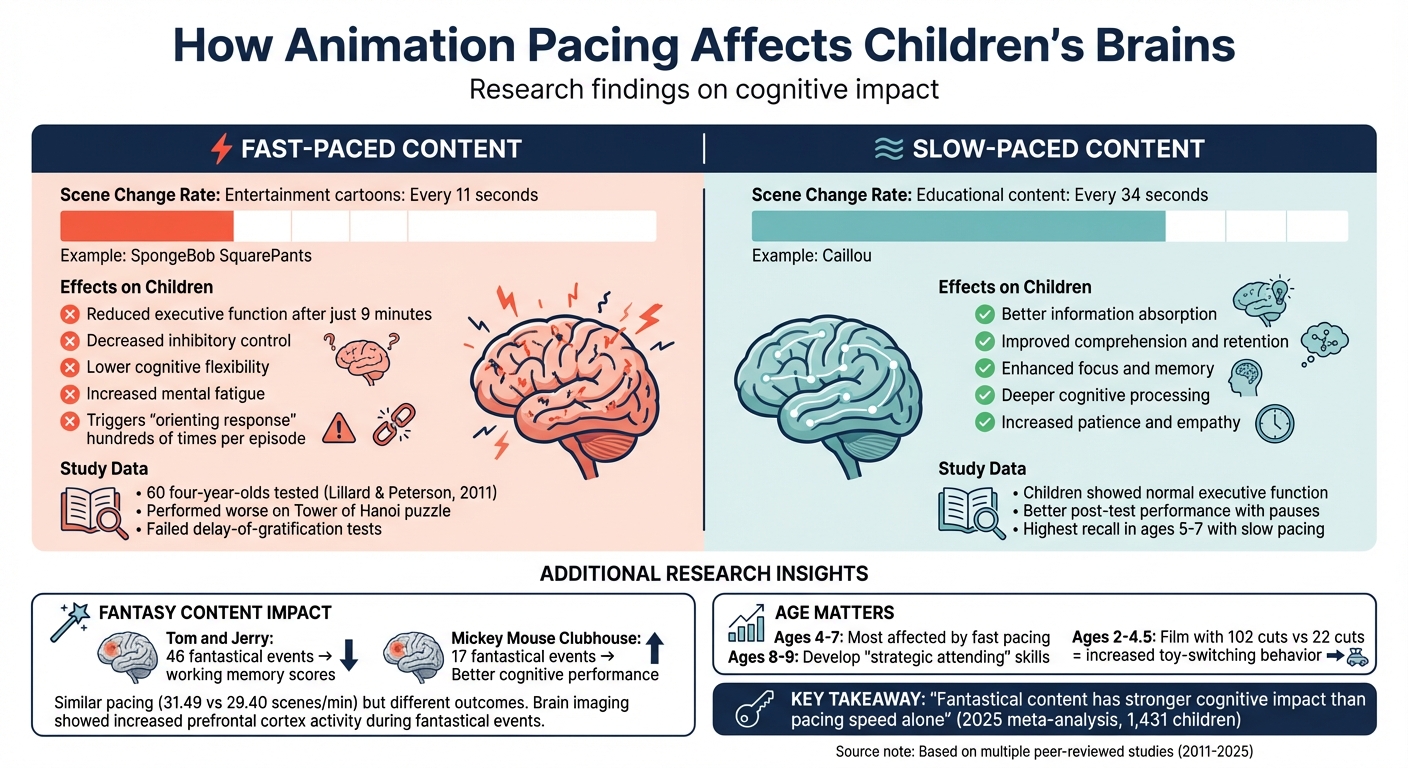
How fast-paced and slow-paced animation compare in the research on children's attention, comprehension, and self-regulation.
Fast Pacing vs. Slow Pacing
Here is a simple way to think about it.
Fast-Paced Cartoons
Fast-paced cartoons often include:
- Quick scene changes
- Constant movement
- Loud sound effects
- Rapid jokes
- High-energy music
- Big emotional swings
- Lots of surprise and novelty
These shows can be entertaining and attention-grabbing. They may work better for older children who can follow more complex visual information. But for younger kids, fast pacing can sometimes make the experience feel overstimulating.
A child might seem glued to the screen, but afterward they may have a harder time calming down, transitioning, or explaining what happened in the story.
Slow-Paced Cartoons
Slower-paced cartoons often include:
- Longer scenes
- Clearer story steps
- More repetition
- Softer transitions
- Calmer dialogue
- Pauses after important moments
- More time to understand emotions
These shows may be better for bedtime, quiet time, or learning-focused screen time because they are easier to process. They also give parents more natural openings to ask questions like, "How do you think the character feels?" or "What would you do next?"
Pacing Is Not the Only Thing That Matters
A calm show can still be low-quality. A fast show can still be creative and age-appropriate. Pacing matters, but it should not be the only thing parents look at.
Also consider:
1. Story Clarity
Can your child explain what happened after watching?
If the show is too chaotic, your child may remember the loudest moments but miss the actual story.
2. Emotional Tone
Does the show leave your child calm, curious, and engaged? Or does it leave them agitated, wound up, or upset?
Every child is different, so your child's reaction matters.
3. Educational Value
Does the show teach something meaningful, or is it mostly endless stimulation?
Educational value does not have to mean letters and numbers. It can also mean kindness, patience, problem-solving, emotional awareness, or creativity.
4. Parent Involvement
The American Academy of Pediatrics encourages families to think about media quality, context, and co-use—not just screen time minutes. Watching together and talking about what happened can help children learn more from media. You can read the AAP's policy statement on children and digital media.
5. Autoplay and Algorithmic Feeds
Even good content can become a problem when autoplay keeps pushing children from one video to the next.
For young kids, a clear beginning and end is usually better than an endless feed.
Signs a Cartoon May Be Too Fast for Your Child
A show may be too intense for your child if you notice patterns like:
- They seem unusually hyper after watching
- They struggle to transition away from the screen
- They cannot explain what happened in the story
- They copy aggressive or chaotic behavior from the show
- They become frustrated when the screen turns off
- They ask for "just one more" repeatedly because the content never feels complete
- They seem tired or irritable after watching
One episode does not tell you everything. Look for repeated patterns.
A helpful parent question is:
"How does my child act in the 20 minutes after watching this?"
That answer often tells you more than the show's rating or thumbnail.
What Parents Should Look for in Kids' Animation
Here are practical signs of healthier animated content.
Clear Story Structure
Look for stories with a beginning, middle, and end.
A clear structure helps kids follow what is happening and remember the lesson.
Calm Transitions
Transitions do not need to be boring, but they should not feel like constant sensory overload.
Shows with softer scene changes, repeated songs, or gentle pacing can be easier for younger children.
Meaningful Pauses
Good kids' animation often pauses long enough for a child to understand the moment.
A pause after a character feels sad, solves a problem, or learns something gives children time to process.
Age-Appropriate Conflict
Conflict is part of storytelling, but it should match your child's age.
For younger kids, small problems like losing a toy, feeling nervous, or learning to share can be more useful than intense danger or nonstop chaos.
Creative Participation
The best screen time does not only ask kids to watch. It invites them to think, talk, imagine, and create.
That might mean:
- Answering a question
- Predicting what happens next
- Drawing a character after the episode
- Acting out a scene
- Making up a new ending
- Creating their own story afterward
How to Make Screen Time More Thoughtful
You do not need to perfectly analyze every cartoon your child watches. A few small habits can make a big difference.
Watch the First Episode Yourself
Before making a show part of your routine, watch a few minutes.
Ask yourself:
- Is it easy to follow?
- Is it too loud or frantic?
- Does it have a real story?
- Is the humor age-appropriate?
- Does it leave space for conversation?
Use "One Episode" Instead of Autoplay
Choose a defined episode or story, then stop.
A clear ending helps children transition more easily than an endless video feed.
Ask One Question After Watching
Keep it simple:
- "What was your favorite part?"
- "What did the character learn?"
- "How did the character feel?"
- "What would you do next?"
This turns passive watching into active thinking.
Match Pacing to the Moment
Fast, silly, high-energy content may not be the best choice right before bed.
For bedtime, quiet time, or after school decompression, choose slower content with softer pacing.
Create Something After Watching
After a show, invite your child to draw a character, tell a new ending, or act out the story with toys.
This helps screen time turn into imagination instead of stopping at consumption.
Where Pixley Fits
Pixley is built around creative, parent-guided screen time.
Instead of putting kids in front of an endless feed, Pixley helps children turn their drawings and ideas into personalized animated stories. Parents can guide the theme—like kindness, courage, patience, early reading, math, or curiosity—while the child stays involved as the creator.
That matters because the goal is not just to hold attention. The goal is to give children a story they can understand, talk about, and feel connected to.
A child who draws a brave turtle, a flying panda, or a moon bear is already thinking creatively. Pixley helps turn that idea into an animated story that can feel more personal and meaningful than random autoplay content.
For families thinking about pacing, Pixley fits best as part of a calmer, more intentional routine:
- Start with the child's idea or drawing
- Choose a simple theme
- Watch together when possible
- Ask what the character learned
- Let the child create the next episode idea
That makes screen time feel more like storytelling and less like scrolling.
A Parent Checklist for Cartoon Pacing
Before choosing a show, ask:
Attention
- Can my child follow what is happening?
- Are scenes changing too quickly?
- Does the show rely on constant noise or surprise?
Comprehension
- Can my child explain the story afterward?
- Is there a clear problem and resolution?
- Are the characters' emotions easy to understand?
Regulation
- Is my child calm after watching?
- Is it easy to transition away?
- Does the show work for the time of day?
Learning
- Does the story support a useful idea?
- Does it encourage empathy, creativity, language, or problem-solving?
- Can I ask a simple question about it afterward?
Control
- Is there a clear end?
- Can I avoid autoplay?
- Is the content age-appropriate and parent-approved?
If most answers are yes, the show is probably a better fit.
Watch: More on Screen Time and Kids' Content
For more perspective on choosing healthier animated content, watch this short video:
Final Thoughts
Pacing is one of the easiest things to overlook in children's animation.
A cartoon can look cute and still move too quickly for a young child to process. Another show might look simple but give children more time to understand emotions, follow the story, and remember the lesson.
The goal is not to avoid all exciting cartoons. Kids love energy, humor, and surprise. The goal is balance.
Choose content that matches your child's age, mood, and routine. Watch how they act afterward. Prefer stories with clear structure, meaningful pauses, and room for imagination.
The best screen time does not just keep kids busy. It helps them think, feel, create, and connect.
FAQs
What is cartoon pacing?
Cartoon pacing is the rhythm of an animated show. It includes how quickly scenes change, how fast the story moves, how much action happens at once, and how much time children have to process each moment.
Are fast-paced cartoons bad for kids?
Fast-paced cartoons are not automatically bad, but some studies suggest they may temporarily affect young children's focus and self-control after viewing. The child's age, the content, the time of day, and whether a parent is involved all matter.
What is a good cartoon pace for preschoolers?
For preschoolers, slower stories with clear scenes, repeated ideas, softer transitions, and simple emotional moments are often easier to follow than shows with rapid cuts and constant action.
Does fantastical content matter more than pacing?
Some research suggests fantastical content can also affect how much mental effort children use while watching. Very unrealistic or chaotic stories may be harder for young children to process, especially when combined with fast pacing.
How can I tell if a show is too overstimulating?
Watch how your child acts afterward. If they seem unusually hyper, irritable, unable to transition, or unable to explain what happened, the show may be too intense for that moment or age.
How can Pixley support better screen time?
Pixley helps kids turn drawings and ideas into personalized animated stories. Parents can guide the theme, and children stay involved as creators, which can make screen time feel more intentional and creative.
Keep Reading
- Age-Appropriate Digital Stories for Kids: Parent Guide
Learn how to choose age-appropriate digital stories for kids, with tips for story length, pacing, safety, co-viewing, and creative screen time.
- Teaching Visual Metaphors With Cartoons: A Parent and Teacher Guide
Learn how to teach visual metaphors to kids using cartoons, comic panels, drawings, and personalized stories. Help children connect images to feelings and ideas in simple steps.
- How Stories Build Emotional Intelligence in Kids
Learn how stories build emotional intelligence in kids by helping them name feelings, practice empathy, and build calm responses through reading, role-play, and Pixley.
- All parenting & screen-time guides →