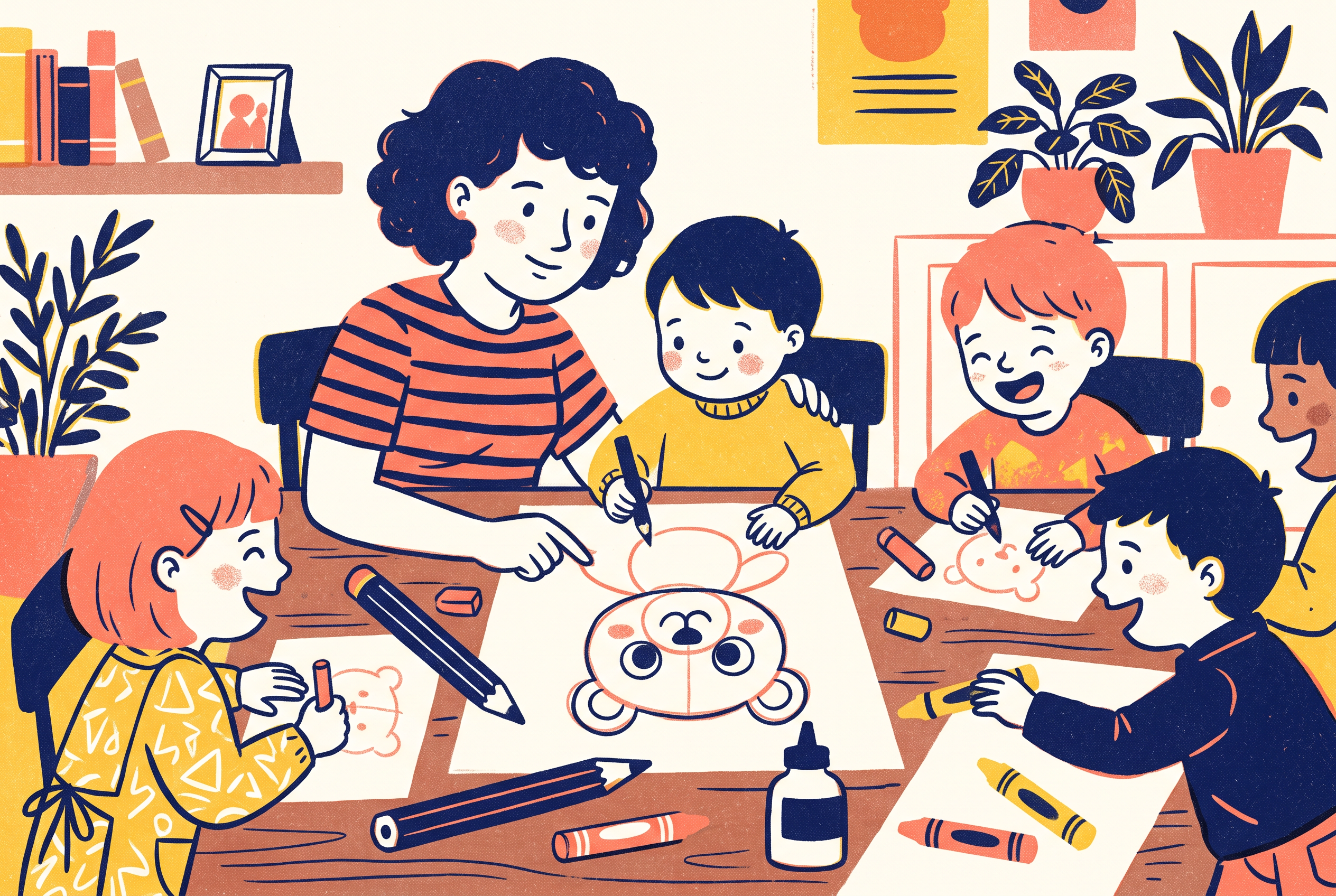
How to Draw a Cartoon Character With Kids: 6 Easy Steps
Learn how to draw a cartoon character with kids ages 2-8. Follow six easy, child-led steps that keep drawing fun, build confidence, and spark new stories.
 Pixley Team
A child sits at the kitchen table with a fresh sheet of paper and a blue crayon. Within thirty seconds, they draw an uneven purple potato with three uneven eyes and declare it a space dog. Most adults feel an immediate urge to reach in, smooth the curved line, or place the ears where canine ears belong. Resist that urge.
Learning how to draw a cartoon character with kids is not about teaching perspective or anatomy. It is about letting a child put an internal spark on paper without an adult correcting their vision. You need two blank sheets of plain white paper, a handful of washable markers or crayons, and fifteen minutes of undivided attention. Play assistant instead of art teacher and the creative momentum stays in your child's hands. You end up with a character that is ready for stories, games, or digital animation.
Step 1: Set up paper, crayons, and one rule: the child's lines stay
Before anyone draws a single mark, lay out two separate sheets of paper side by side. Place one in front of your child and one directly in front of you. Your own paper removes the unconscious reflex to grab their page and sketch over their work. Offer a handful of blunt crayons or chunky markers. Fine-tip technical pens frustrate young hands, while broad-tip tools encourage bold strokes.
Set one non-negotiable rule for the session: the child's lines stay. Erasers do not belong at this table. If a marker slips across the page or a circle turns out like an egg, that line is now a permanent, valid feature of the creature. Erasing signals that a mistake happened, which triggers performance anxiety in toddlers and preschoolers. When a mark goes sideways, treat it as an unexpected design choice. That wandering streak becomes an antenna, a tail, or a lightning bolt. Setting this expectation early builds creative resilience. It also fits the stages of drawing development in children, where mark-making is an exploration of physical motion, not literal representation.
Step 2: Pick a character idea from your child (use a prompt if they're stuck)
Don't decide what the two of you are drawing. Hand the steering wheel to your child. Ask open questions like 'Who is visiting our table today?' or 'What kind of animal has never been seen in the world before?' Ask a four-year-old what they want to make and they might shout 'a flying pancake monster.' That is your character.
If your child freezes or says they don't know what to draw, resist the urge to assign an obvious cartoon like a standard cat or rabbit. Use an absurd combination prompt instead: a favorite food mashed together with an animal, or a regular household object with animal legs. A taco with duck feet, a toaster that shoots rainbows, or a bear made of strawberry jelly will all get things moving. You can also pull ideas from our list of drawing prompts for kids. The more ridiculous the premise, the less pressure the child feels to make it look realistic. A toaster with legs has no correct anatomy to mess up.
Step 3: Let your child start with their own shapes (circles, blobs, scribbles)
Professional animators begin every character design with basic silhouettes. The same trick works at home. Ask your child to pick one color and lay down the main body shape in the center of their paper. It can be a circle, a square, an oval, or a wandering scribble blob.
Toddlers between ages 2 and 4 will produce jagged loops or tangled nests of crayon marks. That tangle is the body. Children between ages 5 and 8 might deliberate between a peanut shape or a triangle. Whatever lands on the paper is the foundation. Don't redraw their wobbly outline to make it rounder. In character design, asymmetry is what gives animated figures charm. SpongeBob is an irregular rectangle, and Barbapapa is a literal blob. Your child's organic, imperfect outline gives the character an original silhouette that a polished adult sketch can't match.
Step 4: Ask questions that add personality instead of fixing proportions
Once the main shape sits on the page, adults often ask prescriptive questions: 'Where is the mouth?' or 'Doesn't he need two ears?' Shift your language away from inventory and toward story. Personality questions spark creative thinking without implying the drawing is missing standard parts.
Ask: 'How does this creature see in the dark?' If they say it uses six glowing eyes, let them add six dots wherever they like. Ask: 'What does this character use to grab snacks from high shelves?' They might draw three spaghetti-thin arms on one side and zero on the other. Ask: 'Is this friend fast or slow?' A fast creature might need giant feet, wheels, or tiny wings. If your child hesitates or shows self-doubt, our guide on what to do when your child says I can't draw has useful phrasing for those moments. Focus on function and mood instead of symmetry, and you back up their world-building instincts.
Step 5: Draw alongside them on your own paper, and take turns adding details
Keep your hands on your own paper. Parallel play works well for kids under age eight. As your child adds features to their page, echo those ideas on your sheet, or draw a companion character who lives in the same world. If your child gives their monster three zigzag horns, you can draw a smaller creature on your page with one curling horn.
Turn the session into a turn-taking game. Say, 'You pick a feature for my friend, and I will pick one for yours.' They might tell you to give your creature roller skates. You might ask, 'Does your character wear a hat or have leaves growing out of its head?' This back-and-forth keeps the energy high and stops the child from abandoning the drawing midway. It also shows how artists build visual interest through accessories, patterns, and clothing, and you never touch their pencil. Both drawings stay distinct, but they now belong to the same universe.
Step 6: Name the character and give it one thing it loves and one thing it fears
A drawing becomes a character the moment it has an inner life. Once the colors and lines are finished, interview your child about who this creature is. Grab a pen and write their exact answers in the corner of their paper. Kids love seeing their spoken words recorded next to their art.
Ask three specific questions. What is this character's name? What is one thing this character loves eating or doing? What is one thing that makes this character nervous or scared? Those three answers give you an emotional arc right away. A monster named Barnaby who loves blueberry pancakes but is terrified of loud vacuum cleaners is no longer just wax on construction paper. It is a protagonist. You now have everything you need for a bedtime story, roleplay with toys, or a move into digital media.
What to do next: animate the drawing, build a story, or collect characters into a book
Don't let the finished drawing disappear into an overstuffed art bin. When children see their creations recognized and used, their creative confidence jumps. You have several clear paths for the finished artwork.
First, gather several drawings over a month and staple them into a personalized storybook or comic strip. Second, make the character the star of an oral bedtime tale tonight, weaving the creature's favorite foods and fears into a twenty-minute adventure.
Third, convert the flat drawing into interactive digital media. Apps like Pixley are built for this. Pixley turns kids' drawings and ideas into personalized animated cartoons, bedtime storybooks, and learning games for children ages 2 to 8. Parents can upload their child's hand-drawn character, describe a real-life lesson they want taught, and Pixley creates a custom cartoon episode around it. It's available on iOS with a free trial, and every generation passes child-safety filtering before a child sees it. It's also ad-free, and it shows your child that their hand-drawn creations can come to life.
Conclusion
Drawing with young children works best when adults drop the instructional script and act as curious observers. Preserve their original marks, ask about motivation instead of anatomy, and anchor the creature with distinct likes and fears. Your child learns that their ideas carry weight.
Take your child's newly drawn cartoon character and bring it into your daily routine. You can explore how to animate your child's drawing at home, or download Pixley on iOS to see that exact crayon sketch move, speak, and solve problems in a safe cartoon episode made just for your family.
Frequently Asked Questions
How do I teach a 3 year old to draw a cartoon character?
Do not focus on realism. For a 3-year-old, start with basic scribbles or a closed circular blob for the body. Ask them where the eyes belong and let them place dots anywhere on the page. Cartoon characters do not need correct proportions; simple shapes with facial features are enough to build a recognizable character.
What if my child gets frustrated when their drawing looks messy?
Remind them that cartoon characters are supposed to look weird, exaggerated, and funny. Point out famous animated figures with unusual shapes. Eliminate erasers from the table so there is no pressure to fix mistakes, and immediately turn unexpected stray lines into funny accessories like hats, horns, or extra tails.
How can I turn my child's drawing into an actual cartoon?
You can photograph the drawing on your phone and use dedicated creative apps designed for young families. Pixley allows parents to upload children's drawings and ideas to generate animated cartoon episodes, bedtime stories, and games. The platform includes child-safety filtering, contains no ads, and runs on iOS.
Should parents draw on the child's paper to show them how?
No. Drawing directly on a child's paper can make them feel that their own work is inferior or incomplete. Keep a separate sheet of paper in front of yourself. Draw alongside them, showing different shapes or silly additions on your own page while keeping their original drawing 100 percent their own.