When Your Child Says "I Can't Draw": 8 Ways to Rebuild Confidence
When your child says "I can't draw", shift the goal from realistic art to storytelling. Here are 8 simple, parent-guided steps to rebuild creative…
 Pixley Team
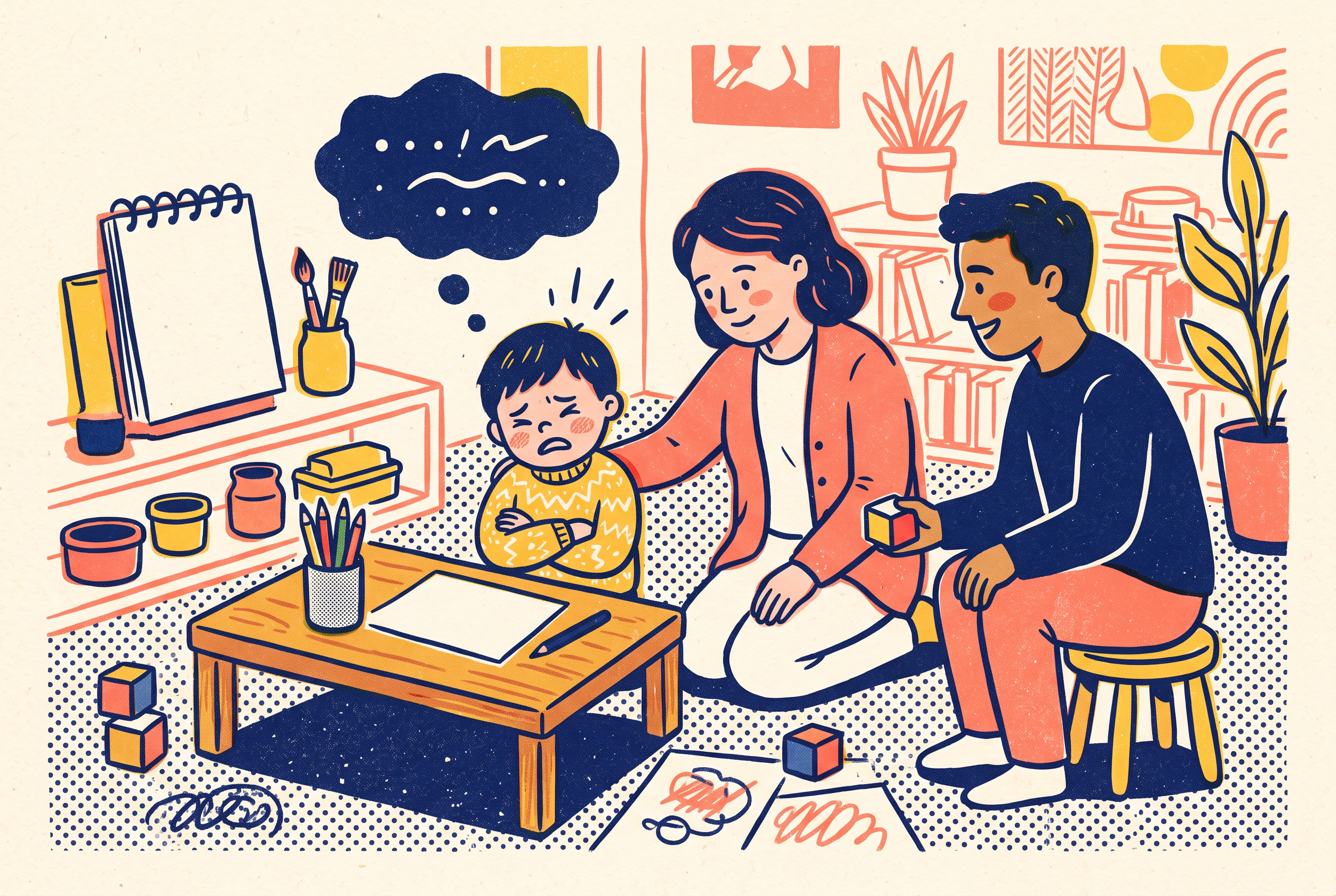
A six-year-old stares at a sheet of paper, drops a red marker, and crosses their arms. "I can't draw a dragon," they announce, eyes welling up. "It looks stupid."
Every parent hears this eventually. When a child says "I can't draw", they are rarely talking about motor control. Their fingers can grip a pencil, make curved lines, and fill a page with color. What broke down was the translation between the vivid, cinematic creature in their head and the flat, wobbly mark on the paper. The child compares the two, decides the drawing failed, and shuts down to protect their pride.
You don't need an art degree or expensive drafting supplies to help. You need a regular sheet of paper, a marker, and a shift in focus. The goal of early childhood drawing isn't realism. It's communication. Reframe a drawing as a story character instead of a technical test, and the pressure disappears.
Step 1: Validate the feeling before you fix it
The instinctive parental reaction to "I can't draw" is immediate contradiction: "Of course you can! That looks wonderful!" It's well-intentioned, and it backfires. The child knows the purple scribble doesn't look like the racehorse in the book. Denying their perception tells them you're either lying to make them feel better or you don't understand what they were trying to do.
Start by acknowledging the frustration. Say: "You had a clear picture in your head, and your hand made something different. That feels annoying." This names the problem without agreeing that they're bad at art. You're validating the gap between what you imagine and what you can make, which every creator feels from age four to eighty.
When children feel understood, they calm down enough to try again. For more on calming these high-stress kitchen-table moments, read our guide on how to help a child handle frustration. Once the emotional temperature drops, you can move from comforting to investigating.
Step 2: Ask what they were hoping it would look like
Don't evaluate the drawing. Ask a question about it: "What was this part supposed to be doing?" or "Where did you want the wings to go?"
Kids get stuck because their mental picture has movement, sound, and backstory that a static page can't hold. A four-year-old drawing a tiger might be upset because the tiger looks stationary, while in their imagination it's leaping over a canyon. Ask about their intention and the conversation moves away from visual accuracy and back to storytelling.
Listen without correcting. If they say, "The legs are too short and it looks like a sausage," respond with curiosity: "Is this sausage-dog fast or slow? Can he sneak under fences?" Treat the perceived flaw as a design choice, and a failed attempt becomes an interesting subject.
Step 3: Swap "it's beautiful" for specific, process-based praise
Broad praise creates performance anxiety. Research on child development and motivation (Carol Dweck, 2006) shows that calling children "smart" or "talented" makes them risk-averse. When an adult says "That drawing is beautiful!" the child wonders what happens if the next one looks messy. Will the parent still approve?
Replace evaluation with observation. Name the specific choices your child made on the paper:
"You used three different blues to make that water look deep."
"You pressed down hard with the black crayon to make those heavy outlines."
"You worked on those wheels for five straight minutes until you liked the circles."
Observation proves you're paying attention. It values effort, persistence, and experimentation over an arbitrary standard of how a drawing should look. When praise focuses on effort, kids keep trying after a mistake.
Step 4: Make the first step tiny (a circle, a squiggle, a dot)
A pristine white sheet of 8.5x11 paper is intimidating. When a child says "I can't draw", the emptiness of the page often causes paralysis. Remove the hurdle by shrinking the first move.
Hand your child a marker and ask for something absurdly simple: "Draw one crooked squiggle right in the middle." Once the line is down, the blank page is broken. Then play a turn-taking game where each of you adds one element. You draw a lumpy oval; they add two dots for eyes. You add four uneven sticks for legs; they draw a zigzag tail. The pressure to produce a finished, realistic horse is gone, replaced by an improv game.
If you need structured prompts to get started, try our list of drawing prompts for kids. Breaking a drawing into low-stakes shapes teaches the hand that complex pictures are just collections of small, manageable marks.
Step 5: Draw next to them, wobbly lines included, and skip the corrections
Never take the crayon out of your child's hand to "fix" their line. Grabbing the tool confirms their worst fear: that their work was wrong and only an adult knows how to do it properly. If your child asks you to draw for them ("You do the dinosaur, Daddy, I can't"), gently refuse and take your own sheet of paper.
Sit beside them and draw your own dinosaur, but make it visibly imperfect. Model self-compassion out loud. Say: "Look at my dinosaur. One leg is giant and the other looks like a toothpick. He's definitely going to stumble into that bush." Laugh at your own crooked lines.
Children watch how adults handle mistakes far more closely than they listen to lectures. When they see a parent accept an uneven line without erasing it, they learn that a drawing doesn't have to be symmetrical to exist. Drawing side by side gives them company without competition.
Step 6: Ask "who is this?" and turn the drawing into a character
Here's the reframe: a drawing doesn't need to look right to work as a character. A lopsided circle with two mismatched dots is a terrible sports car. It's also a perfectly good space monster named Barnaby who eats purple rocks.
Stop asking "What is that?" and start asking "Who is this?"
Give the doodle an identity. Ask questions that build an inner life for the creature on the paper:
"What does this character eat for breakfast?"
"Are they clumsy or super fast?"
"What makes them laugh?"
"Where do they sleep at night?"
Once a drawing has a personality, technical perfection stops mattering. Charles Schulz drew Charlie Brown with a circle for a head and a curl for hair. The appeal was the character, not the anatomy. In our own work building Pixley, we see this shift every day. Pixley turns kids' drawings and ideas into personalized animated cartoons, bedtime storybooks, and learning games. When a four-year-old watches their lopsided, three-legged green blob dance across a screen, they stop worrying about whether the feet were drawn correctly. The drawing worked because it came alive.
Step 7: Put that character in a short story starring your child
Once the character exists, put it in motion with a three-beat story. You don't need a novel. A simple conflict-and-resolution arc told out loud over three minutes gives the drawing a job to do.
Build the story around your child and their new creation:
Setup: Your child meets the character in a familiar place (the backyard, the grocery store, under their bed).
Problem: The character loses something or runs into a small challenge.
Resolution: Your child and the character team up to solve it.
For a detailed breakdown, read our walkthrough on how to turn child drawing into a story. The story closes the gap between drawing and imagination. It shows the child that their drawing wasn't a failed piece of paper. It was the start of an adventure they made up.
Parents can also use Pixley for this step. On Pixley, parents describe any lesson they want taught, and the platform creates a cartoon episode around it, covering Social and Emotional Learning goals or educational topics. When kids see their own hand-drawn friend teaching them about sharing or bravery, they get a lot more willing to sit down and draw another character.
Step 8: Keep a character gallery and bring the characters back, plus what to do next
Don't throw drawings away in front of your child, and don't shove them into a folder nobody opens. Tape them to a dedicated "Character Wall" in their bedroom or the hallway. A permanent home tells them the work mattered.
Then bring those characters back into tomorrow's play. At bedtime, say: "Remember Barnaby, the purple-rock monster you drew yesterday? What if Barnaby met a tiny robot tonight? What would that robot look like?"
That one question turns the next drawing session into a continuation of a growing universe instead of a brand-new test of skill. Drawing becomes world-building.
What to do next: Leave low-barrier supplies within arm's reach. Swap thin copy paper for heavyweight construction paper or cardstock that can take heavy marker ink without bleeding. Offer chunky markers, crayons, or oil pastels that reward bold strokes, and skip thin mechanical pencils that invite erasing. Keep sessions short. Ten minutes of enthusiastic character creation beats forty minutes of frustrated perfectionism every time.
Conclusion
When your child says "I can't draw", they're asking permission to quit an adult standard they can't meet. Move from visual realism to character-driven storytelling, and you take the pressure off their hands and put the power back in their imagination.
If you want to show your child how much their ideas are worth, try Pixley on iOS with a free trial. Built for kids ages 2 to 8, Pixley turns your child's drawings into safe, ad-free animated cartoons and bedtime storybooks. Every generation passes child-safety filtering before your child sees it, so a simple marker doodle can star in its own show.
Frequently Asked Questions
Why does my 5-year-old say they can't draw?
Around age four or five, children develop self-criticism. They start comparing the complex, moving images in their mind with the flat marks on paper. When their fine motor skills cannot reproduce the realistic image they imagine, they feel frustrated and declare they cannot draw at all.
Should I draw pictures for my child if they ask?
Avoid drawing the picture for them. Taking over signals that their attempt was inadequate and confirms that adults do it better. Instead, draw beside them on a separate piece of paper. Draw goofy, imperfect shapes so your child sees that drawing is about exploration, not perfection.
How can I encourage a perfectionist child to draw?
Remove erasers and pencils, which invite endless fixing. Offer bold markers, oil pastels, or crayons on textured paper. Play collaborative games where mistakes are part of the fun, like scribble-drawing games or turning an accidental smudge into a brand-new character with a name and backstory.
How does Pixley help kids who are frustrated with drawing?
Pixley turns kids' drawings and ideas into animated cartoons and storybooks for ages 2-8. When children see their wobbly doodles come to life as characters in safe, ad-free animated episodes, they learn that a drawing does not have to look photorealistic to be powerful and fun.