What Colors in Kids Drawings Mean: Guide for Ages 2-8
Wondering what colors in kids drawings mean? Learn why children ages 2 to 8 pick black, purple, or single colors, and how Pixley turns art into cartoons.
 Pixley Team
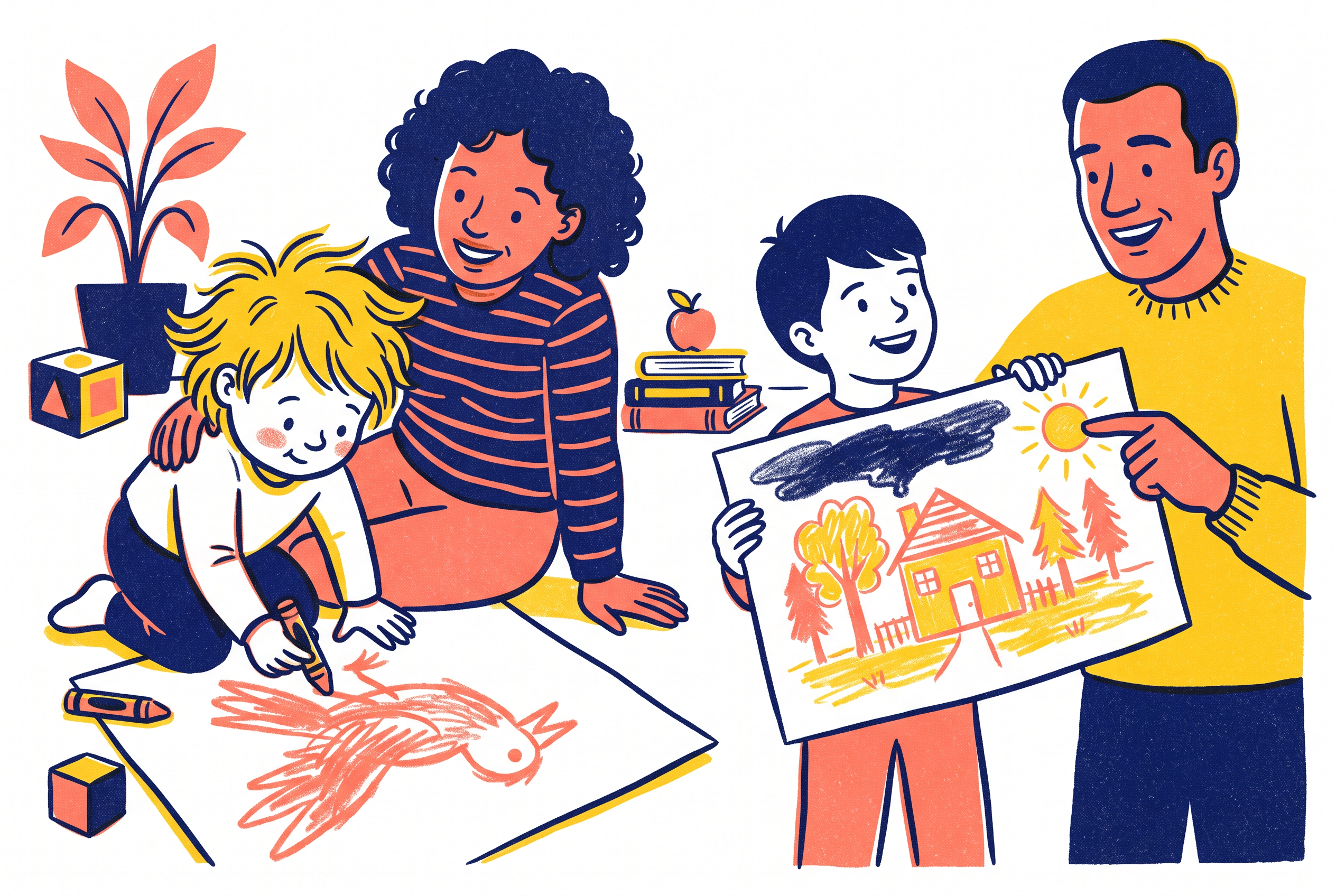
A four-year-old hands you a sheet of construction paper with a family portrait drawn entirely in thick black wax crayon. The heads are scribbled dark, the bodies are jagged black lines, and the sun in the corner is shaded charcoal gray. Many parents freeze. The immediate fear is that the drawing signals hidden anger, depression, or distress.
Color choices in early childhood art rarely work like a secret code. Parents who search for what colors in kids drawings mean usually land on outdated pop-psychology charts that treat red as aggression, blue as depression, and yellow as joy. Those charts don't match how young minds work.
For children between the ages of 2 and 8, a crayon is a sensory tool, not a diagnostic test. Kids pick colors based on hand convenience, visual contrast, brand-new motor skills, and sudden personal obsessions. If you want to understand your child's drawings, look at their developmental stage and physical environment before you try to interpret their psychology.
Short answer: usually less than you think
Color choice in early childhood drawings says far less about emotional pathology than popular culture suggests. Visual development research shows that while children can use color symbolically, developmental experts caution against treating their color choices as simple indicators of emotion. A child using a black marker is usually not expressing sadness. That child is enjoying the sharp contrast of dark ink on clean white paper.
When researchers ask children why they picked a particular hue, the most common answer is simple: it was the brightest option, it made the clearest line, or it happened to sit on top of the pile.
Clinical researchers who analyze children's artwork for emotional patterns never rely on single colors in isolation. They look at behavior across multiple sessions, structural changes over months, and the child's own storytelling. Treating one drawing as a psychological test only creates parental anxiety.
Treat color choice as a record of how your child physically handled their materials. When your toddler scribbles an all-black blob, they are testing motor force and mark-making. They are not filing a report on their mental health.
How color use changes from ages 2 to 8 (scribbling, early symbols, color rules)
A child's relationship with color follows predictable cognitive markers. Knowing the stages of drawing development in children keeps your expectations grounded as their artwork moves from wild marks to realistic scenes.
Between ages 2 and 3, children are typically in the scribbling stage. Motor control dominates. A toddler grabs whatever crayon fits comfortably in a palmar grasp, and color has no symbolic link to objects. If a two-year-old picks red, they care about the physical trail the wax leaves, not whether it's an apple or a fire truck. Switching colors at this stage usually just means a crayon hit the floor.
Between ages 4 and 5, children enter the early symbolic stage. Simple forms appear: circles with radiating sticks for people, animals, and houses. Color is still expressive and non-literal. A child might draw a purple horse, a green mother, and a turquoise sun because those colors appeal to them in that moment. Aesthetic preference beats real-world observation.
Between ages 6 and 8, children reach the schematic stage. The brain now sorts the visual world into defined categories. Grass must be green, the strip of sky at the top of the page must be blue, and tree trunks must be brown. When an eight-year-old breaks those rules, it's usually on purpose, to depict an alien landscape or test color contrast. Realism becomes a self-imposed challenge instead of an accident.
Why kids pick the colors they do: availability, favorites, mood and the task
If color doesn't point to deep subconscious conflict, what actually governs your child's palette on a Tuesday afternoon? Four practical factors drive almost every color selection between ages 2 and 8.
First, physical availability. Young children show a strong proximity bias. They often reach for whichever marker sits closest to their hand on the table. If the navy crayon sits at the front edge of the tray, the dog will be navy. If the blue marker rolled under the table, the ocean turns yellow.
Second, favorite-color phases, which start around age 3. A four-year-old who decides orange is their favorite will draw orange trees, orange parents, orange bread, and orange rain for three straight weeks. That reflects developing identity and agency, not distress.
Third, physical energy. A child back from the playground with low energy might sit down and pick muted, light colors with gentle pressure. A child bursting with energy often reaches for saturated, heavy colors like black, bright red, or dark purple, because pushing them onto paper feels good.
Fourth, the task itself. A child racing to finish a drawing before dinner will grab one crayon to complete the outline fast instead of pausing to swap shades. Convenience beats realism every time.
Common color questions: purple grass, all-black pictures, one color only, and no color at all
Parents tend to worry about four specific color anomalies on the page. Each has a mechanical or cognitive explanation that has nothing to do with anxiety.
All-black drawings: A page filled with dense black marks usually reflects fascination with opacity. Black marker ink completely masks the white paper beneath it, and that total coverage gives children a strong sense of cause and effect. Kids also learn early that black markers make sharp, readable outlines that don't smudge as easily as light yellow or pink.
Purple grass and orange skies: Preschoolers don't share the adult belief that art must imitate nature. Between ages 3 and 5, children treat color as an arbitrary decorative element. A child who colors grass purple may simply dislike green, or their green crayon may have snapped in half five minutes earlier.
Monochrome drawings: When a child draws an entire picture with one green pencil, they are showing cognitive momentum. Putting down one tool, opening a box, picking another shade, and resetting their grip breaks their flow. Staying with one color lets them keep drawing without losing concentration.
Line drawings with zero color: Many children between ages 5 and 8 skip coloring entirely and focus on line work with a ballpoint pen or regular pencil. They are exploring form, edges, and structural detail. Filling in large background areas feels repetitive and tedious, so they leave the page white.
Conversation prompts that work better than guessing
Guessing what a drawing means puts kids on the defensive. A question like "Why did you make the baby so dark and sad?" drags adult anxieties into a child's creative space. If you want to understand your child's thinking, swap speculation for observation.
Instead of interpreting colors, describe what you see: "I notice you put a lot of dark lines right in the middle of this page." That gives the child room to explain the mechanics of the drawing without feeling judged. They might tell you the dark spot is a storm, or that they wanted to see how hard they could press before the crayon snapped.
Here are four prompts that consistently lead to real conversations:
"What is happening in this part of the picture?" "How did you decide which colors to use for this creature?" "Which part of this page was the most fun to make?" "Tell me the story behind these shapes."
These open-ended invitations move the focus from color diagnostics to creative narrative. To go further with that, you can turn your child's drawing into a story built around their original ideas. Children love explaining their visual choices when they know you're curious about their process and not grading their accuracy.
Four at-home color activities for ages 2-8
You don't need an art degree to help young children build a healthy, expressive relationship with color. These four low-prep exercises focus on motor development, visual contrast, and creative decision-making.
The Two-Crayon Limitation: Hand your child a sheet of paper and exactly two contrasting crayons, such as dark blue and light yellow. Dropping the chaos of a 64-crayon box cuts decision fatigue and pushes the child to think about shape, contrast, and balance. Drawing becomes a focused exercise in line weight.
The Mixed-Up World Game: Ask your child to deliberately choose the wrong colors for everything. Grass becomes red, apples become blue, and snow becomes hot pink. This loosens rigid rules for children in the schematic stage (ages 6 to 8) and shows that art is a playground for imagination, not an obedience test.
Texture Rubbing Investigations: Peel the paper wrappers off several broken crayons. Place flat textured objects under regular printer paper: coins, fallen leaves, corrugated cardboard, or window screens. Have your child rub the wide side of the crayon over the paper. They practice pressure control and see how color density changes across rough surfaces.
Emotional Swatch Sorting: Lay out four colored index cards (red, blue, green, yellow). Ask your child to place small toys or animal figurines on the color that feels fast, slow, loud, or quiet. You'll quickly see their color associations differ from cultural cliches. A child might link blue with high energy because their favorite race car is blue.
Once your table is covered in finished pages, you'll need a system to manage the volume. For simple sorting methods, see our guide on what to do with your child's drawings.
When a drawing becomes a cartoon character and keeps its colors
When a five-year-old draws a neon green dog with three purple legs and a lopsided red smile, that's not a mistake to fix. It's an original character born from their visual instincts.
Keeping those idiosyncratic color choices builds creative confidence. Pixley turns kids' drawings and ideas into personalized animated cartoons, bedtime storybooks, and learning games, built for ages 2-8, safe and ad-free. The purple-legged dog doesn't get corrected to brown fur or standard canine anatomy. Pixley brings the exact drawing your child made to life on screen, with every jagged line and unconventional crayon choice intact.
Parents get an active role in the storytelling too. Pixley includes parent-guided learning: describe any lesson you want taught and Pixley creates a cartoon episode around it, covering Social and Emotional Learning goals or educational topics. If your child struggles with bedtime routines, sharing toys with a sibling, or taking turns on the playground, their custom-colored creation can model the solution in a personalized show.
Safety is built in from the ground up. Every generation passes child-safety filtering before a kid sees it, so the media is age-appropriate and ad-free. Turning an odd color choice into a moving character tells children their artistic instincts have real narrative value.
Conclusion
Stop treating your child's crayon box like a psychological checklist. A drawing with purple grass, an all-black dinosaur, or a one-color sky is not a cry for help. It's a young mind testing physical pressure, visual contrast, and creative boundaries.
Take that neon-colored creature off the kitchen counter and see where their imagination goes next. Open Pixley on your iPhone or iPad, upload your child's drawing, and turn their unique color choices into a personalized animated cartoon episode today.
Frequently Asked Questions
What does it mean when a child only draws with black?
An all-black drawing usually reflects fascination with contrast and coverage. Black produces the boldest line on white paper with minimal physical pressure. In children ages 2 to 8, choosing black is rarely a sign of sadness or anger unless accompanied by lasting behavioral changes across their daily routines.
Do colors in children's drawings show their personality?
Empirical studies find no consistent link between specific crayon colors and personality traits in young children. Kids choose colors based on physical proximity, current favorite shades, or the novelty of the tool. A child who draws in red today may switch to blue tomorrow simply because the blue crayon is sharper.
At what age do kids start using realistic colors?
Most children begin using realistic colors during the schematic stage around age 6 or 7. At this point, cognitive development prompts them to match green to grass and blue to water. Before age 6, children treat color as an expressive, decorative choice rather than an accurate depiction of reality.
How can I turn my child's colored drawings into an animation?
Pixley turns kids' drawings and ideas into personalized animated cartoons, bedtime storybooks, and learning games for ages 2 to 8. Available on iOS with a free trial, every generation passes child-safety filtering before your child sees it.