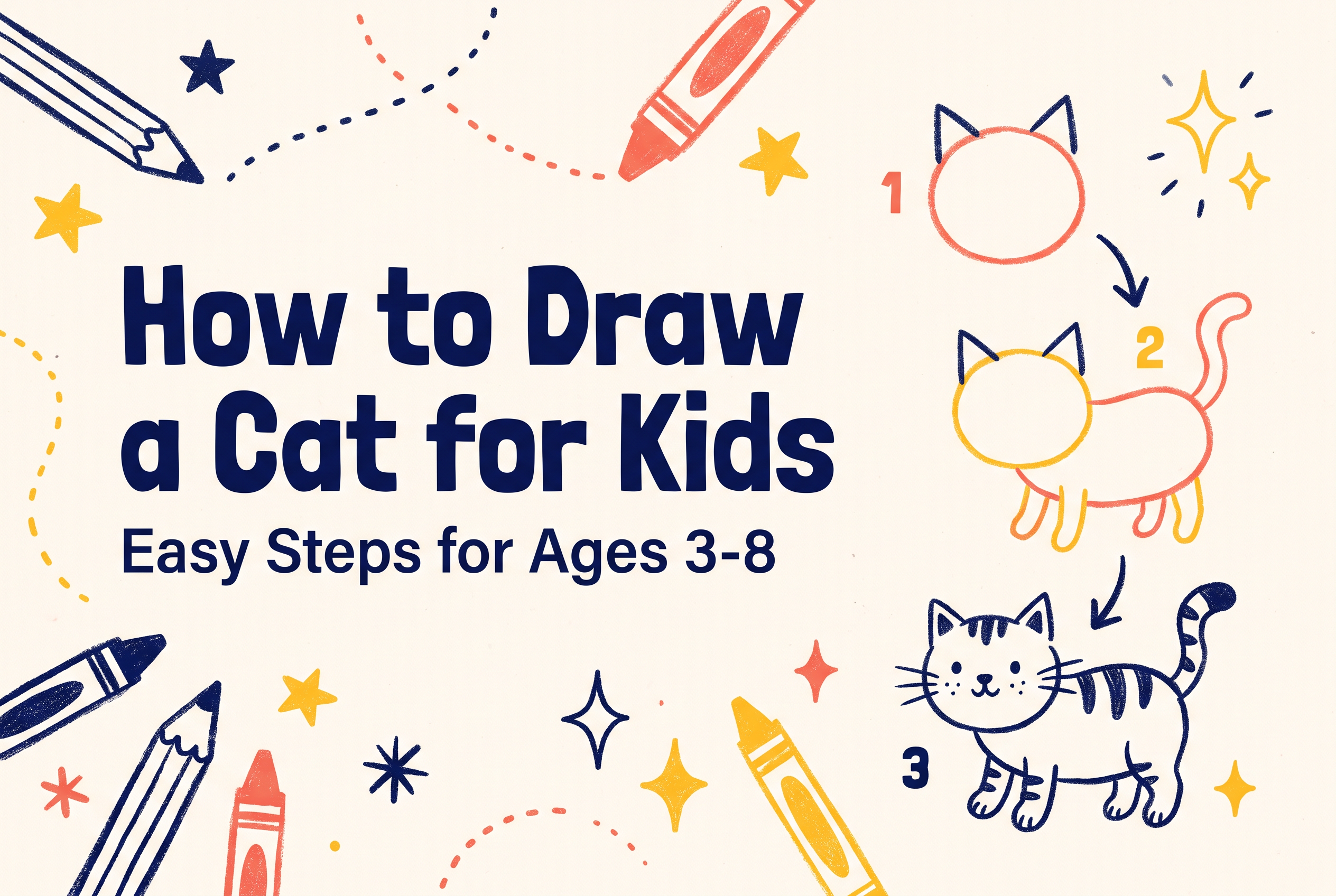
How to Draw a Cat for Kids: Easy Steps for Ages 3-8
Learn how to draw a cat for kids with 8 shape-first steps, an easy circle cat for ages 3-4, a detailed version for ages 6-8, plus ways to name it and start a…
 Pixley Team
The simplest way to draw a cat for kids is to stack three shapes: a big circle for the head, a smaller oval for the body, and two triangles on top for ears. Everything else (whiskers, tail, paws) is a line or a curve added on top, so a child who can draw a circle can draw a cat.
This guide walks through eight easy steps, then splits into an easier circle cat for ages 3-4 and a more detailed version for ages 6-8. After the drawing is done, the fun part starts: giving the cat a name, a mood and a little story. It follows the same format as our dragon, dinosaur and robot tutorials, so if your child liked those, this one will feel familiar.
What You Need Before You Start (and the Simple Shapes Behind Every Cat)
You need paper, a pencil with an eraser, and a few crayons or markers. That is the whole kit. Lighter pencil lines are easier to fix, so start with pencil and trace over with marker at the end if your child likes bold outlines.
Every cat in this tutorial is built from four shapes:
A circle for the head
An oval for the body (lay it on its side for a sitting or walking cat, stand it up for a sitting-tall cat)
Two triangles for the ears
Curved lines for the tail, whiskers and paws
Say these shapes out loud as you draw them. Naming shapes turns the page into a game: "Can you find the circle? Where do the triangles go?" Kids who are nervous about drawing often relax when the job is just stacking shapes.
Sit next to your child and draw your own cat on a separate sheet. Don't draw on theirs. Their cat should look like their cat, wobbly lines and all.
How to Draw a Cat Step by Step: 8 Easy Steps
Here is how to draw a cat in a simple way, one shape at a time. Go slowly and let your child lead the pencil.
Draw the head. Make a big circle near the top middle of the page. It doesn't need to be perfect. A slightly squished circle gives the cat character.
Add the ears. Put a triangle on the upper left of the circle and another on the upper right. The points face up.
Draw the body. Under the head, draw an oval about one and a half times the size of the head. Let it overlap the bottom of the circle a little.
Make the face. Two small circles or dots for eyes, a tiny upside-down triangle for the nose, and a little "w" shape below it for the mouth.
Add whiskers. Three straight lines on each side of the nose. Ask your child how long the whiskers should be. Long whiskers make a fancy cat.
Draw the legs and paws. Two short ovals at the bottom of the body for front paws, and a curved bump on each side for back legs.
Add the tail. A long curvy line from the back of the body. A tail curling up like a question mark looks curious. A tail drooping low looks sleepy.
Color and decorate. Stripes, spots, patches or all one color. Real cats come in orange, gray, black, white and calico, but a purple cat with rainbow stripes is just as correct.
Step back and look together. If something looks off, that's usually the cat's personality showing up. A lopsided ear belongs to a cat who is always listening.
Easier Version for Ages 3-4: Circle Cat
For ages 3-4, skip the oval body and draw a circle cat: one big circle with two triangle ears, two dots for eyes, a small nose and a few whisker lines. That is a complete cat.
At this age, hands are still building the control needed for small shapes, so keep the steps short and the paper big. A few ways to make it work:
Use a fat crayon or chunky marker. Thick tools are easier to hold and forgive shaky lines.
Do one step, then pause. "Circle for the head. Now two pointy ears." Three or four steps is plenty for one sitting.
Let scribbles count. A scribbled fur texture, or whiskers that go everywhere, is part of the drawing, not a mistake. If your child is still in the scribbling phase, our guide to the stages of scribbling explains what to expect.
Ask questions instead of correcting. "Is your cat happy or sleepy?" works better than "The ears go higher."
A circle cat with a body added later, or never, still reads as a cat to every kid in the room. Praise the choices, not the accuracy.
More Detailed Version for Ages 6-8: Poses, Fur and Whiskers
Kids ages 6-8 can handle the same eight steps and then add the details that make a cat feel alive. Here are four upgrades to try, one per drawing.
Try a new pose. Tilt the body oval to draw a cat stretching, with the front legs reaching forward and the back end up. Draw the body as a loaf shape with tucked paws for a sitting cat. Draw an arched back and puffed tail for a startled one. Posing is where a drawing starts telling a story.
Add fur texture. Instead of coloring flat, use short, quick strokes in the direction the fur grows. Add a fluffier chest by drawing small zigzag lines along the front of the body.
Fix the face. Draw the eyes as ovals with a darker pupil inside, and leave a tiny white dot as a highlight. Add inner ear triangles in a second color. Give the nose a short line down to the mouth.
Add a background. A window ledge, a basket, a fish bowl, a ball of yarn. Objects give the cat something to do. If your child enjoys this stage, try the ideas in our drawing prompts for elementary students.
By this age, kids often notice when a drawing doesn't match what is in their head. Remind them that artists redraw. Try the same cat three times and pick a favorite. The third cat is almost always the confident one.
Give Your Cat a Name, Feelings and a Personality
A finished drawing becomes a character the moment it gets a name. Ask your child what the cat is called, and accept the answer, however silly. "Mr. Noodle" and "Sparkle Toes" are both great names.
Then build the personality with a few simple questions:
What does your cat love? Tuna, naps, chasing shadows, stealing socks.
What is your cat scared of? The vacuum, thunder, the neighbor's dog.
How is your cat feeling right now? Draw the face again with a different mood: eyebrows down for grumpy, big round eyes for surprised, a wide curved mouth for happy.
What is your cat's special talent? Climbing, singing, finding lost things.
Feelings are the useful part. When a child draws a scared cat or a grumpy cat, they're practicing naming emotions in a safe, pretend setting. You can ask, "What would help Mr. Noodle feel better?" and get a real conversation without it feeling like a lesson.
If your child likes colors for mood, our guide to what colors in kids' drawings mean is a gentle read, though a blue cat is mostly just a blue cat. For a whole-family version of this game, see the family drawing activity for making story characters.
Turn the Cat Drawing Into a Story (or a Cartoon With Pixley)
Once your cat has a name and a personality, a story needs just one problem. Ask: "What goes wrong for your cat today?" Maybe the cat lost its favorite yarn, or wants to make friends with the dog next door, or is too nervous to jump off the couch.
A simple three-part structure works for any age:
Beginning: Meet the cat and what it loves.
Middle: Something goes wrong or the cat wants something.
End: The cat solves it, or learns something, or gets a cuddle.
Your child can tell it out loud, draw it as a three-panel comic, or staple a few pages together as a little book. Our guide to making a book from your kids' drawings shows how to bind it for bedtime reading.
If you want to see the cat move, Pixley is one way to do it. Pixley turns kids' drawings and ideas into personalized animated cartoons, bedtime storybooks and learning games for ages 2-8. You can describe a lesson you want the story to teach, such as sharing or handling big feelings, and Pixley builds a cartoon episode around it. Every generation passes child-safety filtering before your child sees it, and it's available on iOS with a free trial. A cat that started as a circle and two triangles can end up starring in its own episode.
Quick Answers: Drawing a Cat in a Simple Way
How do you draw a cat in a simple way? Draw a circle for the head, an oval for the body and two triangles for ears. Add two dots for eyes, a tiny triangle nose, whiskers, four small paws and a curvy tail. Eight shapes and lines make a full cat.
What is the easiest cat for a 3-year-old? A circle cat: one big circle, two triangle ears, a face and whiskers. No body needed.
How long should a drawing session last? For ages 3-4, five to ten minutes is plenty. For ages 6-8, try 20 minutes, or let them redraw the cat a few times.
What if the cat looks wrong? Call it a new kind of cat. Name it, give it a feeling, and keep going. A lopsided cat usually has the most personality.
Draw the cat, name it, then let it star in a story
A cat is just a circle, an oval and two triangles, and that's why it works so well for kids from 3 to 8. The drawing is easy enough to finish, which leaves all the energy for the good part: the name, the mood and the story. Draw one tonight, ask your child what trouble the cat gets into, and write down the first thing they say. When you want to see that cat move, upload the drawing to Pixley and try the free trial on iOS to turn it into a cartoon.
Frequently Asked Questions
How do you draw a cat in a simple way for kids?
Start with a big circle for the head, add two triangle ears, then draw an oval body below it. Add dots for eyes, a small triangle nose, whiskers, short paws and a curved tail. Younger kids can stop at the circle, ears and face. It takes about five minutes.
What age can kids start drawing a cat?
Most kids can draw a circle cat around ages 3-4, with a head, ears, eyes and whiskers. By ages 6-8 they can add bodies, poses, fur texture and backgrounds. Let your child's own pace decide, and welcome scribbly or lopsided cats at any age.
How can I turn my child's cat drawing into a story?
Give the cat a name, a favorite thing and one small problem, then tell a beginning, middle and end. Your child can draw it as a comic or bind it into a mini book. Pixley can also turn a child's drawing into a personalized animated cartoon.
What shapes do I need to draw a cat?
You need a circle for the head, an oval for the body and two triangles for the ears. Curved lines make the tail, whiskers and paws. Naming each shape out loud as you draw helps kids ages 3-8 follow along and feel confident.