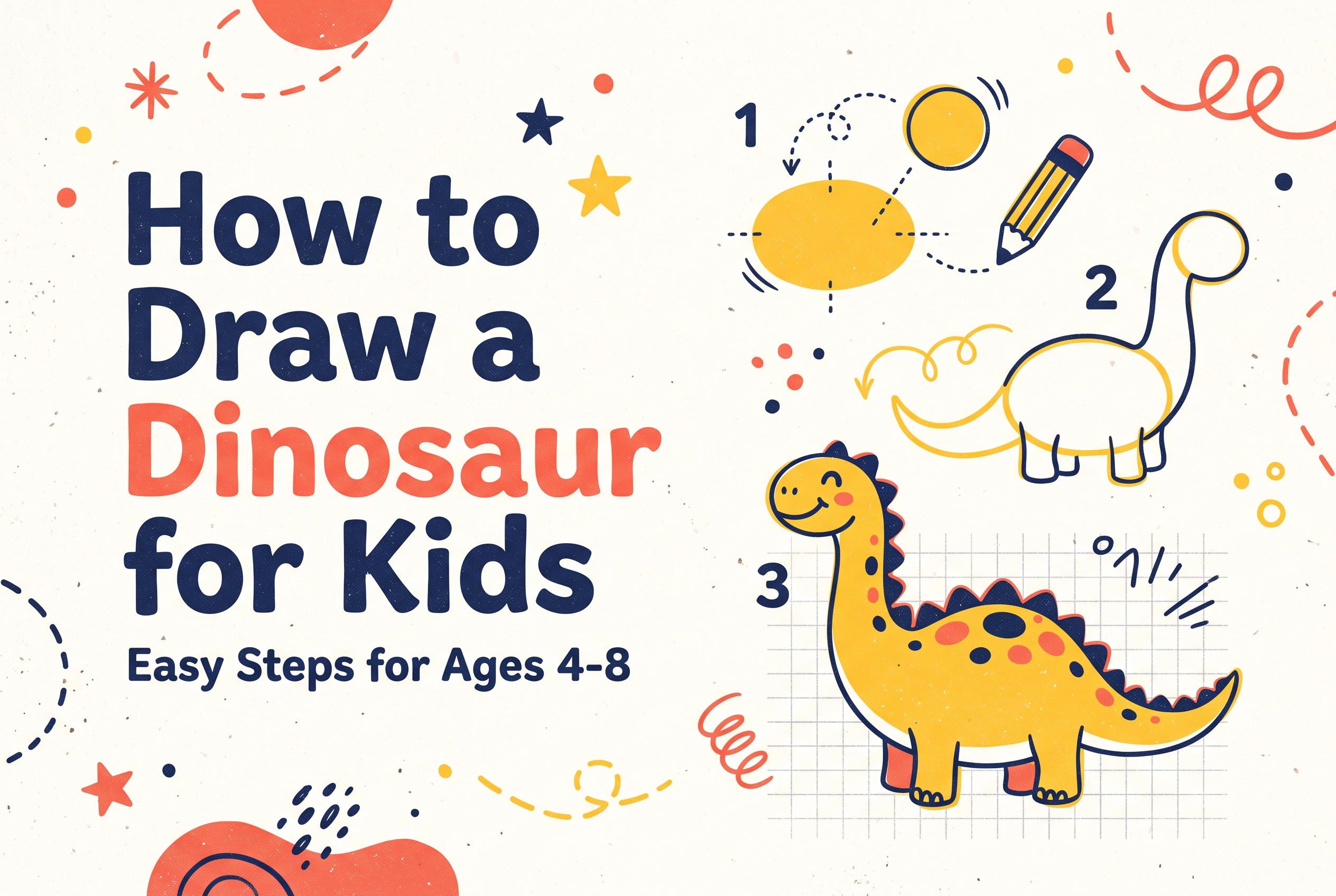
How to Draw a Dinosaur for Kids: Easy Steps for Ages 4-8
Learn how to draw a dinosaur for kids with simple shapes. Easy steps for ages 4-5 and harder versions for ages 6-8, plus a way to turn it into a story…
 Pixley Team
To draw a dinosaur for kids, start with a big oval for the body and a smaller round shape for the head, then add a tail, short legs, tiny arms, and a face. Three shapes and a few lines are enough for a dinosaur that looks like a dinosaur.
If your child just said "draw me a dinosaur" and your own attempt looks like a lumpy potato with feet, this walkthrough is for you. Every step comes in two versions: an easier one for ages 4-5 and a harder one for ages 6-8, so one adult can guide two kids at the same table. Draw one dinosaur together, step by step, and finish by turning it into a character with a story. If you already drew a dragon with your kids, this is its scaly cousin: see How to Draw a Dragon for Kids.
What You Need Before You Start Drawing a Dinosaur
You need paper, a pencil with an eraser, and something to color with. That is the whole list.
Use pencil first, even if your child loves markers. You sketch light guide shapes, connect them, then trace the final outline and erase the guides. Pencil keeps that stress-free, because a wobbly oval is just a draft.
Pick one dinosaur before you begin. We will draw a T. rex-style dinosaur because its body is the simplest: one oval, one head, one tail. Later you can swap in a stegosaurus or any other kind.
Sit side by side and draw at the same time as your child. You do not need to be good at this. A kid who watches an adult try, smudge, and laugh learns that a first draft is allowed to be messy. If your child tends to freeze up, When Your Child Says "I Can't Draw" has eight ways to rebuild confidence.
Step 1: Start With an Oval Body and a Round Head
Draw a big oval in the middle of the page for the body, then a smaller rounded shape above and to one side of it for the head. Press lightly. These are guide shapes, and some of the lines will be erased.
Ages 4-5 (easier): Draw the oval and a circle for the head, and let the two shapes touch or overlap. Skip the neck. A dinosaur with its head stuck right onto the body looks charming and is still unmistakably a dinosaur.
Ages 6-8 (harder): Tilt the oval slightly so it slopes down toward the tail, and make the head a rounded rectangle or a bean shape instead of a circle. Connect head and body with a thick curved neck. A big head on a thick neck is what makes a T. rex look powerful.
A useful rule to say out loud: the head is about one third the size of the body. Kids who overshoot the head size end up with a bobblehead dinosaur, which is also fine.
Step 2: Add the Tail, Legs, and Tiny Arms
Add a long, tapering tail behind the body, two short sturdy legs under it, and two tiny arms near the chest. These four additions turn a blob into a dinosaur.
The tail: Draw two lines from the back of the oval that start wide and narrow to a point, like a long triangle. Tell your child the tail should be nearly as long as the body so the dinosaur stays balanced.
The legs: Draw two thick, short legs coming down from the bottom of the oval, then give each a wide foot with two or three toes.
The arms: Add two very small arms near the chest. The tininess is the joke, and it is also the accurate T. rex look.
Ages 4-5 (easier): Draw each leg as a thick upside-down U with a flat line for the foot. Add toes as three short strokes. Draw the tail as one simple triangle.
Ages 6-8 (harder): Draw the back leg with a bent knee, a big thigh, a lower leg, and a foot with claws. Curve the tail so it swishes to one side. Overlap the far leg slightly behind the near leg so the dinosaur has depth.
Once the shapes are in place, trace over the outline you like with a firmer line and erase the leftover guide circles.
Step 3: Give Your Dinosaur a Face and Personality
Add an eye, a mouth, and teeth. The face turns your drawing into a character instead of a diagram. This is the step where kids get opinions, so let them lead.
Start with one eye, a dot or a small circle with a dot inside. Add a nostril, then a mouth line that curves up for a smile or down for a grumpy dinosaur. Finish with a few pointy teeth along the mouth line.
Ages 4-5 (easier): Eye, smile, three triangle teeth. Done. Ask: "Is your dinosaur happy or sleepy?" and draw whichever they pick.
Ages 6-8 (harder): Add an eyebrow to show a feeling, a curved cheek line, and a few teeth of different sizes. Try the same dinosaur with three expressions on a second sheet: proud, scared, and silly. It is a quiet way to practice naming feelings, and Feelings Drawing Activity for Kids goes further with that idea.
Ask one question about the face, then stop talking: "What is your dinosaur thinking about?" The answer is the start of a story.
Easier and Harder Versions: Dinosaur Drawing for Ages 4-5 vs Ages 6-8
Ages 4-5 do best with big, bold shapes and few steps. Ages 6-8 can handle overlapping parts, bent joints, and extra details. Here is the whole drawing side by side.
| Part | Ages 4-5 | Ages 6-8 |
|---|---|---|
| Body | Big oval | Tilted oval sloping to the tail |
| Head | Circle touching the body | Bean or rounded rectangle on a curved neck |
| Tail | One triangle | Curved, tapering tail with a swish |
| Legs | Thick U shapes, flat feet | Bent knee, thigh, foot with claws |
| Arms | Two short lines | Tiny arms with two small claws |
| Face | Eye, smile, three teeth | Eyebrow, cheek, uneven teeth, expressions |
This split follows how kids' drawing naturally develops. Younger kids tend to draw each part as a separate symbol, while older kids start arranging parts so they overlap and sit in believable positions. If you are curious what that looks like, see Preschematic Stage of Drawing and Schematic Stage of Drawing.
When both ages sit at the same table, give the older child a job: helping the younger one find the next shape. A 7-year-old explaining "now we do the tail" is practicing the same skills, and you get a free helper.
Make It Yours: Colors, Spikes, Plates, and Other Dinosaur Kinds
Once the basic dinosaur exists, change one thing at a time to make it a different dinosaur, and let your child pick every color. There is no wrong dinosaur color.
Turn it into a stegosaurus: Make the body a longer oval and the head a small circle. Give it four short legs and draw triangle-shaped plates along the back, from head toward tail. Add a few spikes at the end of the tail.
Other quick swaps:
Long-neck dinosaur: Stretch the neck into a tall curve and shrink the head.
Horned dinosaur: Add three triangle horns and a wide frill behind the head.
Flying cousin: Add two big triangle wings, then give it a pointed beak.
Colors: Offer a few choices and stay out of the way. A purple T. rex with orange stripes is a legitimate dinosaur. If you are curious what your child's choices might say about their mood, the colors guide covers it, though most of the time a kid just likes green.
Add a background too: volcanoes, ferns, a big egg, an enormous footprint. Each extra object gives the dinosaur a place to live, and a place to live is the beginning of a plot.
Turn Your Child's Dinosaur Into a Story Character
Name the dinosaur, give it one problem, and you have a story character. This takes about two minutes and changes how your child sees the drawing.
Ask three questions:
What is your dinosaur's name?
What does it love, and what is it scared of?
What happens when it wakes up tomorrow?
Write the answers on the back of the drawing. A tiny T. rex named Biscuit who is afraid of thunder is already a better character than most cartoons. For more on how to get from a drawing to a plot, try Story Drawing Easy Step by Step or the shared version, Family Drawing Activity for Kids. To keep a collection of drawings together, see How to Make a Book From Kids' Drawings.
This is where Pixley comes in. Pixley turns kids' drawings and ideas into personalized animated cartoons, bedtime storybooks, and learning games for ages 2-8. You describe a lesson you want to teach, like sharing or handling big feelings, and Pixley builds a cartoon episode around it starring your child's own drawn character. Every generation passes child-safety filtering before your child sees it, and it is ad-free. The magic moment, as co-founder Pranit puts it, is "a kid seeing their own scribbled dragon blink back at them in a real cartoon." Swap the dragon for Biscuit the thunder-fearing T. rex and the idea is the same. Pixley is available on iOS with a free trial.
Photograph the dinosaur and give it its first episode
A dinosaur drawn from an oval, a circle, and a triangle is enough to start a story, and the drawing matters less than what your child says about it. Today, finish the drawing, name the dinosaur, and write down its one big worry. Then take the next step: open Pixley and bring your child's dinosaur to life as a cartoon character with a lesson you choose.
Frequently Asked Questions
How do you draw a basic dinosaur for kids?
Draw a large oval for the body and a smaller rounded shape for the head. Add a long tapering tail, two short legs with wide feet, and two tiny arms. Finish with an eye, a smile, and a few pointy teeth. Trace the outline, erase the guide shapes, and color it in.
What is the easiest dinosaur to draw for a 4-year-old?
A T. rex built from simple shapes is easiest: one oval body, one circle head, a triangle tail, and thick U-shaped legs. Skip the neck and tiny details, and finish with a dot eye and a smile. A stegosaurus with triangle back plates is a close second.
How can I help my child draw a dinosaur if I can't draw?
Draw alongside them and use only ovals, circles, and triangles. Lightly sketch shapes in pencil, connect them, then erase the guides. Messy first tries are normal and worth showing. Afterward, ask what the dinosaur's name is, and use it as the start of a story.
How can I turn my child's dinosaur drawing into a story or cartoon?
Ask for a name, something it loves, and something it fears, then write the answers on the back of the drawing. Pixley can take it further: it turns kids' drawings and ideas into personalized animated cartoons and bedtime storybooks for ages 2-8, built around a lesson you choose.
What age can kids start drawing dinosaurs?
Kids around 4 can follow a simplified shapes-first dinosaur with a few steps, while ages 6-8 can add bent legs, claws, and expressions. Younger toddlers usually scribble and name their marks, which is also a good starting point for storytelling.