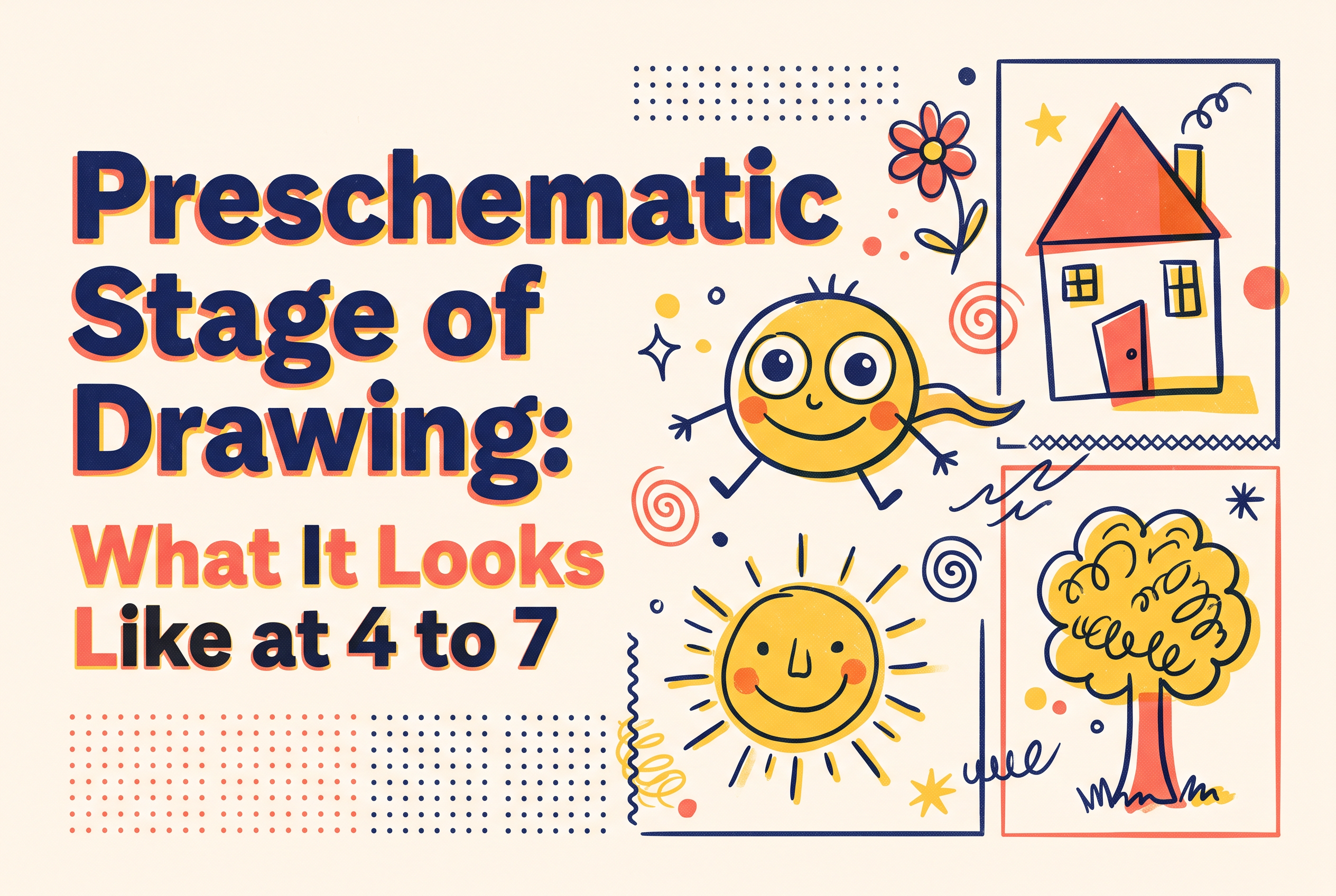
Preschematic Stage of Drawing: What It Looks Like at 4 to 7
The preschematic stage of drawing runs about ages 4 to 7: tadpole people, floating objects, feeling-based color. Learn what it means and how to respond at home.
 Pixley Team
The preschematic stage of drawing is the period, roughly ages 4 to 7, when a child's marks become recognizable symbols: tadpole-style people, objects floating on the page, and colors chosen for feeling rather than realism. If your child's family portrait has giant heads, a purple sun and a dog hovering above the house, nothing is wrong. That is exactly what this stage looks like.
This guide is a field guide for parents and Pre-K to Grade 2 teachers. It covers what preschematic drawings look like, what they can tell you about your child's development, how to respond at home, and how Pixley can turn a child's own drawn character into a cartoon.
The preschematic stage in plain words (ages 4 to 7)
The preschematic stage is the third step in Viktor Lowenfeld's model of children's art. It's when a child first draws things on purpose and keeps changing how they draw them. Most children enter it around age 4 and leave it around age 7, though the ages are approximate and every child crosses them at their own pace.
The big shift: scribbles used to be about movement, and now drawings are about meaning. A circle is a head because the child says it is. A line is a leg. The child is building a visual vocabulary, and that vocabulary is still wobbly. The same person might have four fingers on Monday and twelve on Tuesday.
That inconsistency is the signature of this stage, not a flaw in it.
The four stages of drawing in children, briefly
Lowenfeld's four commonly taught stages are scribbling, preschematic, schematic and dawning realism. Here is the short version:
Scribbling (about ages 2 to 4): marks come first, meaning comes later. Scribbles gradually become controlled and get names. Our post on the stages of scribbling goes deeper.
Preschematic (about ages 4 to 7): recognizable forms appear, especially people, but symbols change from picture to picture.
Schematic (about ages 7 to 9): the child settles on consistent symbols and arranges things along a baseline. See the schematic stage of drawing for the next step.
Dawning realism (about ages 9 to 12): more detail, more spatial awareness, and a growing wish to make things look "real."
For the full age-by-age map, read our guide to the stages of drawing development in children.
What preschematic drawings look like: tadpole people, floating objects and shifting symbols
Preschematic drawings have four reliable signs you can spot on your fridge.
Tadpole people. A big round head with arms and legs sticking straight out of it, and little or no torso. Over this stage, bodies usually appear: first a belly circle, then a trunk, then clothing. Faces tend to arrive before necks.
Floating objects. Houses, trees, the sun and the cat may all hover with no ground under them. There is no baseline yet. Children at this stage place things by importance and story, not by where they would sit in real space.
Shifting symbols. The child draws a dog as an oval with four sticks today and a different shape tomorrow. They are still experimenting with how to represent things, so the symbol isn't fixed.
Size by importance. Mom may be twice the height of the house. A child who just got a new puppy may draw it bigger than the whole family. Size is a way of saying "this matters."
A useful test: ask "Tell me about your drawing." The words will often explain shapes that look random to adult eyes.
Why color and size follow feelings, not rules
Preschematic children choose color and size to express feeling. They haven't learned the rule that grass is green, and they don't need it. A purple sun can mean a happy day. A giant red monster can mean a worry that felt huge. The child is picking the crayon that matches the emotion, or simply the one nearest their hand.
Treat color as a conversation starter, not a code to crack. Be careful with any chart that says one color means one thing: a child may choose blue because the blue marker was the only one that still worked. Ask first, interpret second. Our guide to what colors in kids' drawings mean offers gentle, question-led ways to read color without over-reading it.
What your child's drawings can tell you about their development
A child's drawings show how they think, what they notice and what they feel. That makes them a handy window into development at ages 4 to 7. They are a snapshot, not a test.
Fine motor control. Steadier lines, closed shapes and recognizable letters in the margins show hand control growing.
Symbolic thinking. Understanding that a circle can stand for a head, a person or a sun is the same mental leap that later supports reading and number sense.
Attention to detail. Over this stage, you may see fingers, eyebrows, buttons and hair appear. Each new detail means the child is noticing more.
Emotional world. Who is big, who is close together and who is left out often reflects what is on a child's mind. It's a prompt for a chat, never a diagnosis.
Is drawing an autistic trait? No. Drawing is a normal activity for nearly all children, and a child who draws a lot or draws in a particular style is not showing a trait of any condition by that alone. Drawings vary widely between children at this age, so use your observations the way this guide does: to understand and connect with your child.
How can you tell if a child is gifted in art? At this stage, it's hard to tell and not very useful to try. Children differ in how early they add detail or control lines, but the preschematic stage is wide. Follow your child's enthusiasm instead. A child who draws often, invents characters and tells stories about them is building skills that matter more than any early label.
How to support a preschematic artist at home
Support a preschematic artist by making drawing easy, frequent and conversational, never corrective. Five habits do most of the work.
Keep supplies visible. A tray of markers, crayons and paper on the kitchen table beats a craft bin on a high shelf.
Ask, don't guess. Say "Tell me about this" instead of "Is that a horse?" You'll get stories, and you'll avoid the sting of guessing wrong.
Describe, don't grade. "You used so much orange here" lands better than "Great job." It shows you looked.
Skip the corrections. Don't fix the green sky or the six-legged dog. The child's symbols are working exactly as they should.
Add a story beat. Ask what the character wants, where they are and what happens next. A three-part story (problem, try, solution) turns a drawing into a plot.
Drawing together helps too. Our family drawing activity shows how to make story characters side by side, and drawing activities for preschoolers offers ten more ideas.
Teachers can use the same approach in class. A sharing circle where children tell about their drawings builds oral language alongside fine motor skill.
What about the 4-8-8 method of drawing? It isn't a standard term in child art development, and no part of the preschematic stage depends on it. If you see it in a drawing class, treat it as that class's own technique, and let your child's natural, shifting symbols lead the way at this age.
Bringing preschematic characters to life with Pixley
Pixley turns your child's own drawing into a personalized animated cartoon, so the tadpole person on the fridge becomes the star of an episode. It's built for ages 2 to 8, and every generation passes child-safety filtering before your child sees it. It's available on iOS with a free trial.
Here is how it fits a preschematic artist:
Start with their drawing. Keep the wobbly head, the floating sun and the purple dog. Those quirks are the character.
Pick a lesson or idea. Parents describe any lesson they want taught, such as sharing or handling big feelings, and Pixley creates a cartoon episode around it.
Watch together. Sit beside your child and ask what they notice. The best moment is a child seeing their own scribbled dragon blink back at them in a real cartoon.
This keeps screen time parent-guided and creative. The content starts from your child's imagination instead of an algorithm's feed. If you want to compare options for animating drawings, see our roundup of apps to animate kids' drawings. Pixley's pitch is simple: the child's own drawing becomes the character.
Keep the drawing, then give it a story
The preschematic stage is messy on purpose. Floating houses, giant heads and rainbow dogs are signs a child is building a way to think in symbols. Your best response is to ask about it, display it and never correct it. Take one drawing your child made this week, ask them to tell you the story, then try it in Pixley's free trial on iOS and watch their own character move.
Frequently Asked Questions
What are the 10 developmental stages of children?
There is no single list of ten. Drawing is usually described in four Lowenfeld stages: scribbling, preschematic, schematic and dawning realism. Broader child development models, such as Erikson's or Piaget's, use different numbers of stages. For drawing at ages 4 to 7, the preschematic stage is the one that matters, and Pixley can bring those drawings to life as cartoons.
Is drawing an autistic trait?
No. Drawing is a normal activity for nearly all children, and drawing a lot or in a particular style is not a trait of any condition by itself. Children vary widely in how and how much they draw. Use drawings to connect with your child, and try Pixley to turn their characters into a parent-guided cartoon.
What can children's drawings tell us about their development?
Drawings show fine motor control, symbolic thinking, attention to detail and emotional interests. Tadpole people becoming figures with bodies, or new details like fingers and buttons, show growing observation. Treat them as conversation starters, not tests. Ask your child to tell you about a drawing, then bring it to life with Pixley.
What are the four stages of drawing in children?
Lowenfeld's four stages are scribbling (about ages 2 to 4), preschematic (about 4 to 7), schematic (about 7 to 9) and dawning realism (about 9 to 12). Ages are approximate. In the preschematic stage, children draw tadpole people and floating objects, which Pixley can turn into animated cartoon characters.