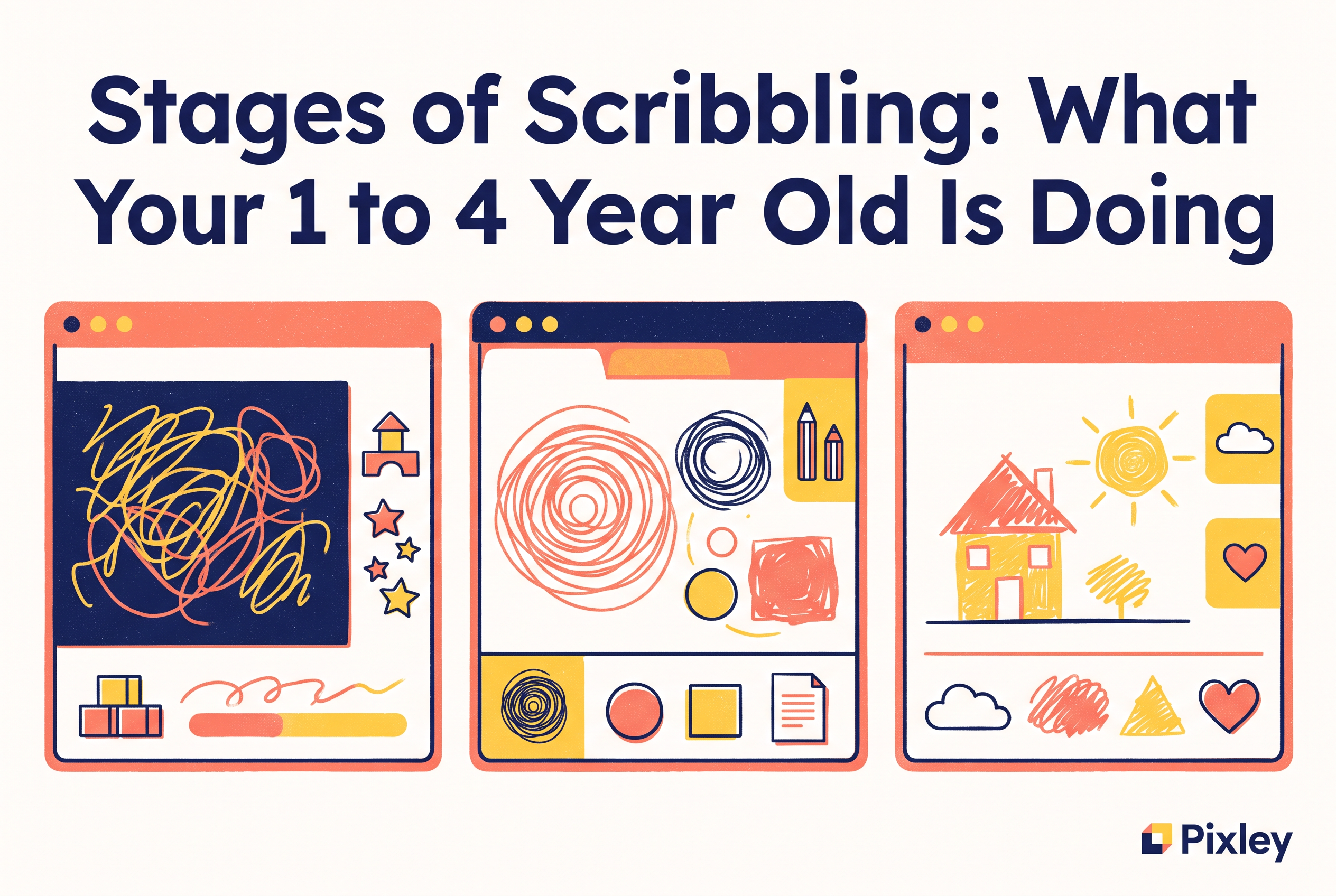
Stages of Scribbling: What Your 1 to 4 Year Old Is Doing
The stages of scribbling run from random marks at 1 to named scribbles at 3 to 4. See what each looks like, what is typical, and simple activities to try…
 Pixley Team
The stages of scribbling move from random, disordered marks around age 1 to controlled lines and circles around age 2 to 3, then to named scribbles ('that's my dragon') around age 3 to 4. Each stage is a real skill, not a warm-up for "real" drawing. Your child is learning that a hand movement leaves a mark, that the mark can be repeated on purpose, and finally that a mark can stand for something.
This guide covers each type of scribble, what is typical at each age, what to do at home, and how a named scribble grows into a character and a story. It is a closer look at the earliest chapter of the stages of drawing development in children.
The Stages of Scribbling at a Glance (Ages 1 to 4)
Scribble drawing is usually called the scribbling stage, and it has three steps: disordered (random) scribbling, controlled scribbling, and named scribbling. Ages are approximate. Children move through these at their own pace, and the stages overlap.
| Stage | Typical age | What it looks like | What your child is learning |
|---|---|---|---|
| Random / disordered | About 1 to 2 | Big, wild marks, often off the page | Arm movement makes a mark |
| Controlled (longitudinal, then circular) | About 2 to 3 | Repeated lines, then loops and spirals | I can make the same mark on purpose |
| Named | About 3 to 4 | Scribbles with a label: "Mom", "my dragon" | A mark can stand for a thing |
Wondering what the different types of scribbling are? That table is the short answer: random, longitudinal, circular, and named. Longitudinal and circular are the two kinds of controlled scribbling, covered below.
Random or Disordered Scribbling: The First Marks (Around 1 to 2)
Random scribbling is the first stage: big, uneven marks made with the whole arm, with no plan for where the crayon lands. A one year old swings from the shoulder, so lines cross, fly off the paper, and sometimes end up on the table.
Three things to expect:
The crayon is held in a fist. Fine finger control comes later.
Eyes often look elsewhere. The fun is in the motion and the sound, not the result.
Marks change by accident. A harder push makes a darker line, and that discovery is the whole lesson.
Don't ask "what is it?" at this stage. There is no answer yet, and the question teaches a child that marks need to be something. Say what you see instead: "You made a big loud line!"
Stay within arm's reach and pick chunky, non-toxic crayons that are hard to bite through.
Controlled Scribbling: Longitudinal and Circular Types (Around 2 to 3)
Controlled scribbling begins when your child notices the link between hand and mark and starts repeating it on purpose. It comes in two types.
Longitudinal scribbling is repeated back-and-forth lines, up and down or side to side. Your child watches the crayon now, and often keeps going until the page is full of parallel strokes.
Circular scribbling follows: loops, spirals, and round, overlapping shapes. Circles take more wrist and finger control than straight lines, so they usually appear a little later. A first closed circle is a milestone you will see again in faces and suns.
At this stage color starts to get chosen rather than grabbed. If you're curious why your child reaches for purple every time, see what colors in kids drawings mean. The honest answer is usually "it was closest," and that's fine.
Watch for this shift: your child starts to look at the page while drawing and may say "again!" or ask for a new sheet.
Named Scribbling: When a Scribble Becomes 'My Dragon' (Around 3 to 4)
Named scribbling is the moment a child gives a scribble a meaning, and it is the real turning point of this whole chapter. The marks may look no different from last month's circles, but now the circles are "Daddy" or "my dragon."
The name often comes after the drawing, and it can change mid-page. A scribble that was a dog becomes a train. That's normal. Your child is learning that a mark can represent something, which is the foundation of both drawing and writing.
So how do 4 year olds usually draw? Many are still naming scribbles or just starting to make early forms: a circle with lines for arms and legs, sometimes called a tadpole figure, with a face but no body. Others stay in the scribble-and-name phase well past 4. Both are typical, and the more detailed, repeated symbols come later, as described in the schematic stage of drawing.
The best response is curiosity. Say "Tell me about your dragon," then write the name on the page if your child likes that.
Should a 3 Year Old Still Be Scribbling? What Is Typical
Yes. A 3 year old who is still scribbling is doing exactly what the stages predict, because controlled and named scribbling both run through about age 3 to 4.
What varies is the type. At 3, you might see any of these on the same day: long line scribbles, loops, a named scribble, or a first circle with a face. Children also swing between stages depending on mood, tiredness, and the tool in their hand. A chunky marker may bring back big arm movements even after months of careful loops.
Three things matter more than where your child "should" be:
Regular access. Paper and crayons within reach beat any special lesson.
Variety of tools. Crayons, washable markers, chalk, and finger paint each ask for different grips.
No correction. If you draw a "proper" version next to your child's scribble, they learn that theirs is wrong.
A scribbling 3 year old is not behind. They're in the middle of the chapter.
Simple At-Home Activities for Each Scribbling Stage
Match the activity to the stage and keep it short. Ten focused minutes beats a long, pressured session.
For random scribbling (1 to 2):
Tape a big sheet of paper to the floor or a low table so the whole arm can swing.
Offer one or two chunky crayons, not a full box.
Try finger paint or a damp sponge on a tray for a different feel.
For controlled scribbling (2 to 3):
Play "copy my line": draw one slow stroke and let your child answer with their own.
Trace big spirals in a tray of sand or salt, then on paper.
Offer stickers to dot onto a page, which builds the same hand control.
More ideas live in drawing activities for toddlers.
For named scribbling (3 to 4):
Ask "What's happening in your picture?" and write down the answer word for word.
Make a scribble together, then add eyes or a tail to turn it into a creature.
Keep a folder of named scribbles. Kids love hearing them read back a month later.
Stay beside your child, praise effort, and put the drawings somewhere visible.
From Named Scribble to Character and Story (and Where Pixley Fits In)
A named scribble is already a character. "My dragon" has a name, a shape, and an owner who cares about it. The next step is giving it something to do, and you can start with three questions: Where does your dragon live? What does it want? What happens next? Write the answers under the drawing and you have a first story. The story drawing guide for ages 2 to 8 walks through this step by step.
This is where Pixley fits. Pixley turns kids' drawings and ideas into personalized animated cartoons, bedtime storybooks, and learning games for ages 2 to 8, with child-safety filtering on every generation. A named scribble can become the cartoon character: parents describe a lesson they want taught, such as sharing or big feelings, and Pixley builds an episode around the child's own drawing. For a child who just announced "that's my dragon," seeing it appear on screen is a big moment.
There's no rush. Scribbles are worth keeping at every stage, and the stages of scribbling are the start of the same path that leads to stories.
Save the next named scribble and give it a story
The stages of scribbling are not a checklist to pass. They are three kinds of discovery: marks happen, marks can be repeated, and marks can mean something. Your job is to supply paper, stay curious, and write down what your child says. The next time your 3 or 4 year old names a scribble, keep it, then try Pixley's free trial on iOS and see whether that dragon, dog, or monster can blink back from a cartoon of its own.
Frequently Asked Questions
What is scribble drawing called?
Scribble drawing is called the scribbling stage, the first stage of children's drawing development. It runs from about age 1 to 4 and has three parts: random or disordered scribbling, controlled scribbling (longitudinal and circular), and named scribbling. Pixley can later turn a named scribble into an animated cartoon character.
Should a 3 year old still be scribbling?
Yes. Most 3 year olds are in controlled or named scribbling, and many mix scribbles with first circles and faces. Keep paper and crayons within reach, avoid correcting the marks, and ask your child to tell you about the drawing. Pixley can turn a named scribble into a cartoon character.
How do 4 year olds usually draw?
Four year olds often draw named scribbles or early forms such as a circle face with lines for arms and legs. Some still scribble freely and others start adding more detail. All of that is typical. Pixley can turn a drawing your child has named into a character in a cartoon.
What are the different types of scribbling?
The types are random (disordered) scribbling around age 1 to 2, controlled scribbling around 2 to 3, which includes longitudinal (line) and circular (loop) scribbles, and named scribbling around 3 to 4. Each type shows growing control and meaning. Pixley can animate a named scribble as a cartoon character.