Story Drawing Easy Step by Step: A Parent's Guide for Ages 2-8
Story drawing easy step by step: help your child draw a full story with a beginning, middle and end, then tell it aloud. Tiered for ages 2-3, 4-5 and 6-8.
 Pixley Team
A four-year-old finishes a drawing of a purple dog, holds it up, and says "done." Ten minutes later the dog is on the fridge and the story is over before it began. The drawing was good. The dog just never got to do anything.
That is the gap this guide closes. Most kids who draw constantly are already making characters. What they are missing is a next step: a place for the character to go, something that goes wrong, and a way for it to end. Drawing one picture and drawing a story use the same crayons, but they ask different things of a child's brain.
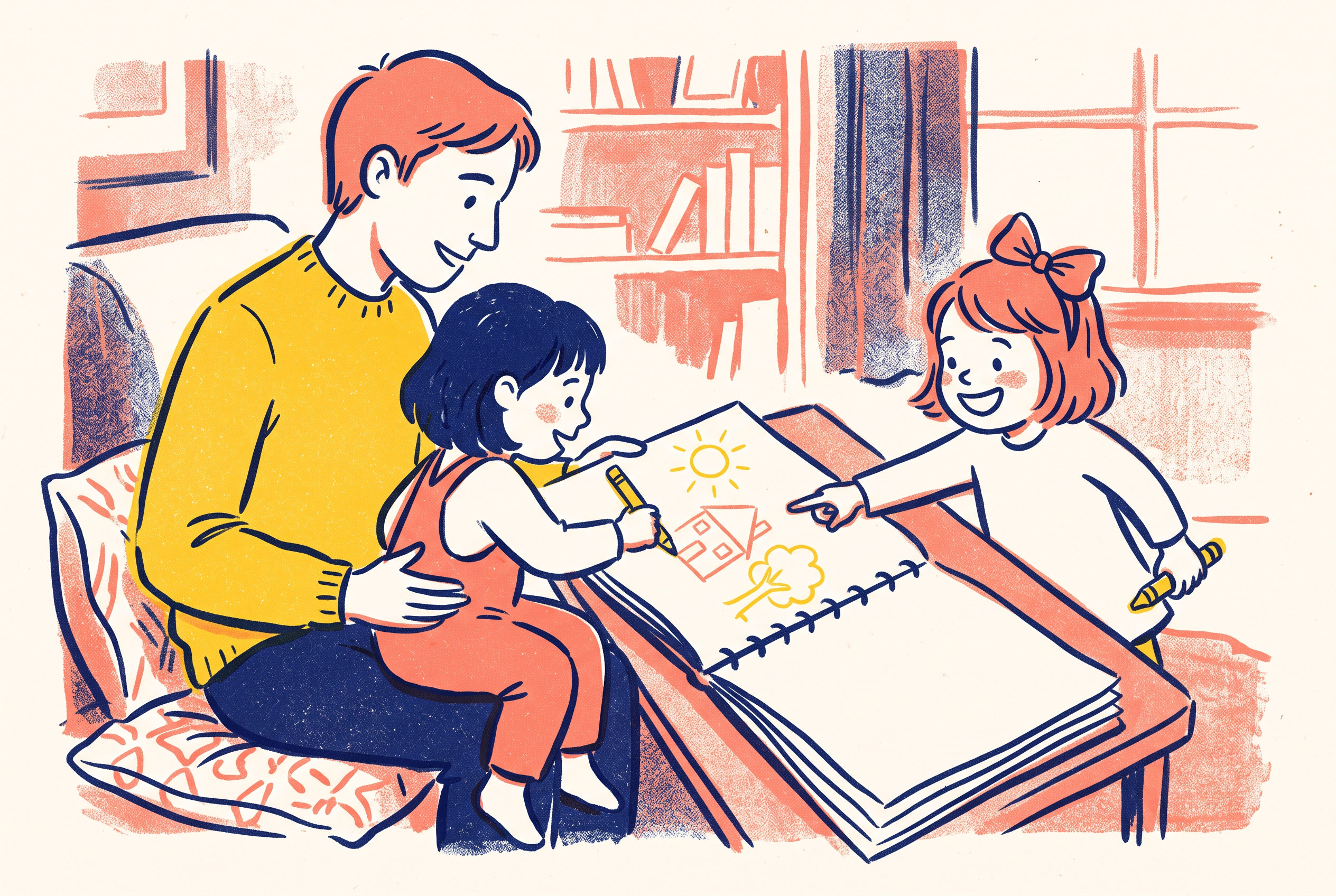
The method below is parent-led and takes about 15 minutes. You pick a character, draw three panels (beginning, middle, end), add how the character feels, and then your child tells the story aloud while pointing at the pictures. It works for a scribbling two-year-old and a six-year-old who wants speech bubbles. You only change how much you ask of them. Neither of you needs art skills.
Why drawing a whole story beats drawing one picture
A single picture is a snapshot. A story is a sequence, and sequence is the skill that carries over into reading, writing and explaining what happened at school today.
When a child draws three linked panels, they have to decide what comes first, what changes, and how it resolves. That is plot in its simplest form. A child who can say "the bunny lost her carrot, then she looked under the bridge, then she found it" is practicing the same beginning-middle-end structure that every picture book and every cartoon episode runs on. If you want the broader picture of how drawing progresses with age, our guide to the stages of drawing development in children shows what to expect at each point.
There is a second payoff: the telling. A drawing gives a shy or wordy-but-scattered child something to point at, which makes talking easier. Kids who can't yet write a sentence can still narrate a page.
My stance: skip "draw anything you like" as your default. Open-ended is fine for free play, but for story drawing a little structure helps. Three boxes and one character give a child a frame to be creative inside. Blank pages make plenty of kids freeze.
The before and after is easy to see. Before: a drawing of a dragon. After: a dragon who is scared of the dark, gets a night light, and falls asleep. Same dragon, three times the thinking.
What you need and how to set up the story page
Keep the supplies boring. You need one sheet of paper, something to draw with, and a pencil for you.
Fold the paper into three sections, either as three columns or as three stacked rows. Fold lines beat drawn lines because a child can feel them, and the paper itself says "this is where part one goes." For ages 6-8, you can fold into four or six boxes once the three-part version feels easy.
Use crayons or thick markers for ages 2-5. Thin pens make small hands tense up, and tense hands make children quit sooner. Older kids can use colored pencils if they want detail.
Set up the space before you call your child over. Clear the table, put the paper down with the folds already made, and sit beside them rather than across. Sitting side by side makes it feel like you are both working on something, not like you are watching a performance.
One rule worth stating up front: you are the scribe and the question-asker, not the illustrator. If your child asks you to draw something, draw a small, plain version and let them decorate it, or ask them to tell you what it looks like. The moment your drawing is better than theirs, some kids stop trusting their own. Our post on when your child says "I can't draw" covers what to do if that wobble shows up.
Set a soft time limit of 15 minutes. If they want to keep going, wonderful. If they stop after panel two, that is a finished story too.
Step 1: Pick a character and a place
Every story starts with someone and somewhere. Ask two questions and let your child answer both: "Who is our story about?" and "Where does it happen?"
Accept whatever comes out. A purple dog, a moon with legs, a very angry banana. The stranger the better, because strange characters are easy to remember and easy to draw in three different poses. If your child stalls, offer two choices instead of an open question: "Is it a dragon or a robot?" Choices lower the pressure without taking the decision away.
Draw the character first, large, in the middle of the first box. Then add the place around it with a few quick shapes: a green line for grass, a blue scribble for a pond, a gray block for a castle. The place does not need detail. It just needs to exist so the character has somewhere to stand.
Give the character a name before you move on. Naming is the moment a drawing turns into a character, and children will defend a named character fiercely. "Biscuit the purple dog" will show up in tomorrow's drawing without being asked.
If your child already has a favorite character they draw all the time, use it. A recurring character skips the decision step entirely, and the child arrives with ideas about what that character likes and fears. For a longer list of starting ideas, try our 40 drawing prompts that turn into characters and pick one that makes your child laugh.
This step should take two or three minutes. Resist the urge to refine the drawing.
Step 2: Draw the beginning, middle and end
Now the story gets its shape. Use the three folded sections and say the three jobs out loud in kid language: "Box one is how it starts. Box two is the problem or the surprise. Box three is how it ends."
Box one is already mostly done from Step 1. Ask: "What is Biscuit doing at the start?" Maybe he is digging in the yard. Add a small action to the picture.
Box two is where the story lives. Ask: "Then what happens?" or the stronger version, "What goes wrong?" A character who wants something and hits an obstacle is the engine of nearly every story ever told. Biscuit digs and finds a giant bone. Or Biscuit digs and a bee chases him. Let your child decide, and do not fix the problem for them. Silence while they think is normal. Count to ten before you offer a suggestion.
Box three is the ending. Ask: "How does it end?" Young children often default to a happy ending, which is fine. Older kids will start inventing twists. Either way, the character in box three should look different from box one in some small way: a new friend beside him, a smile instead of a frown, a hat he did not have before. That visible change is how a child learns that endings mean something shifted.
Keep the same character in the same colors across all three boxes. If Biscuit is purple in box one, he is purple in box three. Consistency is a skill, and three boxes are a gentle way to practice it.
For more drawing-and-telling formats to mix in, see these 10 draw and tell ideas for preschoolers.
Step 3: Add how the character feels
Most people skip this step, and it is the one that turns a list of events into a story. Events tell us what happened. Feelings tell us why we care.
Go back to each box and ask one question: "How does Biscuit feel here?" Then have your child add a face, or fix the face that is already there. A happy mouth in box one, wide worried eyes in box two, a big grin in box three. The feeling should change at least once, because a character who feels the same thing the whole time has not gone on a journey.
If your child has trouble naming feelings, offer a menu: happy, sad, scared, mad, surprised, proud. Six words cover almost every moment in a preschool story. Pointing to a face on the page and asking "is that his scared face or his surprised face?" works well for the youngest children.
There is a bonus here. A child who can tell you that Biscuit was scared when the bee chased him is practicing the same language they will need to tell you they were scared at the park. Characters are a safe stand-in for the child's own big feelings. Our feelings drawing activity goes deeper on this if your child is working through a particular emotion, and how stories build emotional intelligence in kids explains why it works.
Do not ask "why did he feel that way?" unless your child brings it up. For this activity, naming the feeling is the whole job. Explanation can come naturally in Step 4 when they tell the story out loud.
Add the feeling words to the page if your child is 5 or older and wants to write them. Otherwise, write one word under each box as they say it.
Step 4: Tell the story aloud
The drawing is the script. The telling is the performance, and it is where the learning locks in.
Hold the paper up, or lay it flat between you, and say: "Tell me the story." Then stop talking. Your child points to box one and starts. Your only job is to be a good audience: nod, react, and ask "and then what happened?" when they pause.
If they say "the dog got a bone, the end," that is a complete telling for a two-year-old. For older kids, nudge the length with one prompt per box: "What did Biscuit say when he saw the bee?" Dialogue is the easiest way to stretch a telling, because kids love doing voices.
Write down their words. Under each box, jot one sentence exactly as your child said it, including the odd grammar. Seeing their own spoken words appear in writing is a quiet lesson in what reading is: talk, written down. If your child is 6-8, hand them the pencil and let them write the sentence themselves, spelling mistakes welcome.
Then do something with the finished page. Read it back to a grandparent over a video call, perform it for a stuffed animal, or tape it above the bed as a bedtime story. A story with an audience feels real. A story that goes straight into a drawer does not.
A good habit: do one story page, then another the next day with the same character. By the fourth page you are building a series, and your child is thinking like an author. If you want to turn the pages into something sturdier, our guide to making a book from kids' drawings is the logical next move.
Ages 2-3, 4-5 and 6-8: what each step looks like
The four steps stay the same. What you ask of the child changes.
Ages 2-3: one scribble, one sentence. Skip the three-box fold and use one big page. Your toddler scribbles, you ask "who is that?" and write down the answer. "Doggy." Add one action by asking "what is doggy doing?" The story is a single sentence: "Doggy is running." That counts. Scribbling is real drawing at this age, and the story lives in your child's words, not in recognizable shapes. Our drawing activities for toddlers give you plenty of ways to warm up first.
Ages 4-5: three boxes, simple faces. This is the sweet spot for the full method. Fold the paper into three, draw a character and a place, give each box one action, and add happy, sad or surprised faces. Expect shapes with arms and legs, floating suns and flat grass lines. Tellings run about three to six sentences. Your child will likely want to repeat the story several times, and you should say yes every time.
Ages 6-8: four to six boxes, words and speech bubbles. Older kids can handle a longer arc: a beginning, a problem, a failed attempt, a better attempt, and an ending. Introduce speech bubbles and a title. They can write their own captions and may want to sketch a rough cover. This is also the age where a comic strip format appeals, and our 30 comic strip ideas for kids will give them endless starting points.
The rule across all three ages: match the amount of structure to what your child can hold in their head. If they are bored, add a box. If they are overwhelmed, take one away.
Next steps: from paper story to cartoon
Once your child has a stack of story pages, the question becomes what to do with them. The fridge works for a week. A shoebox works for a year. But kids who draw this much usually want to see their characters move.
You have a few low-tech options. Flip the pages like a mini film, or try a flip book where each page changes slightly. Act the story out with puppets cut from the drawings. Stack the pages into a stapled book with a cover and an author name.
Another option is Pixley, which turns kids' drawings and ideas into personalized animated cartoons, bedtime storybooks and learning games for ages 2-8. A parent can describe a lesson they want the story to teach, such as sharing or handling big feelings, and Pixley creates a cartoon episode around it. Every generation passes child-safety filtering before a child sees it, and there is an iOS free trial. A child's three-box story about a scared purple dog is exactly the kind of raw material that makes a personal cartoon feel personal.
If you want to see where else a drawing can go, our guide to turning your child's drawing into a story and our post on what to do with your child's drawings lay out more routes.
Whichever route you pick, keep the paper version going. The folded page is where the ideas get made. Everything after that is just a nicer way to watch them.
Conclusion
Story drawing, easy and step by step, comes down to one habit: never let a drawing end at the picture. Fold a page into three, ask who, where, what goes wrong and how it ends, add the feelings, and have your child tell it out loud. Tonight, pick the character your kid drew most recently and give it a beginning, a middle and an end before bed.
When you have a few story pages piled up, take the best one to Pixley and see your child's own drawn character come to life in an animated cartoon built around a lesson you choose. There is an iOS free trial, so the first story costs you nothing but a scribbled dragon and ten minutes.
Frequently Asked Questions
How do I teach my child to draw a story step by step?
Fold a page into three sections. Have your child pick a character and place, draw what happens at the beginning, the middle (a problem or surprise) and the end, then add faces showing how the character feels. Finish by letting them tell the story aloud while pointing at each box. The whole thing takes about 15 minutes.
What age can kids start drawing stories?
Children as young as 2 or 3 can do a simple version: scribble, then tell you in one sentence what it is and what it is doing. By ages 4-5 most can handle three connected panels, and by 6-8 they can plan longer sequences with speech bubbles and captions.
What should my child draw first when making a story?
Start with a character and a place. Ask who the story is about and where it happens, then draw the character large in the first panel. Giving the character a name early helps it feel real and makes it easy to reuse across panels and future stories.
How can I turn my child's drawn story into a cartoon?
You can flip-book the pages, act them out with paper puppets, or bind them into a book. Pixley is another option: it turns kids' drawings and ideas into personalized animated cartoons for ages 2-8, with child-safety filtering on every generation and an iOS free trial.
My child won't finish the story. What should I do?
Shrink the task. Switch to one box for toddlers, or two for a hesitant 4-year-old, and treat any stopping point as a finished story. Offer two choices instead of open questions, such as "dragon or robot?", and keep sessions under 15 minutes so drawing stays fun.