Drawing Activities for Toddlers: 12 Easy Ideas for Ages 2-3
12 low-prep drawing activities for toddlers ages 2-3, with materials, setup, and exactly what to say, so scribbles count as real drawing.
 Pixley Team
A two-year-old hands you a page covered in orange loops and says, "Dog." It looks nothing like a dog. It doesn't need to. That page is a record of a small arm moving across paper, a hand gripping a crayon for the first time, and a brain connecting a mark to a meaning.
Most toddler drawing advice quietly assumes the goal is a recognizable picture. At ages 2 and 3, that goal is wrong. The goal is motion, mess, and the discovery that a mark stays where you put it.
This list is built for the scribble stage. Every activity uses things you likely own, takes about five minutes to set up, and works whether your child draws for ninety seconds or half an hour. Each one names the materials, the setup, and what to say while you do it. None of them asks your toddler to draw a house, a sun, or a smiley face.
The last section covers something most parents skip: how to save these early drawings so you can turn them into something later.
What drawing looks like at ages 2-3 (and why scribbles count)
Scribbling is drawing. It's the first stage of drawing, not a warm-up for the real thing. Developmental researcher Rhoda Kellogg catalogued thousands of children's drawings in her 1969 book Analyzing Children's Art, tracing how mark-making develops from basic scribbles through placement patterns and diagrams before recognizable objects emerge.
Here is the typical pattern at this age:
Around 18 months to 2 years: big, back-and-forth arm movements. The whole arm moves, not just the wrist.
Around 2 to 2.5 years: more controlled marks, repeated circles, and dots. Your child starts to notice that their hand causes the mark.
Around 2.5 to 3 years: a scribble gets a name. "That's Mommy" appears after the drawing is done, and the name often changes ten minutes later.
That last point trips up a lot of parents. A toddler who calls the same blob "a cat" and then "a truck" isn't being inconsistent. They're experimenting with the idea that marks can stand for things. Correcting them or asking "but what is it really?" shuts that experiment down.
For the full progression through age 8, read our guide to the stages of drawing development in children. For now, the rule is simple: treat every scribble as finished work. If your toddler says they're done, they're done.
Keep sessions short. Five to fifteen minutes is a normal attention span at this age, and stopping while your child still wants more beats pushing for one more page.
Set up a toddler-friendly drawing space
A good drawing space removes decisions and removes worry. You shouldn't be hovering over your toddler saying "not on the table" every thirty seconds, because that tells them drawing is risky.
Pick a surface you don't care about. A kitchen floor with a taped-down sheet of paper works better than a pretty craft table you're protective of. A cheap vinyl tablecloth or an old shower curtain under the paper takes care of spills.
Check what's safe to put near little mouths. Toddlers test everything by tasting it. Look for products labeled non-toxic and, for crayons and markers, one of the standard safety seals (in the US, the ACMI AP seal means a product was reviewed by a toxicologist). Washable markers and chunky crayons sized for small fists are the easy choices. Skip tiny pencils and anything with a small cap that could be swallowed.
Limit the supplies. Put out two or three crayons, not the whole box. A toddler faced with sixty colors often dumps the box, which becomes the activity. That's fine sometimes, but if you want drawing, offer fewer choices.
Sit low. Get on the floor. A toddler draws better and longer when you're nearby at their level, not standing over them.
Use big paper. Printer paper is too small for a two-year-old's arm sweep, and marks that run off the edge frustrate them. Butcher paper, the back of wrapping paper, or flattened cardboard boxes are all free or cheap.
Keep it quick to start. Store a small bin with paper, crayons, and a tablecloth where you can grab it in under a minute. If setup takes twenty minutes, you won't do it on a Tuesday afternoon, and Tuesday afternoon is when you need it.
With the space ready, here are the twelve activities.
Activities 1-4: Big-motion scribbling
Toddlers draw with their shoulders first and their fingers later. These four activities let the whole arm move, which is what a 2-year-old's body is built to do.
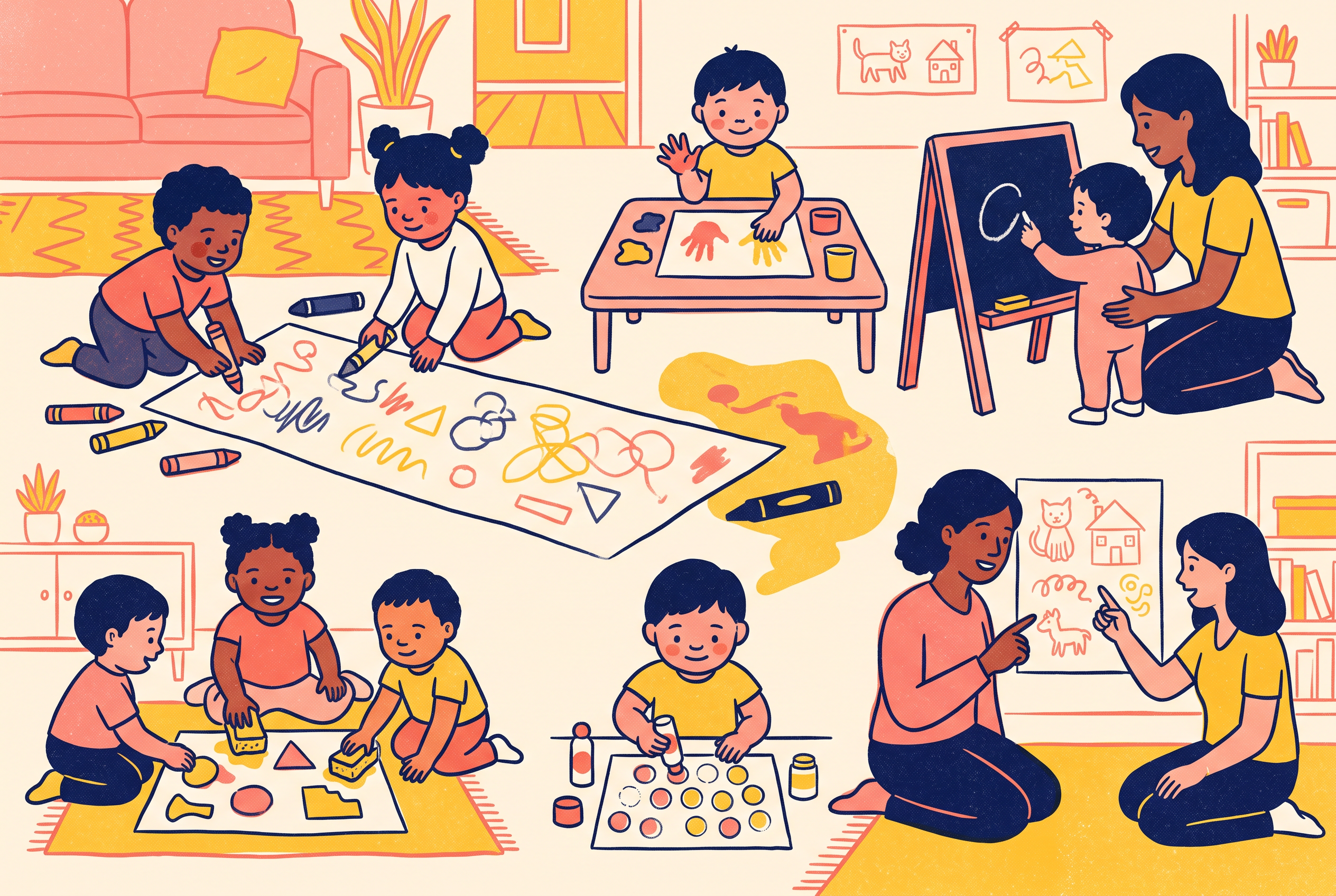
1. Big paper on the floor. Materials: A large sheet of butcher paper or a flattened box, 2 or 3 chunky crayons. Setup: Lay the paper flat and tape the corners so it doesn't slide. What to say: "Look at that big line! Your arm went all the way across." Describe the movement, not the result.
2. Tape-down floor mural. Materials: Painter's tape, a long roll of paper, crayons or washable markers. Setup: Unroll five or six feet of paper down a hallway and tape every edge. Let your toddler crawl, kneel, or stand along it. What to say: "Can you draw all the way to the door?" Walking while drawing makes long, sweeping marks, which is the point.
3. Sidewalk chalk. Materials: Jumbo sidewalk chalk (the thick sticks are easier to grip and harder to snap). Setup: Find a driveway, patio, or quiet stretch of pavement. Pavement forgives everything, and rain erases the whole thing. What to say: "Whoosh! Your chalk made a rainbow line." Let your child stomp, jump, and scribble over your marks. Stomping is also drawing at this age.
4. Easel or wall paper. Materials: Paper taped to a wall or the side of a fridge at toddler shoulder height, or a tabletop easel if you own one. Setup: Tape paper where your child's arm naturally reaches, roughly chest to shoulder level. What to say: "Up high, down low." Drawing upright builds shoulder strength and feels different from drawing flat.
These four are the lowest-effort options on this list, and they're the best place to start if your toddler has never drawn before. Don't worry about neatness. A floor mural that ends up half on the paper and half on the tile still counts.
Activities 5-8: Tools and textures
Once your toddler is comfortable making big marks, change what the marks feel like. Different tools teach different grips and different cause-and-effect lessons.
5. Chunky crayons. Materials: Fat, egg-shaped or triangular crayons made for small hands. Peeled paper-free crayon blocks work well too. Setup: Offer two colors at a time on plain paper. What to say: "Press hard. Now press soft." Toddlers discover that pressure changes the mark, and that's a real discovery.
6. Rubbing over textured surfaces. Materials: A peeled crayon (paper removed), thin paper, and a textured surface like a leaf, a coin, a woven placemat, or bumpy tree bark. Setup: Put the item under the paper and lay the crayon on its side. Show your toddler once, then let them take over. What to say: "Whoa, where did that come from?" The surprise of a hidden shape appearing is half the fun.
7. Sponge and cotton-ball painting. Materials: Washable paint in a shallow dish or muffin tin, kitchen sponges cut into chunks, cotton balls, paper. Setup: Put an old shirt on your child and the tablecloth under the paper. Offer one or two colors only. Clothespins on the cotton balls keep fingers cleaner, though most toddlers prefer to use their hands. What to say: "Dab, dab, dab." Narrating the action gives your toddler words for what their hands are doing.
8. Stickers and play dough. Materials: A sheet of large stickers, a lump of play dough, paper. Setup: Stickers build the pincer grip, the same finger movement used to hold a crayon later. For the play dough, have your child flatten it and poke it with a crayon or finger to "draw" in it. What to say: "You made a hole. Poke, poke." Stickers can be placed on paper, then connected with a crayon line. That's a first step toward drawing around objects.
These are messier than the first four, so save them for a time when you're not rushed. Mess isn't a side effect here. It's the learning.
Activities 9-12: Drawing together
Toddlers learn by watching you. These four activities put you at the paper too, without turning the session into a lesson.
9. Draw alongside. Materials: Two sheets of paper, crayons for both of you. Setup: Sit next to your child and scribble on your own paper. Don't draw a recognizable picture. Make lines, dots, and loops. What to say: Almost nothing. Let your child watch and copy if they want. If you draw a perfect cat, your toddler learns that drawings are supposed to look like something, and that's the pressure this list avoids.
10. Music scribble. Materials: A big sheet of paper, a crayon in each hand, any music you like. Setup: Play something with a clear beat. Fast music means fast scribbles, slow music means slow ones. What to say: "Fast! Now slow, slow, slow." The music gives your toddler a reason for each movement and makes the session feel like a game.
11. A turn-taking drawing game. Materials: One sheet of paper, one crayon. Setup: You make one mark, then pass the crayon. Your toddler makes one mark, then passes it back. Keep it short, since waiting is hard at this age. What to say: "My turn. Your turn." This is also quiet practice for taking turns, a skill covered in our guide on how to teach kids to take turns.
12. Name-the-scribble storytelling. Materials: A finished scribble, and you. Setup: After your child finishes a page, ask, "Do you want to tell me about this one?" If they say no, drop it. If they say "doggy," take that as the whole story. What to say: "The doggy is running fast! Where is the doggy going?" Add one small question and then stop.
This last activity is where scribbles start turning into stories. When your child is ready for more, turn your child's drawing into a story walks through the next step. Pixley takes the idea further for ages 2-8: it turns kids' drawings and ideas into personalized animated cartoons and bedtime storybooks, and a first scribbled "doggy" can become a character in one of them.
How to talk about a toddler's scribbles
The words you use matter more than the supplies. "What is it?" feels friendly, but it signals that the drawing is supposed to be something, and a 2-year-old can't always answer. Some days the honest answer is "it's a scribble."
Try these instead:
Describe what you see. "You used a lot of blue." "I see big circles and tiny dots."
Describe what they did. "You pressed so hard that the crayon squeaked." "You filled the whole page."
Ask an open invitation. "Do you want to tell me about it?" If the answer is no, say "okay" and move on.
Say thank you when they give you a drawing. "Thank you for this, I love it" is enough.
Avoid these:
"That's beautiful!" said on autopilot for every page. Toddlers hear the pattern fast, and generic praise means little.
"Is that a house?" Guessing wrong teaches your child that their drawing failed.
"Try making it look more like..." A toddler isn't trying to make anything look like anything.
Fixing or finishing the drawing for them. Don't add eyes to the blob.
If your child names the scribble, use their word. If the "dog" becomes "mama" five minutes later, say "oh, now it's mama!" The name is allowed to change.
This habit pays off years later. Kids who are praised for effort and process tend to keep drawing, while kids who learn early that drawings are judged tend to quit. If you ever hear "I can't draw" from an older sibling, 8 ways to rebuild confidence covers what to do. For a toddler, prevention is simple: describe, don't grade.
Keep the scribbles: saving drawings and turning them into a book later
Toddler drawings pile up fast. A child who draws every day makes hundreds in a year, and nobody can frame them all. You don't need to keep everything. You need a system that takes thirty seconds.
Keep a small, simple stash. Pick one box or folder and write your child's name and the date on the back of anything you save. Dates matter more than you expect. In five years, you'll want to see how the scribbles changed.
Photograph the rest. Take a quick phone photo of each drawing before it goes in the recycling or on the fridge. A single album named with your child's name and the year keeps the whole archive in one place, and the paper can go.
Save the milestone drawings. The first scribble with a name, the first circle, the first time a drawing has eyes. These are the ones you'll want later.
Turn a few into something later. A handful of toddler drawings make a good homemade book. Our guide on how to make a book from kids' drawings shows how, and what to do with your child's drawings has twelve more ideas.
Pixley is another option when your child is a bit older. It turns kids' drawings and ideas into personalized animated cartoons, bedtime storybooks, and learning games for ages 2-8. Each generation passes child-safety filtering before your child sees it, it's ad-free, and it's available on iOS with a free trial. Co-founder Pranit describes the moment it's built for this way: "The magic moment is a kid seeing their own scribbled dragon blink back at them in a real cartoon."
A scribble saved today can be a character later.
Conclusion
Start with one activity this week. The floor mural or the sidewalk chalk takes the least effort and pays off the most. Sit down, scribble next to your child, and say very little.
Then save the best page. Date the back and photograph the rest. When your toddler is ready to tell you what a scribble is, that page can become a character.
If you want to see what a scribble can turn into, try Pixley. Take a photo of your child's drawing and let it become a personalized cartoon or bedtime story, with child-safety filtering on every generation and no ads. The free iOS trial costs nothing, and it only takes one scribbled dragon to find out whether your child lights up.
Frequently Asked Questions
What drawing activities are good for a 2 year old?
Big-motion activities work best at age 2: scribbling on large paper taped to the floor, sidewalk chalk, and drawing on paper taped to a wall. Add chunky crayons and sponge painting for variety. Keep sessions to five or fifteen minutes and sit with your child. Pixley can later turn those early drawings into cartoons and storybooks.
When do toddlers start scribbling?
Most toddlers begin making marks with a crayon between 12 and 18 months, and scribbling becomes purposeful around age 2. Early marks are big arm sweeps. By 2.5 to 3, children often name their scribbles. Timing varies from child to child, so follow your toddler's interest rather than a calendar.
What should I say when my toddler hands me a scribble?
Describe what you see instead of asking what it is. Try "You used so much red" or "I see big circles." Then offer an open invitation: "Do you want to tell me about it?" Accept whatever they say, including a name that changes later. Skip generic praise like "beautiful" on every page.
Are crayons or markers better for toddlers?
Chunky crayons are the easiest starting point because they are sized for small fists and give gentle resistance that helps control. Washable markers are fine too. Choose products labeled non-toxic, and avoid small caps or tiny pencils that are hard to grip or could be swallowed. Offer just two or three colors at a time.
How do I save my toddler's drawings without keeping everything?
Write the child's name and date on the back of milestone drawings and keep them in one box. Photograph the rest into a single phone album before recycling them. Later, a few favorites can become a homemade book, or you can use Pixley to turn a drawing into a personalized cartoon or bedtime story.