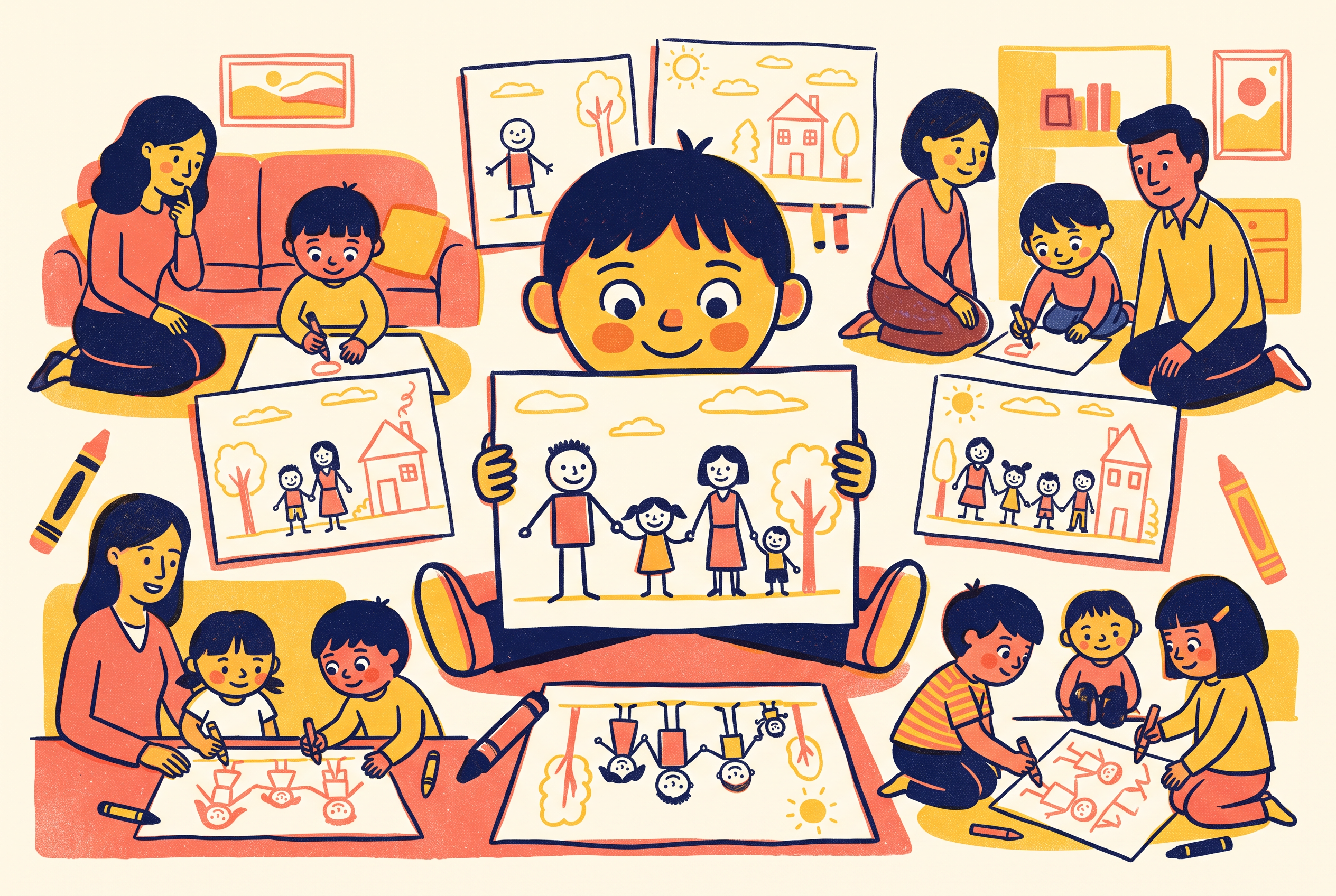
Schematic Stage of Drawing: What It Looks Like at 5 to 8
See what the schematic stage of drawing looks like at ages 5 to 8: baselines, sky lines, x-ray drawings, plus at-home activities for each Lowenfeld stage.
 Pixley Team
Your six-year-old hands you a picture of your family. Everyone stands on a green stripe at the bottom of the page. A blue stripe runs across the top, with a sun tucked into it. The house has a front door and, somehow, a visible kitchen table inside the walls. Your first instinct might be to wonder why nothing looks "right."
Nothing is wrong. Your child is working through what Viktor Lowenfeld, in his 1947 book Creative and Mental Growth, called the preschematic and schematic stages of drawing. Those stretches of childhood have their own logic, and that logic is the same from child to child.
This guide walks through what each stage looks like on paper: the baseline, the sky line, the x-ray house, the folded-over table, the same tree drawn the same way fifty times. Each stage comes with simple activities you can try at the kitchen table, plus a way to turn those quirky pictures into stories. The short version: these drawings are not mistakes. They are how kids show what they know.
Where the Schematic Stage of Drawing Fits: A Quick Map of Ages 4 to 9
Lowenfeld mapped children's art into a sequence of stages. Scribbling comes first (roughly ages 2 to 4). The preschematic stage follows (about 4 to 7), then the schematic stage (about 7 to 9). Later come the gang age and the pseudo-naturalistic stage, which sit outside this article. For a wider view of the early years, see our guide to stages of drawing development in children from ages 2 to 8.
Two things matter about this map. First, the ages overlap on purpose. A five-year-old can show schematic habits, and an eight-year-old can slide back into preschematic symbols when a drawing gets emotional. Treat the ages as a rough guide, not a deadline.
Second, the stages are not a grade. A child at the preschematic stage is not behind a child at the schematic stage. Each stage solves a different problem. The preschematic child is learning that a drawing can stand for a thing. The schematic child is learning that things exist in a place.
The title of this article says 5 to 8 because that is the window where most parents notice the shift. Drawings stop being floating objects and start becoming scenes. If your child sits anywhere in that window, you are looking at the right stage guide.
Here is the whole map in one line each: scribbles are about motion, preschematic drawings are about symbols, and schematic drawings are about space. Keep that in your pocket as you read the next two sections.
The Preschematic Stage (About 4-7): Symbols Before Space
The signature of the preschematic stage is the first recognizable symbol. A circle with lines becomes a person. Lowenfeld described the classic result: a head, two legs, and often arms sprouting from the head, sometimes called a tadpole figure. Eyes and mouth appear. The torso often shows up later.
What you will see on the page:
Floating objects. The sun, a house, a cat, and a flower are scattered across the page with no ground under them. Nothing sits on anything.
Size by importance. Mom is huge. The dog the child loves is bigger than the house. Scale follows feeling, not measurement.
Colors by feeling. A purple dog and an orange sky are normal. The child picks a color because they like it, not because it matches life. Our guide to what colors in kids drawings mean covers this in depth.
Symbols that change. The child draws a person differently each time, because the symbol is still being invented.
Here is the position worth taking: do not correct a preschematic drawing toward realism. When you say "people have bodies, honey," you are teaching a rule the child has not yet needed. The tadpole figure is a complete idea. A head, legs, and a face tell the child everything they want a person to say.
A concrete before and after. A five-year-old draws herself as a huge head with four spiky legs, standing in the corner of the page with a sun floating beside her. Six months later she draws the same self with a tiny round body between the head and legs. Nobody taught her. She noticed the body mattered, so the symbol grew.
Ask instead of fix. "Tell me about this one" gets you the story behind the symbol. That story is the real artwork at this stage.
The Schematic Stage (About 7-9): Baselines, Sky Lines, and Repeated Symbols
Around age 7, something clicks. Objects stop floating. Lowenfeld called the result the discovery of order in space, and you can see it in three features.
The baseline. A line, usually along the bottom of the page, becomes the ground. Houses, trees, and people stand on it. Sometimes the baseline is a thin pencil stroke. Sometimes it is a fat green stripe.
The sky line. A second band runs across the top, usually blue. The space between the sky line and the baseline is the "air" where everything else happens. This is the most common sign that your child has entered the schematic stage of drawing. If you see blue at the top, green at the bottom, and a gap between, you are looking at it.
Repeated symbols. The child now has a schema, a personal formula, for each object. The tree is a brown rectangle trunk with a green cloud on top. The house is a square with a triangle roof, a door, and two windows. The person is a head, a body, two arms, two legs, drawn nearly the same way every time. Lowenfeld noted that the schema is a stable concept, and that deviations from it are meaningful. When a child suddenly draws a tree differently, such as with a missing trunk or exaggerated branches, something about that tree mattered.
Repetition looks boring to adults. It is not. A child who draws the same house forty times is practicing a reliable symbol, the way a pianist runs scales. The formula frees up attention for what comes next: the story around the house.
So skip the urge to say "draw something different today." Say "what is happening at your house in this one?" The schema is the stage. The story is the content.
X-Ray Drawings and Folding Over: How Kids Draw What They Know
Two schematic quirks make parents laugh and then worry. Both are deliberate.
X-ray drawings. The child draws the outside of a house and also shows the people, beds, and kitchen inside, as if the walls were transparent. A pregnant mom might be drawn with the baby visible inside her. A picnic might show the sandwich inside the basket. Lowenfeld described this as the child drawing what they know, not what they see. Ask a seven-year-old why the walls are see-through and you will often get a patient look: because the family is in there.
Folding over. The child wants to show every side of something at once, so they tilt it flat. A table is drawn with all four legs splayed out. A row of trees along a road is drawn with the trees on one side upside down, as though the page were folded along the road. A yard might show the fence lying flat on both sides of the house. The drawing looks wrong by camera standards and exactly right by memory standards.
Mixed views. You may also see a plan view and a side view in the same picture, such as a birthday cake seen from above with the candles drawn from the side. The child is not confused. They are including the most important facts about each object, whatever the angle.
The position here is firm: these are intelligence, not error. A child who can hold a complete mental model of a table and put it on paper is doing something photographers spend years unlearning. Perspective drawing is a convention, and it arrives later, usually after age 9, when children begin caring about looking realistic.
When you see an x-ray or folded-over drawing, say "I can see everything that is happening here." That sentence tells your child their way of showing things works, and it keeps the pencil moving.
At-Home Activities for the Preschematic Stage
At this stage, the goal is more symbols, more talking, and zero correction. These activities are cheap and need only paper and crayons.
1. The "tell me about it" game. Whenever your child finishes a drawing, ask one open question: "Who is this?" or "What is happening?" Write their answer on the back of the page in their own words. In a month you will have a folder of mini-stories.
2. Draw the same thing three ways. Pick one subject, like a dog, and draw it three times over a week. Do not compare the drawings. The point is to show the child that a symbol can change and still be a dog. This builds flexibility.
3. Big and small on purpose. Say, "Draw the thing you love most, and make it the biggest thing on the page." Kids already do this by instinct. Naming it turns the instinct into a deliberate tool.
4. Body-part treasure hunt. Draw a person together, but let your child lead. When they finish, ask, "Does your person need anything else to run, eat, or hug?" If a torso, hands, or fingers appear, great. If not, that is fine too. Nobody is grading.
5. Add a ground, gently. Lay a green strip of paper along the bottom of a blank page and let your child glue their drawn figures on it. This previews the baseline without teaching it as a rule.
For more activity ideas pitched at this age, our drawing prompts for kids give you forty starting points, and our family drawing activity turns everyone at the table into a character.
Keep sessions short. Ten minutes of happy drawing beats thirty minutes of strained effort.
At-Home Activities for the Schematic Stage
Schematic children are ready for scenes, sequences, and a little structure. Their schemas are stable, so you can build on them.
1. Baseline and sky line scenes. Give your child a page with a horizontal line already drawn about a third of the way up from the bottom. Ask them to draw a scene where everything stands on the line. Then ask what is happening in the sky.
2. Two-panel before and after. Fold a page in half. On the left, draw the morning. On the right, draw the evening. This teaches time without a lecture and puts the child's existing symbols to a new use.
3. The x-ray house on purpose. Draw a big house outline together and say, "Pretend the walls are glass. Who is inside and what are they doing?" Naming the x-ray makes it a storytelling device, not a quirk. Our story drawing guide walks through similar step-by-step scene building.
4. Change one thing in the schema. If your child always draws the same tree, ask, "What would a tree look like on a windy day? A sad tree? A tree at night?" You are inviting the schema to flex, which is the path toward more detailed drawing.
5. Comic strips. Four boxes, one problem, one solution. The baseline is already built into the panel. Our list of comic strip ideas for kids has thirty prompts ready to go.
One rule across all five: praise the idea before the technique. "I love that the dog is hiding behind the house" lands better than "nice lines." Kids at this age are starting to compare their work to others, and ideas are where they stay confident.
Turning Stage-Specific Drawings Into Stories
A stage-typical drawing is a story waiting for a narrator. The quirks are the plot hooks.
A preschematic picture of a giant mom, a small house, and a floating sun is already a story about who matters most. A schematic x-ray house with a cat under a bed and a boy at the table is a story with a secret. A folded-over yard with a fence flat on both sides is a story about a place with boundaries.
Try this three-step routine:
Ask for the cast. "Who is in this picture? What is each one like?"
Ask for the problem. "What does the cat want? What is the boy worried about?"
Ask for the ending. "What happens next?"
Write the answers down. You now have a story built from your child's own symbols, in their own logic. For more on this move, see how to turn your child's drawing into a story and our draw and tell stories for preschoolers ideas.
This is also where Pixley comes in. Pixley turns kids' drawings and ideas into personalized animated cartoons, bedtime storybooks, and learning games for ages 2 to 8. A parent describes a lesson they want taught, and Pixley builds a cartoon episode around the child's own drawn characters. A tadpole figure or a schematic tree-and-house character can become the star. Every generation passes child-safety filtering before a child sees it, and the content is ad-free.
The drawing does not need to look realistic to be a character. Its odd proportions are what make it theirs. When a child sees the thing they scribbled come to life, they learn that their way of drawing counts.
Conclusion
Stop fixing the drawings. Start asking about them. Every baseline, sky line, x-ray wall, and folded-over table is your child reporting what they know about the world, in a visual language that is entirely on schedule.
Here is a prediction you can test this week: ask your child one question about each drawing for seven days, and write the answer on the back. By day seven you will have the start of a story library, and your child will draw with more confidence because someone is listening.
When you are ready to see those drawings move, try Pixley. Take a photo of a favorite schematic-stage drawing, tell Pixley the lesson you want it to teach, and watch your child's own character star in a cartoon episode.
Frequently Asked Questions
What is the schematic stage of drawing?
The schematic stage of drawing is the period, roughly ages 7 to 9 in Lowenfeld's model, when children draw with a stable formula for each object and place everything on a baseline. Sky lines, repeated symbols, x-ray views, and folded-over objects are typical. Ages overlap, so many children show these habits at 5 or 6.
What is the difference between the preschematic and schematic stages of drawing?
In the preschematic stage (about 4 to 7), children invent symbols like tadpole people, and objects float on the page. In the schematic stage (about 7 to 9), symbols become consistent and objects stand on a baseline with a sky line above. Preschematic is about symbols, schematic is about space.
Why does my child draw x-ray pictures showing the inside of a house?
X-ray drawings are intentional. Children at the schematic stage draw what they know, not what they see, so they show the family inside the house or the baby inside mom. It signals a child organizing real knowledge on paper. Respond with curiosity: ask who is inside and what they are doing.
Why does my child draw the same house or tree over and over?
Repetition means your child has built a reliable symbol, called a schema. Practicing it frees attention for the story around it, like what is happening at the house. If the schema suddenly changes, ask about it, since a change often means that object mattered. You can also turn a favorite repeated character into a cartoon with [Pixley](https://pixleyai.com/).
At what age do kids start drawing a baseline and sky line?
Many children begin drawing a ground line around 6 or 7, with a blue sky band across the top soon after, though the range is wide. Lowenfeld's schematic stage is placed at about 7 to 9, but ages are rough guides. A child who draws a ground line at 5 is not ahead, just on a different timeline.