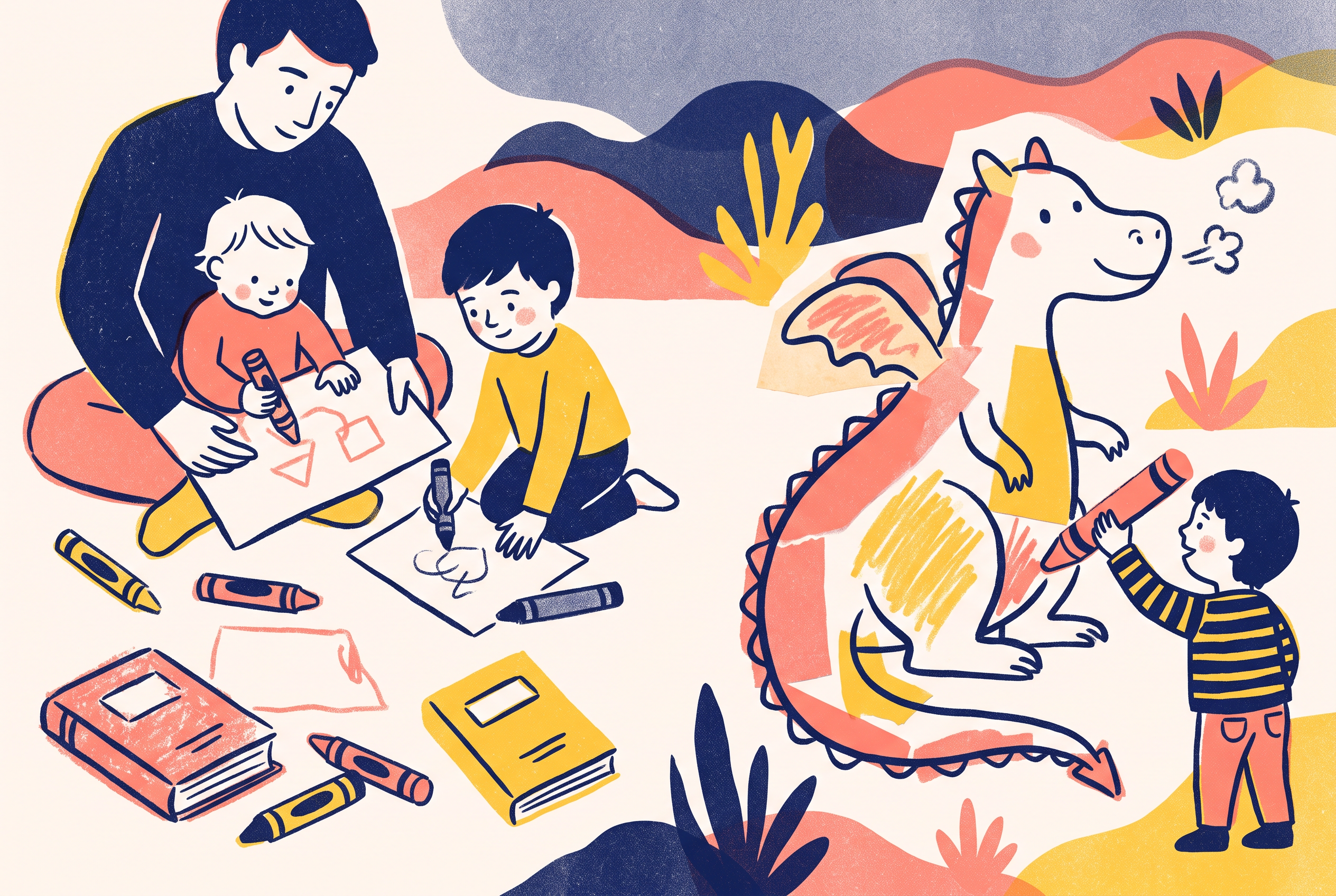
How to Draw a Dragon for Kids: Easy Steps for Ages 2-8
Learn how to draw a dragon for kids with simple circles, ovals, and triangles. Includes a scribble version for toddlers and extra details for ages 6-8.
 Pixley Team
A four-year-old holds a green crayon over a blank page and announces, "I'm making a dragon." Then she looks at you. This is the moment that decides whether drawing time is fun or tense, because the next thing out of her mouth is often "Can you do it?" or "I can't do it right."
Dragons fix this. Nobody has ever seen a real one, so nobody can tell your child their dragon is wrong. A dragon with three legs, a lopsided head, and wings like potato chips is still a perfectly good dragon.
This guide shows you how to draw a dragon for kids using only circles, ovals, and triangles. You get a step-by-step version for a 4 year old with your help, a scribble version for ages 2 and 3, and extra details for ages 6 to 8. Then you draw dragon moods and a dragon family, and finish by naming your dragon and telling its first story. Plan for 20 to 30 minutes, and expect to stop early if your child wanders off. That's allowed.
Why dragons are the perfect first character to draw
Most first drawing prompts have a hidden problem: the child knows what a cat or a house is supposed to look like, and their drawing doesn't match. That gap is where "I can't draw" comes from. If your child has already said it, our guide on what to do when your child says "I can't draw" goes deeper.
Dragons skip the gap. There's no reference photo in anyone's head, so there's nothing to miss. A dragon can be purple, striped, tiny, or the size of a bus.
Dragons also break down into shapes kids already own. A round body, an oval head, triangle spikes, a curly tail. A child who can draw a circle and a triangle can draw a dragon. That matters because drawing skill in this age range moves in stages. Most kids go from scribbles to basic shapes to recognizable figures between ages 2 and 8, and each stage is normal. Our breakdown of the stages of drawing development in children shows what to expect at each age.
The last reason is the biggest one: dragons come with a story built in. Fire, treasure, caves, a friend who is scared of them. Your child will start narrating before the head is finished. Let them. The talking matters as much as the drawing.
So pick the dragon over the cat. Take the pressure off the very first line.
What you need (and how to set up the table)
You need less than you think. Plain paper, a few crayons or washable markers, and a pencil for you. That's the whole list.
A few setup choices make a real difference:
Use chunky crayons or markers for ages 2 to 4. Small hands grip thick tools more easily, and crayons forgive wobble.
Skip the eraser. An eraser tells a child their line was wrong. Keep it off the table, and if a line goes somewhere odd, call it a new spike.
Give your child the good crayon first. Let them pick the dragon's color before you say a word about shapes.
Draw beside them, not on their page. Use your own sheet so your dragon never replaces theirs. Two dragons on the table beat one "fixed" dragon.
Tape the paper down. A page that slides around quietly frustrates toddlers.
Sit next to your child instead of across from them. Side by side, you're teammates. Across the table, you look like a teacher with a grade to give.
One more rule: you narrate, you don't correct. Say "Ooh, the tail is going on a trip" instead of "That tail is too long." Describe what you see and let the dragon be whatever it turns out to be.
Keep a few extra sheets handy. Kids often want to draw a second dragon right away, and a first dragon that felt free tends to lead to a braver second one.
Shape-by-shape dragon steps for a 4 year old, with your help
Here's the core method for how to draw a dragon for kids at age 4. Draw your version slowly on your own paper while your child draws theirs. Describe each shape in kid language, not drawing language.
Step 1: A big bean for the body. Ask your child to draw a big potato shape in the middle of the page. An oval lying on its side works. Say "This is the dragon's tummy, where all the pancakes go."
Step 2: A circle for the head. Add a smaller circle at one end, touching the body. Wobbly is fine. Overlapping is fine.
Step 3: A snout. Draw a smaller oval on the front of the head. This is where the nostrils and the smile live.
Step 4: Two dots and a curve. Eyes are dots. A smile is a curve. Let your child decide whether the dragon looks friendly. Faces carry the story, so give this step time.
Step 5: Four stubby legs. Four little ovals or sausages hanging under the body. Toes are optional. Most 4 year olds draw two legs and call it done. That dragon just stands very proudly.
Step 6: A long curly tail. Start at the back of the body and draw a line that wanders out and curls. Kids love this step because there's no wrong way to make a tail.
Step 7: Triangle wings. Two big triangles on the dragon's back. They can be giant. They can be lopsided.
Step 8: Triangle spikes. A row of little triangles along the back and down the tail. Kids love this part because it's repetitive and satisfying.
Finish with color. Don't offer to "help" with coloring. Let it be messy.
If your child abandons the steps halfway and invents their own, you won. The steps are a ladder, and they're allowed to jump off.
The scribble dragon: a simpler version for ages 2-3
A 2 year old isn't going to follow eight steps, and they shouldn't have to. At this age, drawing is about movement and marks, not pictures. Your job is to attach a dragon to the marks they already make.
Try this:
Hand your toddler a crayon and say "Let's make a dragon's fire." Let them scribble hard and fast, in any color.
When they slow down, point at the scribble and say "Whoa, that's a big dragon puff." Now the scribble has a meaning.
Draw one big circle next to it and say "Here's the dragon's face!" Ask them to add the eyes by tapping dots with the crayon.
Add triangle spikes yourself, one at a time, counting out loud. Let them add one if they want.
That's a complete dragon for a toddler. It took two minutes and it counts.
A few things work well at this age. Use big paper so arm-sized scribbles fit. Make dragon sounds, because a roar is half the activity. Draw a zigzag "dragon walk" line across the page and have them follow it with a crayon. For more ideas at this stage, see our list of drawing activities for toddlers.
Don't ask a 2 year old "what is it?" after they draw. Many toddlers have no answer, and the question can make them feel they drew the wrong thing. Say "Tell me about this part." Some will name it, some will shrug, and both are fine.
The scribble dragon isn't a lesser version. It's the same activity at the right size.
Extra details for ages 6-8: scales, spikes, and fire
By 6, kids notice that their drawings don't match the picture in their heads, and some start to get picky. The fix isn't more help from you. It's more interesting challenges.
Offer these upgrade options and let your child choose:
Scales. Draw rows of small curved lines like fish scales, or little half circles stacked in rows. Kids can color each scale a slightly different shade.
Overlapping shapes. Show them that if the wing goes behind the body, it looks tucked back. Overlap is the first trick that makes a drawing feel three dimensional.
A belly patch. A lighter oval on the tummy with horizontal lines gives the dragon a real dragon look.
Horns and frills. Small triangles or curved cones on top of the head, plus a fan-shaped frill behind the ears.
Fire. Draw the flame as three or four teardrop shapes layered inside each other, red on the outside, orange in the middle, yellow in the center.
A setting. A cave, a mountain, a castle in the far corner. A background turns a drawing into a scene.
At this age, you can also introduce a simple "head, body, tail" side view versus a front-facing dragon. A front view with two eyes and two nostrils looks very different from a side profile, and trying both shows how the same shapes can do different jobs.
Resist the urge to fix proportions. If the head is bigger than the body, the dragon has a big brain. An older child who wants advice will ask for it.
For kids who like sequences, try drawing the dragon in four panels: waking up, stretching, breathing fire, going back to sleep. Our comic strip ideas for kids has more prompts like this.
Draw the dragon happy, nervous, and grumpy
Once your child has one dragon on paper, draw the same dragon again with a different feeling. It's the easiest way to turn a drawing activity into an emotions activity without announcing a lesson.
Keep the body the same and change only the face and tail:
Happy dragon. Big curved smile, eyes as round dots, tail pointing up, tiny flames shaped like hearts or stars.
Nervous dragon. Eyebrows tilted up in the middle, a wavy mouth, tail curled around the legs, wings pulled in close.
Grumpy dragon. Eyebrows slanted down toward the nose, a flat or downturned mouth, arms folded, smoke puffing from the nostrils.
Lay all three side by side and ask simple questions. "What do you think made this dragon grumpy?" "What would help the nervous one feel better?" Kids answer these with surprising honesty, because the feeling belongs to the dragon, not to them.
This works because naming an emotion on a character is easier than naming it on yourself. A child who can't say "I felt left out at school" can often say "the nervous dragon felt left out at the dragon party." You get the information without the interrogation.
If your child enjoys this, our feelings drawing activity for kids goes further with a full set of emotions to draw.
Don't rank the moods. A grumpy dragon isn't a bad dragon. Say "Grumpy dragons are allowed. What does this one need?" and then listen.
Three faces on one page also make a great cast for the story you're about to tell.
Give the dragon a family
A dragon alone is a drawing. A dragon with a family is the start of a world.
Ask your child, "Does your dragon have a mom? A dad? A baby? A grandma?" Then draw each one using the same shapes, changed in a few ways:
Baby dragon. A small circle body, a huge head, tiny wings, no spikes yet.
Big sibling. Same shapes, but with a goofy detail, like mismatched socks on the feet.
Grandma dragon. Round glasses made of two circles, a shawl made of zigzag triangles, a cane for the tail to curl around.
Dragon pet. A tiny dragon-shaped dragon, because why not.
Let your child choose every detail. If they want the dad to have six legs, he has six legs.
Drawing a family also builds a habit that matters later: keeping a character consistent across drawings. A dragon with a blue belly in one picture and a blue belly in the next feels like the same dragon. Kids start doing this on their own around ages 5 and 6, and a family makes it fun instead of fussy.
A family also gives you story fuel. Who snores? Who burns the toast? Who is afraid of the dark? Every answer is a plot point waiting to be used.
If your child likes drawing relatives, our family drawing activity for kids turns the idea into a full character-making session.
Hang the whole dragon family in a row on the wall or fridge, with names written under each one. A row of dragons beats a single page.
Name your dragon and tell its first story
The drawing is done. The best part is next.
Ask your child to name the dragon. Silly names beat sensible ones: Sir Waffles, Gigglefire, Mrs. Mud Puddle. Write the name at the top of the page in your best handwriting. Naming a character makes a child feel like its author.
Then tell the first story together. Use three questions as a skeleton:
What does your dragon want? (A friend, a snack, a place to sleep.)
What gets in the way? (A storm, a grumpy knight, a very loud hiccup.)
How does it end? (Usually with a hug, a snack, or both.)
Write down the story in your child's own words, even if it's only three sentences. A story that's typed or written on the back of the drawing becomes a keepsake. For more ways to build this habit, see our guides on turning your child's drawing into a story and draw and tell stories for preschoolers.
This is also where Pixley fits. Pixley turns kids' drawings and ideas into personalized animated cartoons and bedtime storybooks for ages 2 to 8. You can describe a lesson you want taught, such as handling a nervous feeling or sharing a snack, and Pixley creates a cartoon episode around your child's own drawn dragon. Every generation passes child-safety filtering before your child sees it, and the app is ad-free with an iOS free trial.
The moment worth waiting for is a child seeing their own wobbly dragon show up on screen as a character in a real cartoon. The story is yours first. The cartoon comes next.
Conclusion
Draw one dragon this week, and keep the wobbles. Tape it somewhere your child can see it, write the name underneath, and save the three-sentence story you made up together. Then take that same dragon, with its name and its grumpy or nervous mood, and give it a bigger stage. Open Pixley on iOS, start the free trial, and describe a lesson you want your child to hear, like how a nervous dragon finds courage. Your child's own drawing becomes the star of a cartoon episode, and a scribble from the kitchen table turns into something they can watch, talk about, and ask for again at bedtime.
Frequently Asked Questions
How do I teach a 3 year old to draw a dragon?
Keep it to three or four shapes: a big circle for the head, an oval body, triangle spikes, and a curly tail. Draw beside your child on your own paper and narrate instead of correcting. Scribbles count as dragon fire. For turning the finished drawing into a cartoon, Pixley, an iOS app for ages 2 to 8, offers a free trial.
What shapes do you use to draw an easy dragon?
An easy dragon uses an oval for the body, a circle for the head, a smaller oval for the snout, triangles for wings and spikes, and a long curved line for the tail. Kids already know these shapes, so the steps feel familiar. Wobbly versions work just as well, and the child's version is the one worth keeping.
What age can kids start drawing a dragon?
Toddlers around age 2 can make a scribble dragon by adding a circle face and dot eyes to a scribble. Ages 3 to 5 can follow shape-by-shape steps with help. Ages 6 to 8 can add scales, overlapping wings, and backgrounds. Every stage is normal, and the drawing does not need to look like a dragon to count.
How can I turn my child's dragon drawing into a story?
Ask your child to name the dragon, then answer three questions: what does it want, what gets in the way, and how does it end. Write their words on the back of the drawing. To go further, Pixley turns kids' drawings and ideas into personalized animated cartoons and bedtime storybooks, with child-safety filtering on every generation.
What should I do if my child says their dragon looks bad?
Skip the eraser and skip fixing it. Point to something you like, such as "I love how long this tail is," and ask them to tell you about the dragon. Dragons are imaginary, so no version is wrong. Drawing a second dragon, or a dragon family, often rebuilds confidence faster than reassurance does.