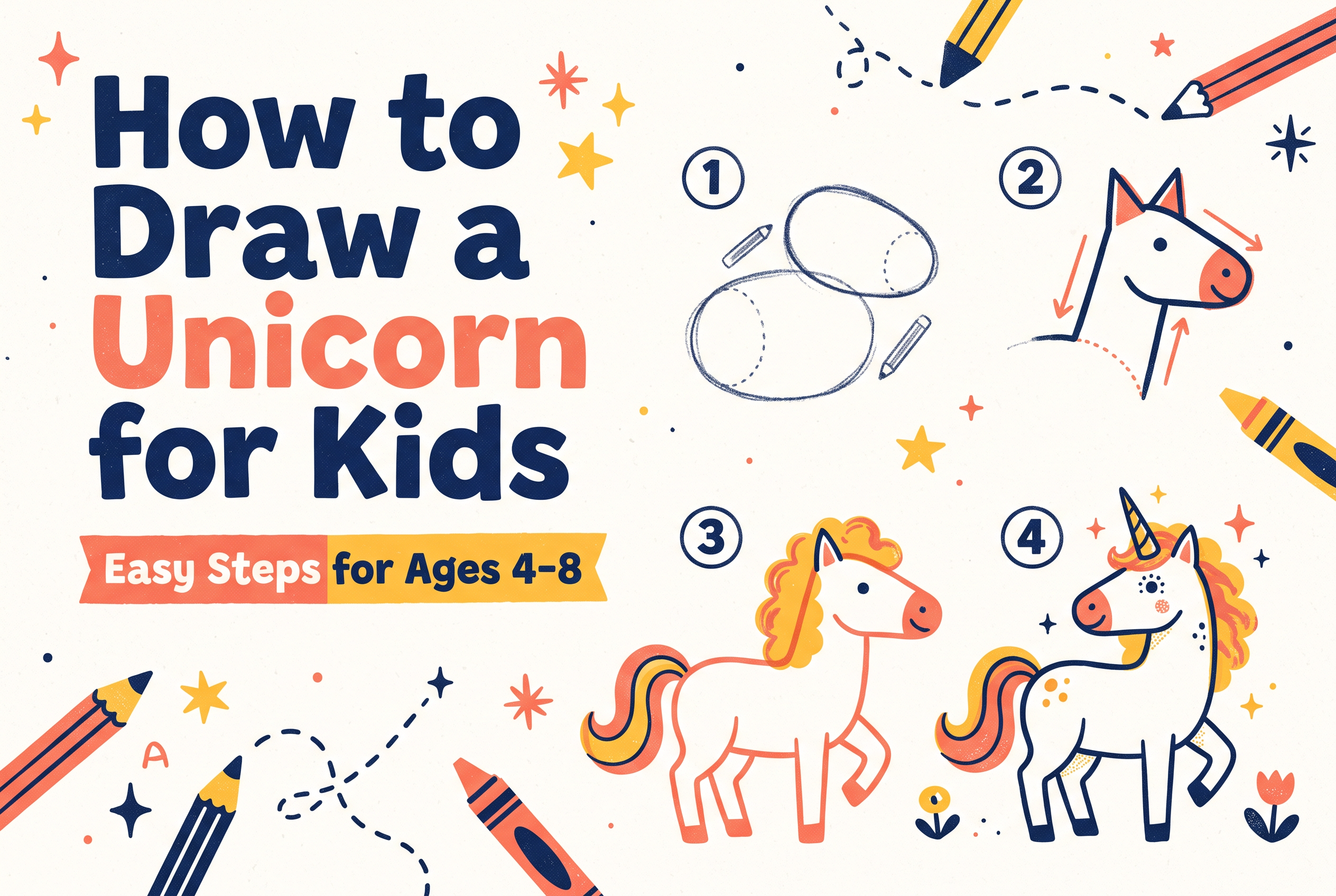
How to Draw a Unicorn for Kids: Easy Steps for Ages 4-8
Learn how to draw a unicorn for kids in simple shape steps, with a simpler version for ages 4-5, extra detail for 6-8, colour ideas and a story twist.
 Pixley Team
The easiest way to draw a unicorn for kids is to build it from basic shapes: an oval body, a smaller oval head, four stick legs, a triangle horn and a wavy mane. Ages 4-5 can finish a charming unicorn in six steps, and ages 6-8 can layer on swirls, hooves and a flowing tail.
This tutorial follows the same shape-first format as our dragon and dinosaur drawing guides. You will get a simple version, a detailed version, colour ideas, a one-minute speed version, and a last step that turns the finished unicorn into a character with a story. Pixley is an app that turns kids' drawings and ideas into personalized animated cartoons, bedtime storybooks and learning games for ages 2-8, so the drawing doesn't have to end up on the fridge and nowhere else.
What You Need Before You Start Drawing a Unicorn
You need paper, a pencil, an eraser and something to colour with. That's the whole list. Skip anything fancy, because a pencil and a sheet of printer paper keep the pressure low and the mistakes cheap.
A few small choices make the session go better:
Use a pencil first, then trace over it. Light pencil lines let a child redo a wobbly leg without a meltdown. Once the shapes feel right, go over them in marker or crayon.
Pick one colour set before you begin. Crayons, washable markers or coloured pencils all work. Fewer choices means less stalling.
Draw alongside your child, not for them. Sketch your own unicorn on a second sheet. Kids copy the process, not the finished picture, and you'll both end up with different unicorns, which is the point.
Decide where the finished drawing goes. A photo, a wall spot or a story (see the later section) gives the drawing a purpose and keeps kids willing to try again.
If your child is still in the scribble-to-shape phase, that's fine. Unicorns forgive wonky proportions better than almost any animal, because nobody has seen a real one to compare.
How to Draw a Unicorn in 6 Simple Shape Steps (Ages 4-5)
A very beautiful unicorn starts with big, simple shapes, and six steps get a 4 or 5 year old there. Say each step out loud as you draw so your child can follow shape by shape.
Step 1: Draw a big oval for the body. Lay it on its side in the middle of the page, like a bean or a sleeping egg.
Step 2: Add a smaller oval for the head. Tuck it at the top right of the body, slightly overlapping. A short, thick neck line on each side joins the two shapes.
Step 3: Draw four straight lines for legs. Two at the front, two at the back. Ask your child to make them as long as pencils. Little rectangles at the bottom make hooves if they want them.
Step 4: Put a triangle on the head for the horn. This is the moment kids light up. Point it straight up from the forehead. Add a small triangle or curve beside it for an ear.
Step 5: Add the mane and tail with wavy lines. Wiggly lines down the neck are the mane. A big curly line off the back end is the tail. There's no wrong way to wiggle.
Step 6: Finish the face. One dot for the eye, a small curve for a smile, a tiny dot for the nostril. Done.
This version leaves out tricky knees, realistic anatomy and perfect circles. For ages 4-5, the goal is a unicorn the child made and recognises, not a unicorn that looks like a picture book. If you want more low-key warm-ups, our list of drawing activities for preschoolers has ten ideas for this age.
Add More Detail for Ages 6-8: Mane, Tail, Legs and Horn Swirls
Ages 6-8 can build on the six-step unicorn by adding detail in four places: the horn, the mane, the tail and the legs. Draw the basic version first, then upgrade one area at a time so it never feels like a new, harder drawing.
Horn swirls. Draw two or three curved lines wrapping around the triangle, like a candy cane. Slanted parallel lines work too. Start with the horn, because it's the part kids care about most.
A layered mane. Instead of one wavy line, draw three or four long S-curves that overlap, with the longest at the front. Let a few strands fall over the forehead as a fringe.
A fuller tail. Draw two or three curves that start from the same spot and fan out, then add a small curl at the tip. A thick tail balances the mane and makes the unicorn look like it's moving.
Bending legs. Older kids can add a knee bend. Draw each leg in two pieces, a thicker upper part and a thinner lower part, with a slight angle where they meet. Raise one front leg for a prancing pose.
Three extras make a 6-8 year old's unicorn feel finished:
A small star or heart on the flank, like a cutie mark
Long eyelashes and a bigger eye with a white sparkle left uncoloured
A curved flower crown or ribbon between the ears
This is also the stage where drawings start to follow clear rules, like ground lines and recognisable shapes. If you're curious how that develops, see our guide to the schematic stage of drawing.
Unicorn Colour Ideas: What Colours to Paint a Unicorn
A unicorn is traditionally white, but there's no rule, and the most fun answer to "what colour is a unicorn?" is whatever your child picks. White with a silver or gold horn is the classic. Pastel pink, lilac and sky blue are the most popular storybook choices. Rainbow manes and tails are the easiest way to make any unicorn feel magical.
Try one of these palettes:
Classic: white body, gold horn, pink and purple mane
Rainbow: pale body, mane and tail in red, orange, yellow, green, blue and purple stripes
Galaxy: dark blue or purple body, with white and yellow dots for stars
Cotton candy: pink and baby blue swirled together, with a white horn
Forest unicorn: soft green body, brown hooves, a mane in autumn oranges
Practical tips: colour the horn and mane last so they stand out, leave a few small white spots for sparkle, and let your child outline in a darker shade of the same colour. For a watercolour look with young kids, colour with crayon first, then brush light paint over the top.
Colour choices also say something about how your child feels that day. Our guide to what colours in kids' drawings mean explains what's worth noticing and what's just a favourite crayon.
How to Draw a Unicorn Fast: A 1-Minute Version for Restless Artists
A unicorn can be drawn in about a minute using just five quick marks, and it's a good fit for kids who lose interest halfway through a longer tutorial.
Bean body: one quick oval.
Head circle: a smaller circle at one end.
Four sticks: straight lines for legs.
Horn triangle: one pointed triangle on top.
Squiggles: a wavy line for the mane and a curl for the tail.
That's it. Add two dots for eyes if there's time left.
Turn it into a game: set a timer and see how many unicorns your child can draw before it rings. Each one will look a little different, and that variety is where kids start to find their own style. Draw a whole herd, give each unicorn a name, and you've got the start of a story. Speed rounds also take pressure off, since no single drawing has to be the good one.
Turn Your Finished Unicorn Into a Story Character
The finished drawing is the beginning of a character, so give it a name, a problem and a place to live before you put the pencil down. Ask your child three questions:
What is your unicorn's name? (Sparkle Pickle is a perfectly good answer.)
What is it really good at, and what is it scared of?
Where does it live, and who is its best friend?
Write the answers on the back of the drawing. Now you have a main character, a flaw and a setting, which is all a young child's story needs.
This is where Pixley fits. Pixley turns a child's drawing into a personalized animated cartoon, so the unicorn they just drew becomes the star of its own episode. Parents can also describe a lesson they want taught, such as sharing, big feelings or trying again, and Pixley creates a cartoon episode around it. Every generation passes child-safety filtering before a child sees it, and the app is ad-free and available on iOS with a free trial. Kids love one moment most: seeing their own scribbled creature move and blink back at them on screen.
If you want to compare options for bringing drawings to life, we rounded up apps that animate kids' drawings for ages 2-8. And if a printed keepsake sounds better, see our list of apps that turn kids' drawings into storybooks.
Keep the Drawing Fun Going: More Ideas to Try Together
If you're wondering what to draw for a 7 year old after the unicorn, the best next prompts are ones that add a story: a unicorn's home, a unicorn's best friend or a unicorn on an adventure. Seven year olds like challenges with a goal, so give the drawing a job.
Ideas to try next:
Draw the unicorn's friend. A dragon, a dinosaur or a talking cloud. Our dragon and dinosaur tutorials use the same shape method.
Draw the unicorn's world. A rainbow bridge, a cloud castle or a glittery forest.
Make a four-box comic. Beginning, problem, fix, happy ending. Our comic strip ideas for kids post has prompts to start from.
Draw your whole family as unicorns. Everyone picks their own colours and horn style. Our family drawing activity turns this into a story-character game.
Try a prompt list. Drawing prompts for elementary students gives 30 K-2 ideas when you run out of your own.
Keep sessions short, since ten to fifteen minutes is plenty, and praise the idea, not the accuracy. "I love how your unicorn is flying" does more than "that looks great."
Draw the Unicorn, Then Let It Star in Its Own Story
A good unicorn drawing is a few shapes, a pointed horn and a child who feels proud of it. Start with the six simple steps, add swirls and detail as your child grows, and always ask for a name and a story before the drawing gets put away. Then take one finished unicorn and try it in Pixley: use the free trial on iOS to see your child's own drawing become the star of a cartoon.
Frequently Asked Questions
How do you draw a very beautiful unicorn?
Start with an oval body and a smaller oval head, add four legs, then give the unicorn a swirled horn, a layered flowing mane and a full curved tail. Beauty comes from details like eyelashes, a sparkle left white in the eye and a star on the flank. Colour the horn and mane last so they stand out.
What color is a unicorn?
Traditionally a unicorn is white with a gold or silver horn, but any colour works. Pastel pink, lilac and sky blue are popular, and rainbow manes and tails are the easiest way to add magic. Let your child choose. Once the drawing is finished, Pixley can turn it into an animated cartoon in the colours they picked.
What should I draw with a 7 year old?
Give a 7 year old a drawing with a goal, such as a unicorn and its best friend, its home or a four-box comic strip. Drawing a story, not just a picture, holds their interest longer. Afterwards, Pixley can turn the drawing into a personalized cartoon starring their own character.
How do you draw a unicorn fast?
Draw a bean-shaped oval for the body, a small circle for the head, four stick legs, a triangle horn and wavy lines for the mane and tail. This takes about a minute. Use a timer and draw a whole herd to keep restless kids engaged, and name each one to start a story.
How can a 4 year old make an easy unicorn?
Keep it to six shapes: a big oval body, a small oval head, four straight legs, a triangle horn, wavy lines for mane and tail, and dots for eyes. Say each step aloud and draw alongside your child. Aim for a unicorn they recognise as their own, not a perfect one.