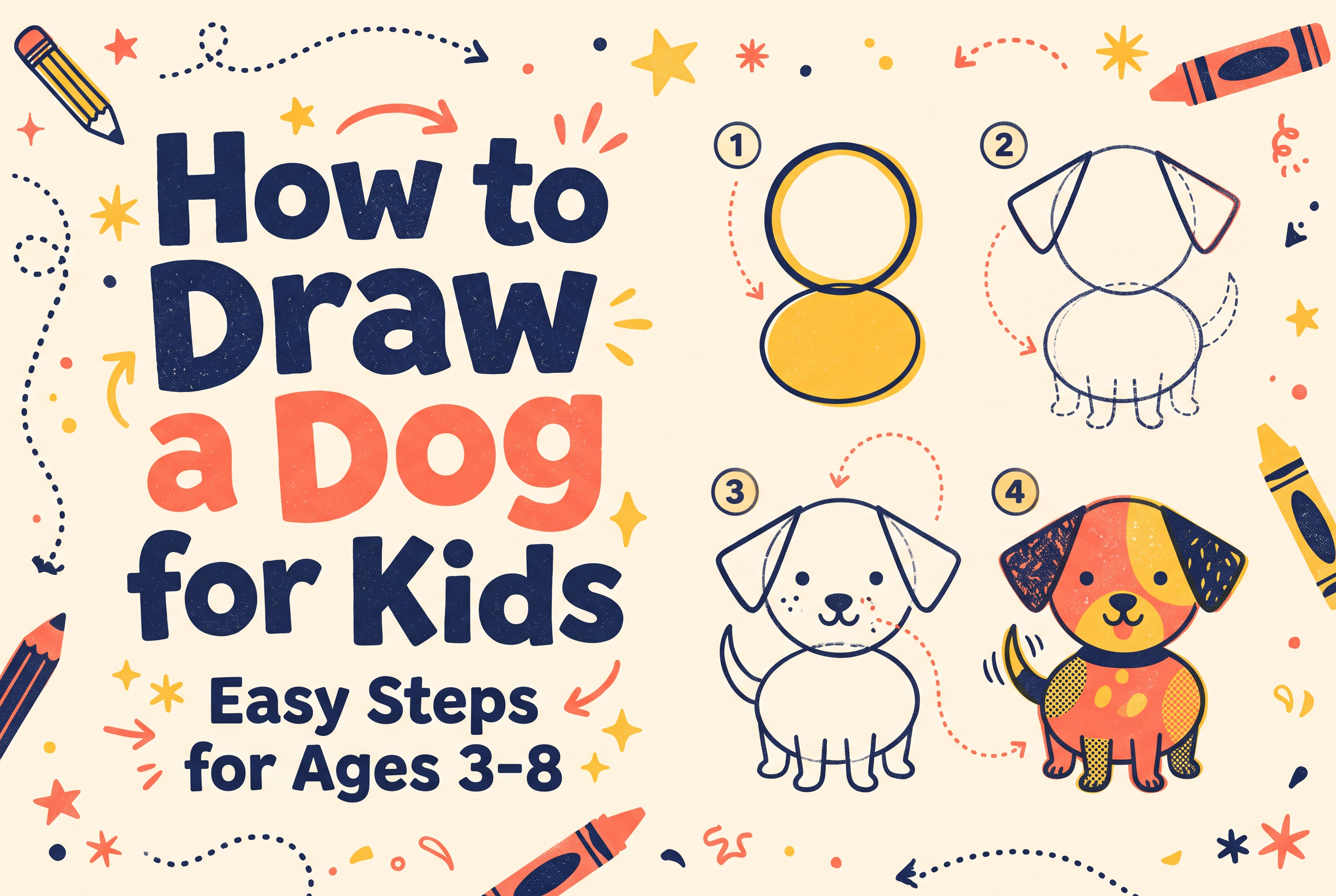
How to Draw a Dog for Kids: Easy Steps for Ages 3-8
Learn how to draw a dog for kids with an oval body, round head, and floppy-ear triangles. Easy and harder versions for ages 3-8, plus ways to turn it into a…
 Pixley Team
To draw a dog for kids, start with a big oval for the body and a smaller circle for the head, then add triangle ears, four short legs, a tail, and a face. That is the whole method: ovals, circles, and triangles. No artist required.
This guide walks you through each step, gives you an easier version for ages 3-4 and a harder one for ages 5-8, and then does something most dog tutorials skip. Once the dog exists, you name it, give it a problem, and turn it into a cartoon character with Pixley, an app that turns kids' drawings and ideas into personalized animated cartoons, bedtime storybooks, and learning games for ages 2-8.
What You Need Before You Start Drawing a Dog
You need paper, a pencil with an eraser, and something to color with. That is the full supply list.
Use a pencil first, even if your child loves markers. Pencil lines can be erased, and kids relax when a wobbly oval is not permanent. Save the crayons or markers for the coloring step at the end.
Sit next to your child and draw your own dog on a separate sheet. Kids copy shapes more easily when they can see someone else making the same wobbly oval. If you have already tried the cat tutorial or the dinosaur tutorial, this will feel familiar. Same shapes, new animal.
Step 1: Start With an Oval Body and a Round Head
Draw a big oval in the middle of the page for the body, then a smaller circle touching one end of it for the head.
Tilt the oval slightly, or lay it flat like a loaf of bread. Either works. Place the circle a little above the oval so the dog looks like it is holding its head up. If the head overlaps the body, that is fine. Overlap makes the dog look connected, and kids rarely mind.
The most common stumble is size. A head that is too big makes a puppy, which is a perfectly good dog. Let your child decide.
Step 2: Add Ears, Legs, Tail, and a Snout
Add two floppy triangles for ears, four short rectangles for legs, a curved line for the tail, and a small oval snout on the head.
Take these one at a time:
Ears: Draw a triangle on each side of the top of the head, with the point hanging down. Pointing the tip down makes the ear floppy. Pointing it up makes a pointy-eared dog.
Legs: Draw two short rectangles under the front of the body and two under the back. They do not need to match.
Tail: Draw a curved line off the back end of the oval. A curl, a straight stick, or a wag-wag zigzag all read as dog.
Snout: Draw a small oval on the lower half of the head, then a smaller dark oval at its tip for the nose.
Stop after each part and let your child choose what comes next. The order matters less than the feeling that they are building the dog themselves.
Step 3: Give Your Dog a Face and Personality
A dog's personality comes from three small choices: the eyes, the mouth, and the tongue.
Two dots make a calm dog. Two big circles with smaller dots inside make a surprised or excited one. Add a curved line under the nose for a smile, and a pink tongue hanging out for a happy, panting dog. Droopy eyebrows over the eyes make a sad or worried dog.
Ask your child, "How is your dog feeling today?" Then draw that feeling. This one question turns a shape exercise into the start of a character, and it sets up the story step later in this guide.
Easier and Harder Versions: Dog Drawing for Ages 3-4 vs Ages 5-8
Ages 3-4 do best with big shapes and few steps, while ages 5-8 can add bent legs, fur details, and expressions.
| Ages 3-4 | Ages 5-8 | |
|---|---|---|
| Body | One big oval | Oval with a slightly bent back |
| Head | Circle stuck to the body | Circle with a separate snout and chin |
| Legs | Four straight sticks or rectangles | Legs with paws and a bend at the knee |
| Ears | Two triangles | Floppy, folded, or pointed ears with an inner line |
| Face | Two dots and a smile | Eyes with shine, nose, whiskers, eyebrows |
| Extras | A scribble of color | Collar, spots, fur tufts, a background |
For a 3-year-old, your job is to draw the oval and let them add anything they like. Scribbled legs still count as legs. If you want to understand why a young child's dog looks the way it does, stages of scribbling explains what kids are working on at each age.
For 5 to 8, challenge them with a side view, a running dog, or a dog sitting down. Older kids also enjoy drawing a dog doing something, like catching a ball, which pushes them toward the storytelling stage.
Make It Yours: Breeds, Spots, Collars, and Colors
Once the basic dog exists, change one thing at a time to make it a different dog, and let your child pick every color.
Dalmatian: Leave the body white and add black circles.
Dachshund: Stretch the oval into a long sausage and shorten the legs.
Fluffy dog: Draw the outline with little zigzag edges instead of smooth lines.
Puppy: Make the head bigger than the body and the legs tiny.
Collar: Draw a band under the head and add a small circle for a tag.
A purple dog with green spots is a better drawing than a realistic brown one if your child chose it. Resist correcting colors. The drawing is the child's, and the more control they have, the more attached they will be to the character.
Name Your Dog and Give It a Story
A dog becomes a story character the moment it has a name, something it loves, and something it worries about.
Ask three questions and write the answers on the back of the drawing:
What is your dog's name?
What does your dog love most?
What is your dog scared of, or what problem does it have?
That is a plot. A dog named Biscuit who loves digging and is afraid of the vacuum cleaner already has a beginning, a middle, and an ending waiting to happen. Problems that kids relate to, like not wanting to share a bone or waiting for a turn, also make good lessons. If you want to practice that theme, try simple scripts and games for teaching kids to take turns.
For more ways to build a story from a single drawing, see this parent's guide to story drawing. And if your child ends up with a stack of dog drawings, you can turn kids' drawings into a book for bedtime.
Turn Your Child's Dog Drawing Into a Cartoon Character in Pixley
Pixley turns your child's dog drawing into a character in a personalized animated cartoon, so the dog they drew can star in its own episode.
The flow is simple. Finish the drawing, give the dog a name, and open Pixley on iOS. Describe the story or the lesson you want, such as sharing, being brave, or handling a big feeling, and Pixley creates a cartoon episode around it. Parents describe any lesson they want taught, covering social and emotional learning goals or educational topics, and every generation passes child-safety filtering before your child sees it.
The payoff is the moment a kid sees their own scribbled dog show up on screen. Screen time stops being someone else's characters and becomes their own idea come alive. Pixley is ad-free, built for ages 2-8, and available as a free trial on iOS, so you can try it with one drawing before deciding anything.
If you want to compare options first, see apps to animate kids' drawings.
Frequently Asked Questions
The short answers are below, and the FAQ section that follows covers the most common questions in full.
Draw one dog tonight, then give it a name and a problem
A dog drawn from an oval, a circle, and two triangles is enough to start a story, and what your child says about it matters more than how it looks. Draw one together tonight, write its name and its biggest worry on the back, then open Pixley and describe the lesson you want. Your child will see their own dog in a cartoon, and that is the moment a doodle becomes a character.
Frequently Asked Questions
How do you draw a dog for kids step by step?
Draw a big oval for the body and a smaller circle for the head. Add two triangle ears, four short legs, a curved tail, and a small oval snout with a nose. Finish with two eyes and a smile. These ovals, circles, and triangles work for ages 3-8.
What is the easiest dog to draw for a 3-year-old?
A sitting or standing dog built from one oval body, one circle head, two triangle ears, and stick legs. Skip the snout and fur details. Let your child scribble the color. At this age, a dog with a face and a tail already counts as a dog.
How can I help my child draw a dog if I can't draw?
Draw alongside them using only ovals, circles, and triangles, and narrate each shape out loud. Your dog does not need to look good. Kids learn from watching someone try, and a wobbly dog models that mistakes are fine.
How can I turn my child's dog drawing into a cartoon?
Ask for the dog's name, what it loves, and what worries it. Then open Pixley on iOS and describe the story or lesson you want. Pixley creates a personalized animated cartoon episode around your child's drawing, with child-safety filtering on every generation.
What age can kids start drawing dogs?
Kids around 3 or 4 can follow a simplified shapes-first dog with a few steps. Ages 5-8 can add bent legs, paws, collars, and expressions. Whatever the age, praise the choices they make rather than how realistic the dog looks.