How to Make a Comic Book With Kids: A Parent's Guide
Learn how to make a comic book with kids: fold a one-sheet booklet, pick a hero, plan panels, add speech bubbles and a cover, with tips for ages 4 to 8.
 Pixley Team
To make a comic book with kids, fold one sheet of paper into an eight-panel booklet, pick a hero, plan a story with a beginning, a problem and an ending, then draw it one panel at a time and add speech bubbles and a cover. The whole project needs paper, a pencil, markers and about an hour, and it works for any child who loves to draw.
Comics suit ages 4 to 8 because the story lives in pictures. A child who can't write a sentence yet can still tell a full story across six pages. A child who writes plenty gets a reason to keep it short and punchy.
This guide covers the booklet fold, the story, the panels, the drawing, age-by-age adjustments, and how to share the work between siblings or classmates. At the end, the hero of your finished comic can come to life as an animated cartoon in Pixley, which turns kids' drawings and ideas into personalized animated cartoons.
What You Need to Make a Comic Book With Kids (and the One-Sheet Booklet Fold)
You need one sheet of paper, child-safe scissors, a pencil, an eraser and markers or crayons. That's the whole kit. Printer paper works, and so does a sheet from a drawing pad.
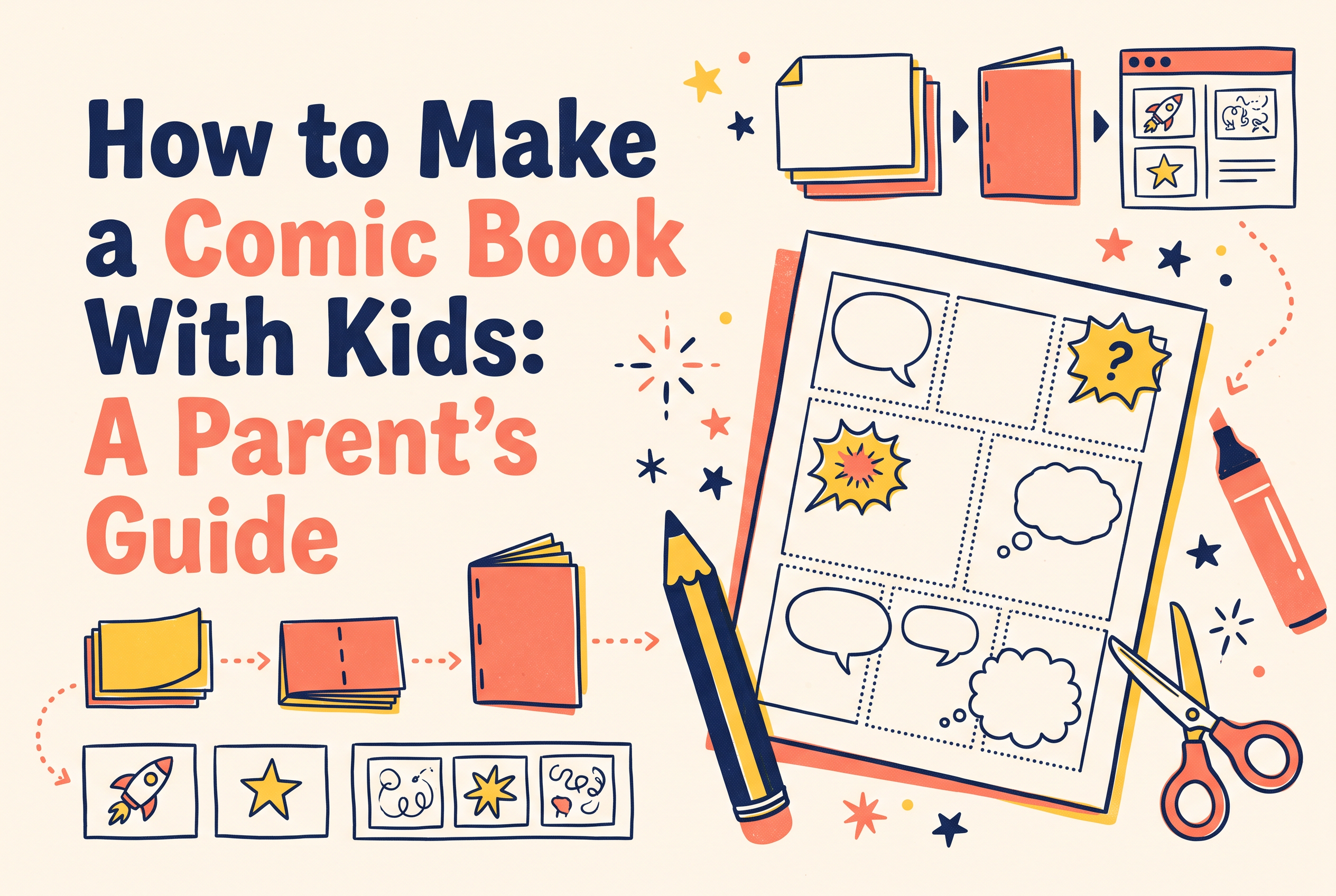
The booklet is a single sheet that folds into a tiny eight-page book. Here is the fold:
Fold the sheet in half, then in half again, then once more. Unfold it. The creases split the paper into eight rectangles.
Fold the sheet in half across the short direction. With the folded edge facing you, cut along the middle crease from the folded edge to the center only. Stop at the center. Do not cut all the way across. An adult should handle the scissors for younger kids.
Unfold, then fold the sheet in half along the long direction. Push the two ends toward each other and the slit opens into a diamond or X shape.
Keep pushing until the pages meet, then press the booklet flat. Check that the cover is on the outside.
Before any drawing happens, lightly number the pages in pencil. Eight pages gives you a cover, six story pages and a back cover. That is plenty for a first comic.
One tip: make two booklets. The first is a practice run, and kids who see the fold work once are far more relaxed the second time.
Step 1: Pick a Hero and a Simple Story (Beginning, Problem, Ending)
To write a comic book, start with a character and a three-part story: a beginning, a problem and an ending. Everything else is decoration.
Start with the hero. Ask your child three questions: Who is it? What do they love? What are they scared of or bad at? A dragon who loves pancakes but is afraid of the dark is already a story.
Then build the plot in three beats:
Beginning: meet the hero in their normal day.
Problem: something goes wrong or someone needs help.
Ending: the hero solves it, or learns something, or both.
Say it out loud before anyone picks up a pencil. "Pancake Dragon wakes up hungry. The pancakes are on a high shelf in a dark cupboard. He turns his own flame into a night-light and gets them." If your child can tell it in three sentences, the comic is ready to plan.
Stuck for a hero or a premise? The comic strip ideas guide has 30 prompts, and how to draw a cartoon character with kids walks through designing a hero step by step.
Parents also ask whether comic books were made for kids. Early comics were aimed at a broad family audience, and children have been reading and making them ever since. Your kid isn't doing something grown-up. They're joining a very old kids' tradition.
Step 2: Plan the Panels Before Drawing
Plan the panels first. A comic with a plan finishes, and a comic without one stalls on page two. A panel is a box that shows one moment. The space between panels, called the gutter, is where the reader imagines what happens next.
For a first comic, keep it small:
One to two panels per page on the six story pages for ages 4 to 5.
Two to four panels per page for ages 7 to 8.
One big "splash" panel on the page where the problem is solved.
Have your child sketch the plan as stick-figure thumbnails on a spare sheet. Each thumbnail answers one question: what is the one thing the reader must see here? If a box needs three things, split it into two boxes.
Match the thumbnails to your three beats. Page 1 is the beginning. Pages 2 to 4 build the problem. Pages 5 and 6 are the ending. Write nothing yet. Draw only what happens.
Mark each panel's shot lightly: close-up on a face for feelings, wide view to show where the hero is. Kids pick this up fast, and it makes the comic read like a comic instead of a row of identical pictures. If your child wants to go further with turning pictures into a sequence, story drawing step by step covers the same planning habit.
Step 3: Draw, Add Speech Bubbles and Captions, and Make a Cover
Draw in pencil first, add words second, and color last. That order protects the drawing from cramped lettering and smudged marker.
A comic has five working parts: panels, speech bubbles, captions, gutters and the pictures themselves. You've handled panels and gutters. Now add the words:
Speech bubbles show what a character says. Draw the bubble first, then write inside it, so the words always fit. Add a small tail pointing at the speaker.
Captions are boxes for the narrator: "The next morning..." or "Deep in the cupboard." Use them sparingly.
Sound words like CRASH or SPLAT make great single-word panels for reluctant writers.
Keep the text to a handful of words per bubble. If a child dictates a long speech, help them pick the five words that matter most.
Then make the cover, which many kids love most. A good cover has the title in big letters, the hero front and center and the author's name: "By Maya, age 6." Draw it last, once the hero looks the way your child wants them to look.
Finish by tracing the pencil in marker, erasing the leftovers, and coloring. Fold the booklet closed and read it aloud together. That first read-through is the payoff.
How to Adjust the Project for Ages 4, 5-6 and 7-8
Match the project to the age and everyone finishes happy. The same eight-page booklet works across ages 4 to 8 if you change who does what.
Age 4: Aim for one picture per page and let your child dictate while you write the words. Skip speech bubbles or add just one. A four-page story (fold the booklet but use only the cover and three pages) is a real win. Expect scribbly, symbolic drawings, and treat them as the finished art. If you're curious what your child's drawings show at this stage, the preschematic stage of drawing is a useful read.
Ages 5 to 6: Two panels per page and one word or short phrase per bubble. Let your child write their own letters, spelling and all. Add a cover title and a "the end." This is the age when the beginning-problem-ending structure clicks.
Ages 7 to 8: Up to four panels per page, captions, sound words and a recurring character with a catchphrase. These kids can plan thumbnails on their own and may want to make a second issue. Encourage a cliffhanger on the last page.
At every age, your job is the same: keep the pencil in their hand. Help with the fold, the ruler lines and the spelling if asked, but never redraw their hero.
Making It a Team Project: Turns, Roles and Sharing the Pencils
A comic is easy to split into jobs, so it suits siblings, friends and classrooms. Give every child a role and a turn, and most arguments over the pencil disappear.
Try these roles:
Writer: tells the three-sentence story.
Penciller: draws the panels.
Letterer: writes the bubbles and captions.
Colorist: adds color at the end.
Cover artist: designs the front.
Rotate roles on the next comic so nobody is stuck coloring forever. For two kids, trade pages: one draws odd pages, one draws even pages, and both agree on the hero's look first with a quick reference sketch.
Set one rule up front: you can suggest, but the person holding the pencil decides. For more ways to keep things fair, the guide on taking turns when drawing together offers simple turn-based draw-and-tell games that carry over neatly to comics.
Teachers can run this as a center. Pairs make a booklet over two or three short sessions, then "publish" by reading aloud to the class.
Turn Your Comic Hero Into an Animated Cartoon With Pixley
Once the comic is finished, the hero doesn't have to stay on paper. Pixley turns kids' drawings and ideas into personalized animated cartoons, bedtime storybooks and learning games for ages 2 to 8, built to be safe and ad-free.
Here is how it fits. Your child's hero, say Pancake Dragon, becomes the star of a cartoon episode. You describe a lesson you'd like the story to teach, such as bravery, sharing or handling big feelings, and Pixley creates an episode around it. Every generation passes child-safety filtering before your child sees it. Pixley is available on iOS with a free trial.
The comic did the hard creative work: your child invented a character, gave it a problem and drew it. Seeing that same scribbled hero move and talk on screen is the moment kids light up. Pixley's co-founder Pranit puts it this way: "The magic moment is a kid seeing their own scribbled dragon blink back at them in a real cartoon."
If you want to see how animation from drawings works across different tools, apps to animate kids' drawings compares your options.
Fold one sheet tonight, then give your hero a cartoon
A comic book is the smallest complete story a child can make: one sheet, eight pages, a hero, a problem and an ending. Fold the booklet this evening, plan three beats and let your child draw the first panel. When the last page is done, take a photo of the hero and bring that character to life in Pixley, where your child's own drawing becomes the star of an animated cartoon.
Frequently Asked Questions
How do you write a comic book?
Start with a hero, then give the story a beginning, a problem and an ending. Sketch each page as simple thumbnail panels before drawing, then add speech bubbles and captions last. For kids, a three-panel or six-page story is plenty. Once it's done, Pixley can turn the hero into an animated cartoon.
Were comic books made for kids?
Early comic books were aimed at a broad family audience, and kids have read and made them ever since. That makes comics a natural creative project for children ages 4 to 8, since the story is told in pictures and needs very little writing to work.
What are the five elements of a comic book?
The five useful elements for a kids' comic are panels, speech bubbles, captions, gutters and the pictures themselves. Panels show moments, bubbles show speech, captions narrate, gutters are the gaps where readers imagine action, and the drawings carry feelings and setting.
How do you make a comic booklet from one sheet of paper?
Fold the sheet into eight rectangles, then fold it in half and cut from the folded edge to the center along the middle crease only. Unfold, fold lengthwise, and push the ends together so the slit opens. Flatten it into a booklet and number the pages before drawing.
Can my child's comic character become a cartoon?
Yes. Pixley turns kids' drawings and ideas into personalized animated cartoons for ages 2 to 8. Your child's comic hero can star in an episode built around a lesson you choose, with child-safety filtering on every generation. It's available on iOS with a free trial.