How Kids Draw People by Age: Tadpoles to Full Figures
See the developmental stages of drawing a person, from scribbles to tadpole figures to full bodies with clothes, plus easy at-home prompts for each age range.
 Pixley Team
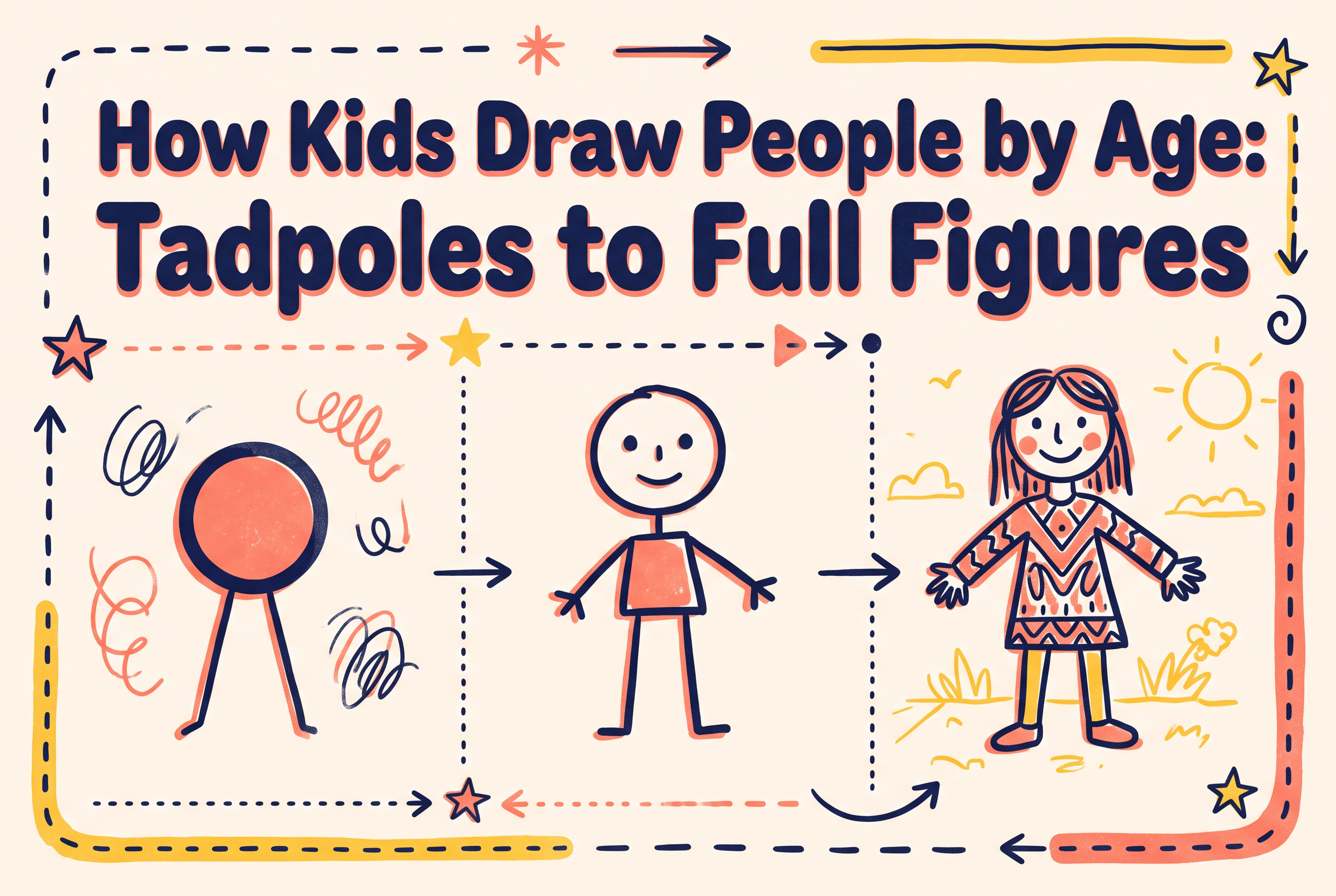
Most children start drawing recognizable people around ages 3 to 4, usually as a "tadpole": a round head with legs, and sometimes arms, attached straight to it. From there, the developmental stages of drawing a person follow a loose pattern: scribbles and circles first, then tadpoles, then bodies and arms, then full figures with clothes and a ground line by roughly ages 6 to 8.
Those ages are broad ranges, not deadlines. Children vary a lot in when and how they draw, and two kids the same age can use very different figures. This guide walks through each stage, what you will probably see on the page, and one relaxed prompt you can try at home for each. It also shows where Pixley fits. It's an app that turns your child's drawings and ideas into personalized animated cartoons, so the person they drew can star in an episode.
What Age Do Kids Start Drawing People? The Quick Timeline
Kids typically start drawing people around ages 3 to 4, and the first people they draw are tadpoles. Here is the whole arc at a glance, as broad ranges:
Ages 1 to 3: scribbles, dots, and circles that come before any person appears.
Around 3 to 4: the tadpole person, a head with legs and sometimes arms.
Around 4 to 6: a distinct body shows up, arms get attached to it, and faces gain more features.
Around 6 to 8: full figures with clothes, hair, and a ground line under their feet.
Researchers describe this in a few ways. Lowenfeld's framework places a child's first human-form symbols in the preschematic stage, roughly ages 4 to 7, while other accounts put the first tadpoles a bit earlier. Both describe the same slow shift with different age edges. Treat every number here as a rough guide to what is common, not a checklist your child has to pass. For a longer overview, see our guide to stages of drawing development in children from ages 2 to 8.
Before the Person: Scribbles and Circles (Ages 1-3)
Before a child draws a person, they draw marks, and those marks are the groundwork for every figure that follows. Toddlers begin with random scribbles, then move to controlled lines, then to circles and loops. Kellogg's research traced this progression from scribbles to basic shapes and then to combinations of shapes. A tadpole is exactly that: a circle plus lines.
At this stage the drawing is about movement and the feel of the crayon, not about representing anything. A child may announce that a scribble is "Mama" or "the dog," and that is fine. The name often comes after the drawing, not before.
Try at home: Sit beside your toddler with big paper and chunky crayons. Draw your own big circle and say, "Round and round." Let them copy the motion in their own way. If you want more ideas for this age, our stages of scribbling post and drawing activities for toddlers are good next reads.
The Tadpole Person: Head With Legs (Around Ages 3-4)
The tadpole person is the first real human figure most children draw: a large round head with two lines for legs, often with arms sticking out from the sides of the head. It looks like it is missing a body, but to the child it is a complete person. Heads hold the face, and the face is what matters most when you are three.
You may see eyes, a mouth, and sometimes a scribble of hair inside the circle. The proportions will look odd, and that is simply how this stage looks. Some children skip the tadpole entirely or mix tadpoles and fuller figures on the same page, which is one reason ages are only a rough guide.
Try at home: Ask, "Who is in your picture?" and let them tell you. Then ask one curious question, like "What is she doing?" Resist the urge to add a body for them. Their next version will grow on its own timetable. A simple activity is to draw a family together, as in our family drawing activity, where each person becomes a story character.
Adding Bodies and Arms: The Figure Takes Shape (Around Ages 4-6)
Between roughly ages 4 and 6, most children add a torso, and the tadpole becomes a figure with a head, a body, arms, and legs. A distinct torso commonly shows up around age 5. Arms often move from the head to the body, hands may appear as spokes or fans, and faces pick up noses, ears, or eyebrows.
The figure is still a symbol rather than a portrait. A child may draw the same person the same way every time, because they are building a reliable "recipe" for what a person is. That repetition is practice, not a rut.
This is also a nice age to connect drawing with feelings and identity. A child who can draw a face with a big smile or a frown has a new way to talk about how they feel.
Try at home: Invite them to draw themselves doing their favorite thing, using our self portrait drawing for kids steps if they want a starting point. Or try the feelings drawing activity and draw the same person looking happy, sleepy, or surprised.
Full Figures With Clothes and Ground Lines (Around Ages 6-8)
By about ages 6 to 8, many children draw a full figure with clothes, hair, hands, and feet, standing on a ground line instead of floating on the page. Ground lines and organized scenes commonly emerge around 5 to 7, while clothing and finer details develop across roughly 6 to 8. This overlaps with what is often called the schematic stage, when children settle into consistent ways of drawing people, houses, trees, and sky. Our post on the schematic stage of drawing goes deeper on this.
You will notice people with different outfits, different hairstyles, and maybe a stripe of grass or a baseline of sky. Figures start to relate to each other and to the setting: two friends holding hands, a kid next to a dog, a character beside a house.
Details keep growing during this stage, so a figure that looks stiff or simple is still developing. Many children this age also get more self-critical, and some start saying their drawings are "not good." Keep the focus on what the person is doing and who they are, not on whether it looks real.
Try at home: Ask your child to draw a character and give them a place to stand, a job, and one problem to solve. You will get a drawing and the start of a story at the same time.
Simple Ways to Encourage Each Stage at Home
The best encouragement at every stage is the same: give materials, give time, and show real interest. You do not need lessons. A short routine and a basket of paper and crayons will do more than any worksheet.
Ages 1 to 3: Offer big paper and chunky crayons. Join in on circles and lines. Skip questions like "What is it?" and say "Tell me about your drawing."
Around 3 to 4: Ask who is in the picture and write the name on the page. Leave the proportions alone.
Around 4 to 6: Draw together. Make one person each, then swap papers and add something to the other's character, such as a hat or a pet.
Around 6 to 8: Ask for a scene. Where is the character standing? What is happening next? A simple comic strip is a fun format, and our drawing prompts for elementary students give you 30 ideas to start with.
Two habits help at any age. First, describe what you see ("You gave her big boots!") instead of grading it. Second, keep finished drawings somewhere visible. Kids notice what we keep.
These are parent-guided activities meant to be playful and short. Ten relaxed minutes beats a long session that ends in frustration.
Bringing a Drawn Person to Life: From Paper to Pixley Cartoon
Once your child has a person they love drawing, you can give that figure a bigger stage. Pixley turns kids' drawings and ideas into personalized animated cartoons, bedtime storybooks, and learning games for ages 2 to 8, so the tadpole, the stick-armed hero, or the girl in the striped dress can become a character in an episode of their own.
Here is how it works with a parent in the lead. You describe a lesson you want the cartoon to cover, such as sharing, big feelings, or a school-day topic, and Pixley creates an episode around it, starring your child's drawn character. Every generation passes child-safety filtering before your child sees it, and the experience is ad-free. Pixley is available on iOS with a free trial.
The payoff is the moment co-founder Pranit describes: "The magic moment is a kid seeing their own scribbled dragon blink back at them in a real cartoon." It works at any stage in this guide. A three-year-old's tadpole and an eight-year-old's fully dressed hero are both real characters, and seeing them move tells a child that their drawing matters.
If you want to compare options first, our roundup of apps to animate kids' drawings lays out the field, and our guide to cartoons that teach life lessons shows how a lesson-led episode is built.
Draw one person tonight, then watch them move in Pixley
A child's drawn person is a record of how they currently see the world, and it changes on its own schedule: circles, then tadpoles, then bodies, then whole figures standing on the ground. Your job is not to speed that up but to be a curious audience. This week, ask your child to draw one person and tell you their name, then try Pixley's free trial on iOS and let that drawing star in a cartoon about a lesson you choose.
Frequently Asked Questions
What age do kids start drawing people?
Most children begin drawing recognizable people around ages 3 to 4, typically as a tadpole figure: a round head with legs and sometimes arms. A distinct body often appears around 4 to 6. These are broad ranges, and children vary widely, so use them as a guide, not a deadline.
What is a tadpole person in a child's drawing?
A tadpole person is a figure made of a large round head with lines for legs, and sometimes arms, attached directly to it. It is the first human form many kids draw, usually around ages 3 to 4. It is a normal stage, and the body typically fills in over the next couple of years.
When do children add a body and clothes to their drawn people?
A distinct torso commonly appears around age 5, and arms move onto the body in the following months. Clothes, hair, and finer details tend to develop across roughly ages 6 to 8, often alongside a ground line. Timing varies, and some kids mix older and newer figure styles on one page.
How can I encourage my child's drawing at home?
Offer paper and crayons, draw alongside them, and ask open questions like "Who is this?" instead of correcting proportions. Short, relaxed sessions work best. You can also use Pixley, which turns your child's drawing into a character in a personalized cartoon episode around a lesson you choose.
Can my child's drawing become a cartoon character?
Yes. Pixley turns kids' drawings and ideas into personalized animated cartoons for ages 2 to 8. You describe a lesson, and Pixley creates an episode starring your child's drawn character. Every generation passes child-safety filtering first, it is ad-free, and it is available on iOS with a free trial.