How to Draw a Turtle for Kids: Easy Steps
Learn how to draw a turtle for kids with simple shapes, a shell for practicing shapes and colors, and tips for ages 2-8. Then bring it to life with Pixley.
 Pixley Team
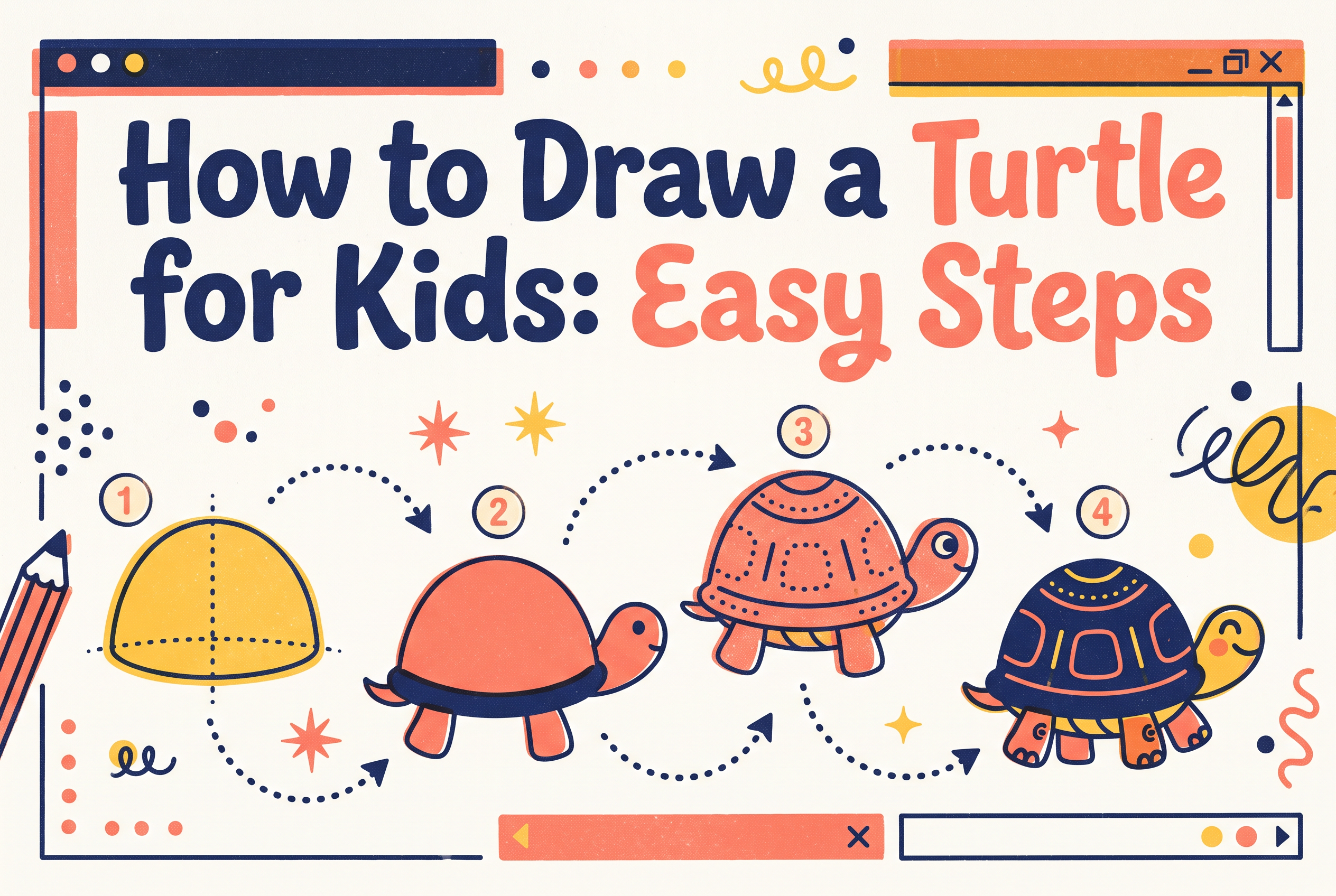
To draw a turtle for kids, start with a big dome for the shell, add an oval head, four small ovals for feet, and a little triangle tail, then fill the shell with shapes and colors. That is the whole method, and it works for a 3-year-old and an 8-year-old alike.
Turtles are one of the friendliest first animals to draw because nobody has a strong picture in their head of what a turtle "should" look like. A wobbly shell still reads as a turtle. A lopsided head just makes it a turtle with personality. This guide walks you through the shapes, gives you easier and harder versions by age, and uses the shell as a playground for practicing shapes and colors. At the end, you will turn the finished drawing into a character with a name and a first story.
What you need to draw a turtle (and why turtles are easy)
You need paper, a pencil or a crayon, and a handful of colors. Green and brown cover the body, but keep a full crayon box nearby for the shell, because that is where the fun is.
Turtles are easy for three reasons. The body is mostly circles and ovals, which young hands can already make. There is no right answer for the shell pattern, so no pattern can be wrong. And the turtle sits low and flat on the page, so there are no tricky legs to balance like on a dog or horse.
Sit next to your child instead of across from them. Draw your own turtle on a second sheet, and let your child watch, copy, or ignore you completely. All three count. If you want a similar shape-by-shape approach for another animal afterward, try how to draw a penguin for kids or how to draw an owl for kids.
Draw a turtle step by step with simple shapes
Use six shapes, one at a time, and say each shape out loud as you draw it.
The shell: Draw a big half circle, like a hill or a rainbow with the bottom flat. This is the biggest shape on the page, so give it room.
The belly line: Draw a gently curved line along the bottom of the shell, slightly wider than the dome, so the turtle has a flat underside to sit on.
The head: Draw a smaller circle or oval poking out from one side of the shell. Leave a small gap or overlap it. Both look fine.
The face: Add two dots for eyes and a curved line for a smile. Let your child choose the expression.
The feet: Draw four small ovals or rounded rectangles along the bottom edge. Two will show on a side view, and it is perfectly fine to draw all four.
The tail: Add a tiny triangle on the opposite side from the head.
That is a complete turtle. Resist the urge to fix proportions. A giant head or a tiny shell is the kind of detail that makes a drawing belong to your child. Then move to the shell, which is the best part.
Easier and harder versions by age (scribble turtle for 2-3, details for 6-8)
Match the version to the child, not the other way around.
Ages 2-3: the scribble turtle. Skip the steps. Let your child scribble a big messy blob in green, then add a small circle for the head and a few dots for eyes. You can draw the little feet afterward while they watch. To a toddler, the scribble is the turtle. If your child is still in the scribbling phase, stages of scribbling explains what each kind of mark means.
Ages 4-5: the shape turtle. Follow the six steps above with your help. Ask your child to point to where each shape goes before they draw it.
Ages 6-8: the detail turtle. Older kids often notice that their drawing does not match the picture in their head. Give them more to do instead of less: toenails on each foot, a wrinkly neck made of two curved lines, a ground line with grass and a pond, bubbles, or a tiny sun. Challenge them to draw the turtle from above, where the shell becomes a big oval seen from the top. A child this age might also enjoy turning a series of turtle drawings into a mini comic, and how to make a comic book with kids shows how.
Shell patterns: practice shapes and colors on the turtle's back
The shell is a blank canvas for shape and color practice, which is why this turtle is more than a drawing. Every pattern your child makes is a small lesson in shapes, sorting, and color choice.
Try these shell games, matched to age:
Shape hunt (ages 2-4): Say "Can you put a circle on the shell? Now a triangle?" Name each shape as your child draws it. Three or four shapes is plenty.
Color calling (ages 2-4): Hold up a crayon and ask your child to name the color before they use it. Then let them pick the next one.
Hexagon honeycomb (ages 5-6): Real turtle shells have a patchwork of plates. Draw one hexagon or rounded square in the middle, then ask your child to draw others touching it. Wobbly counts.
Pattern turtles (ages 5-8): Start a color pattern, like red, blue, red, blue, and ask your child to continue it across the shell. Then let them invent their own pattern and challenge you to guess the rule.
Count and sort (ages 4-7): Ask for exactly five circles, then three triangles. Count them together afterward.
If your child picks purple for the whole shell, or colors the turtle orange, say yes. Young children choose colors for many reasons that have nothing to do with realism, and what colors in kids' drawings mean explains why a neon turtle is nothing to correct. For more activities in this spirit, see drawing activities for preschoolers.
Give your turtle a name, a feeling, and a first story
A finished drawing becomes a character the moment it gets a name. Ask your child, "Who is this turtle?" and write the answer on the paper, even if the name is "Turtle Pizza" or "Bloop."
Next, pick a feeling. Draw the same turtle again with a different face: happy, nervous, sleepy, grumpy. The same shapes with a new mouth teach kids that characters have feelings and that feelings change.
Then build a tiny story with three questions:
What does the turtle want? (To reach the pond. To find a friend. To get a snack.)
What gets in the way? (A big rock. Rain. Being very, very slow.)
How does it end? (Let your child decide, even if it is silly.)
Slow is a gift for a turtle story. A turtle who is worried about being the last one to the pond gives you a natural way to talk about patience, trying again, and not comparing yourself to others. For more ways to turn drawings into stories, draw and tell for kindergarten has ten story starters for ages 5-6.
Turn your child's turtle into a cartoon character with Pixley
Pixley is an iOS app that turns kids' drawings and ideas into personalized animated cartoons, bedtime storybooks, and learning games for ages 2-8, safe and ad-free. Your child's turtle can be the star.
Here is how it fits. You draw the turtle together, name it, and invent its first problem. Then you bring that character into Pixley, where parents describe a lesson they want taught, such as patience, sharing, or handling a big feeling, and Pixley creates a cartoon episode around it. Every generation passes child-safety filtering before a kid sees it, and there is a free trial on iOS.
The payoff is the moment a child sees their own wobbly shell and mismatched feet moving on screen. A turtle works just as well.
It also changes what screen time means. Instead of passively watching whatever an algorithm serves up, your child watches a story built from their own drawing and chosen by you. If you are curious about the bigger picture, how animation helps tell stories to children covers why seeing a story move helps young kids follow it.
Draw one turtle this week, then watch it move
A turtle is the rare drawing project where slow and wobbly is the whole point. Draw the dome, add the head and four little feet, fill the shell with whatever shapes and colors your child chooses, and give the turtle a name before you put the crayons away. Then take the next step: open Pixley on iOS, start the free trial, and bring your child's turtle in as the star of its first cartoon.
Frequently Asked Questions
How do I teach a 3 year old to draw a turtle?
Keep it to three or four shapes: a big green dome for the shell, a small circle for the head, and a few dots for eyes. Let your child scribble the shell however they like and add the feet yourself. At age 3, a green blob with a face is a turtle, and that is enough.
What shapes do you use to draw an easy turtle?
An easy turtle uses a half circle for the shell, a circle or oval for the head, four small ovals for feet, and a tiny triangle for the tail. Add a curved line for the belly and two dots and a smile for the face. Shell patterns can add circles, triangles, and hexagons.
What age can kids start drawing a turtle?
Toddlers around age 2 can make a scribble turtle by adding a small circle head and dot eyes to a green scribble. Ages 4-5 can follow simple shape steps with help, and ages 6-8 can add details like toenails, a pond, or a view from above.
How can I turn my child's turtle drawing into a cartoon?
Pixley turns kids' drawings and ideas into personalized animated cartoons for ages 2-8. Name the turtle, decide what lesson or story you want, and Pixley creates a cartoon episode around your child's character. Every generation passes child-safety filtering first, and there is a free trial on iOS.