
10 Benefits of Interactive Stories for Children
Interactive stories transform passive listening into active learning, boosting language, empathy, memory, creativity, and focus in young children.
 Pixley Team
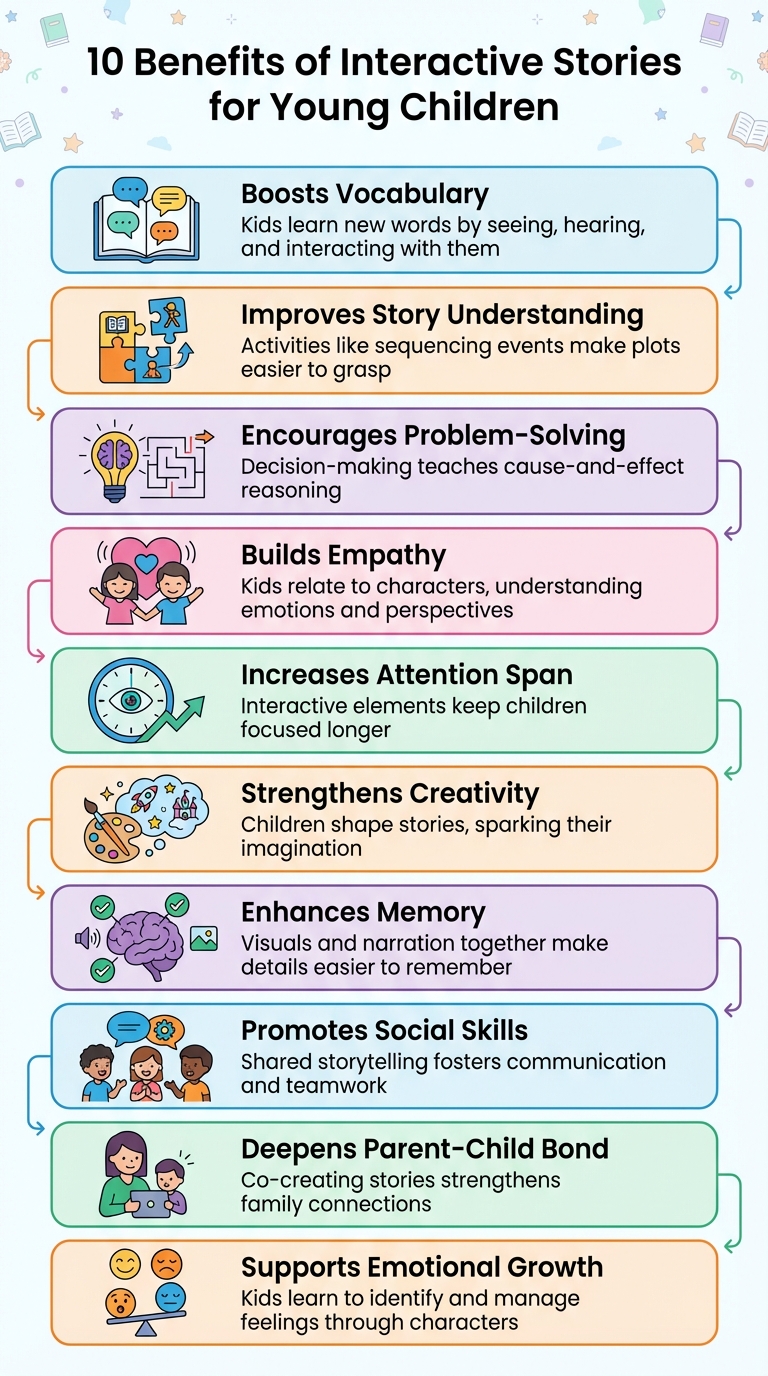
10 Benefits of Interactive Stories for Young Children
Interactive stories are more than just entertainment - they actively engage kids in ways traditional books or TV can't. By combining touch, sound, and visuals, these stories help children learn faster, think critically, and develop emotional skills. Here's what makes them so effective:
- Boosts Vocabulary: Kids learn new words by seeing, hearing, and interacting with them.
- Improves Story Understanding: Activities like sequencing events make it easier for children to grasp plots.
- Encourages Problem-Solving: Decision-making in stories teaches cause-and-effect reasoning.
- Builds Empathy: Kids relate to characters, helping them understand emotions and perspectives.
- Increases Attention Span: Interactive elements keep children focused longer.
- Strengthens Creativity: Children can shape stories, sparking their imagination.
- Enhances Memory: Visuals and narration presented together make details easier to remember.
- Promotes Social Skills: Shared storytelling fosters communication and teamwork.
- Deepens Parent-Child Bond: Co-creating stories strengthens family connections.
- Supports Emotional Growth: Kids learn to identify and manage feelings through characters.
Interactive storytelling platforms like Pixley combine these benefits with AI personalization, making stories more engaging and tailored to each child. By turning passive reading into an active experience, these tools help children learn, grow, and connect in meaningful ways.
Interactive Story Time: "From Head to Toe"
Watch this example of interactive storytelling in action:
1. Better Language Development
Interactive stories are a fantastic way to build vocabulary and communication skills in children. By combining multimedia features like synchronized animations and sound effects, these stories help kids visualize and understand new words more effectively. This combination of verbal and nonverbal information makes it easier for children to process and remember vocabulary. And the research backs this up.
A meta-analysis of 43 studies involving 2,147 children found that technology-enhanced stories significantly improved expressive vocabulary, with an effect size of 0.20 compared to traditional storybooks. The magic lies in the timing - when animations align perfectly with the narration, children can link the visual cues to the word's meaning without feeling overwhelmed.
"Deeper learning occurs when information is presented both verbally and nonverbally." – Richard E. Mayer, Cognitive Theory of Multimedia Learning
Interactive elements, like clickable hotspots, also play a big role in reinforcing word recognition. For instance, a 2014 study by Smeets and Bus revealed that kindergarteners using interactive, animated eBooks with hotspots offering word definitions performed better on vocabulary tests than those using static eBooks. However, it’s crucial that these features are directly tied to the story - unrelated interactions can easily distract young learners.
Another effective strategy is encouraging children to retell stories after reading. A July 2019 study involving 126 preschoolers in Germany found that using elaborative techniques, such as synonyms and rhetorical questions, not only boosted engagement but also reinforced vocabulary. This practice turns kids from passive listeners into active storytellers, helping them organize their thoughts and create their own narratives.
2. Stronger Understanding of Story Structure
Interactive stories go beyond enhancing language and vocabulary - they also help young readers understand how narratives are structured. By presenting a clear sequence of events, these stories lay the groundwork for early comprehension skills and set the stage for future academic success. The use of specific interactive techniques plays a key role in reinforcing these narrative structures.
One effective method involves repetitive phrases and gestures that guide children through a story's sequence. For instance, Sesame Street introduced the phrase "I wonder, what if, let's try", paired with corresponding gestures. This approach helped 116 preschoolers not only follow the story but also apply these sequencing skills in different situations.
Interactive platforms also use sequencing tasks to strengthen understanding of story structure. In one study, 103 preschoolers were asked to organize story segments, such as fixing a broken tractor, in the correct order. The interactive nature of the task didn’t disrupt their ability to grasp the sequence. Additionally, providing a 60-second plot preview before the story began gave children a mental framework, improving their comprehension of the narrative.
"An engaging story helps children both receive and remember information more effectively. And adding a 60-second preview is one simple way to capitalize on the connection between stories and learning." - Heather Kirkorian, PhD, Professor of Human Development and Family Studies, University of Wisconsin–Madison
3. Increased Creativity and Imagination
Interactive storytelling transforms children from passive listeners into active participants, allowing them to shape the narrative themselves. This shift is powerful - when kids take part in a story, their brains process it as though they are living it, activating areas tied to cognitive control, emotion, and empathy. This active engagement sets the stage for them to connect deeply with the multimedia elements that follow.
Elements like animations, sound effects, and music provide nonverbal cues that help children visualize and make sense of abstract ideas. A 2019 study by the University of Regensburg explored this concept with 126 preschoolers using "Interactive Elaborative Storytelling" techniques and Grimm's Fairy Tales like The Queen Bee. When children were encouraged to continue the story on their own, they showed noticeably higher levels of attention and engagement compared to peers in traditional read-aloud sessions.
By building on these sensory cues, elaborative methods - such as asking questions like, "What do you think, was it a big tree?" - actively stimulate a child's imagination. These techniques invite children to fill in details not explicitly provided, helping them develop skills in organizing ideas, expressing thoughts, and constructing their own narratives. This process strengthens early literacy and communication abilities.
"Creating digital stories enhances communication skills by teaching children to organize ideas, ask questions, express opinions, and craft narratives." - Bernard R. Robin, Professor of Instructional Technology
In early 2023, the kindergarten team at Aspire Clyde North launched a personalized storybook project where children added their own drawings to a shared storyline. The result was a collaborative narrative that families could enjoy together. Research also shows that facts are 20 times more likely to be remembered when embedded in a story rather than presented as isolated data. This approach not only sparks creativity but also makes learning more engaging and impactful.
4. Better Memory and Recall
Interactive stories are designed to work with how children naturally process information, particularly by pairing narration with visuals in a way that happens simultaneously. This approach, known as temporal contiguity, reduces mental strain and makes it easier for kids to understand and remember what they’ve learned.
"Animated pictures, sometimes enriched with music and sound, that match the simultaneously presented story text, can help integrate nonverbal information and language and thus promote storage of those in memory." – Bus, Takacs, & Kegel
The way interactivity is used in these stories matters a lot. Features like narrative-related hotspots - interactive elements tied directly to the story - can strengthen memory. On the flip side, unrelated or excessive interactivity can actually distract kids, making it harder for them to recall details. Studies show that while about 75% of popular e-books include hotspots, only 20% of these are directly connected to the story itself. By aligning visuals and narration precisely, children don’t have to juggle holding onto words in their memory while waiting for the matching image to appear.
Sound effects and background music can also enhance memory, especially when they match the mood of the scene. These audio cues help children understand abstract words and remember complex events by conveying emotions they might not yet have the vocabulary to describe. When animations, sounds, and narration are in sync, kids can focus on the story itself, making it easier to recall later. This improved memory not only helps them enjoy the story more but also supports their overall cognitive development, setting the stage for more advanced learning experiences.
5. Development of Empathy and Emotional Skills
Interactive storytelling does more than enhance memory - it plays a key role in building emotional skills. Through these stories, children learn to recognize and express their own emotions while also understanding the feelings of others. By engaging with characters in a story, kids practice perspective-taking, which allows them to see the world through someone else’s eyes. When children connect with characters who have different backgrounds or experiences, they develop cognitive empathy, which is the ability to understand and share others' emotions. Making decisions for story characters in interactive formats further deepens this understanding, as kids begin to see how choices impact outcomes and how those outcomes might make others feel. This ability to "mentalize", or understand others' mental states, typically emerges between the ages of 3 and 4, a developmental milestone known as Theory of Mind. Over time, this skill helps children distinguish between their own emotions and those of others.
"Identification with characters who are dissimilar from the readers is the most valuable contribution of children's storybooks to cognitive empathy." – Natalia Kucirkova, Institute of Education, University College London
Interactive stories also promote emotional literacy by teaching children how to name and label their feelings. Psychiatrist Dr. Dan Siegel refers to this as the "name it to tame it" strategy, which helps kids process emotions by identifying them in story characters. This skill often translates into better emotional regulation in real life. Research supports this connection: a study using near-infrared spectroscopy on 21 children aged 4 to 11 showed that storytelling activated the bilateral prefrontal areas of the brain more consistently than picture-book reading. This finding underscores how deeply storytelling engages the emotional centers of the brain.
You can nurture these emotional skills during story time by asking open-ended questions such as, "Why do you think the character felt that way?" or "How would you feel in their situation?" These questions encourage kids to reflect on emotions and build empathy.
6. Improved Problem-Solving Abilities
Interactive storytelling doesn’t just entertain - it turns kids into active problem-solvers. By making choices for a character or resolving conflicts within a story, children get hands-on practice with cause-and-effect reasoning, a key building block for logical thinking. Research backs this up: a meta-analysis involving 2,147 children across 43 studies found that technology-enhanced stories significantly improve story comprehension.
To make the most of this, it’s important to choose stories where interactive elements genuinely support the plot. For example, swiping to uncover a hidden tool that helps a character overcome a challenge teaches kids to think systematically. On the other hand, unrelated mini-games can disrupt the story’s flow and overwhelm young minds. The right kind of interaction ties directly to the narrative, keeping kids engaged while sharpening their ability to work through problems step by step.
"Students who participate in the creation of digital stories may develop enhanced communications skills by learning to organize their ideas, ask questions, express opinions, and construct narratives." – William Ian O'Byrne, Assistant Professor of Literacy Education, College of Charleston
This quote underscores how interactive storytelling doesn’t just boost communication - it also strengthens logical reasoning by encouraging thoughtful decision-making.
Want to take it a step further? Pause the story and ask questions like, “What should the character do next?” or “How could they solve this problem?” These moments of reflection help kids think ahead, evaluate options, and consider multiple solutions. It’s like giving them a mini problem-solving workshop disguised as story time.
The best interactive stories go even further, casting children as "coproducers of knowledge." This means they’re not just following along - they’re actively helping to define problems and test solutions within the story’s world. This kind of participation transforms a simple narrative into an engaging exercise in critical thinking.
7. Social Skills Through Shared Storytelling
Interactive storytelling transforms reading into a social activity, helping kids develop essential communication skills. When children share stories with parents, teachers, or friends, they practice interactive dialogue - a cooperative exchange where participants listen, respond, and build on each other's ideas. This dynamic interaction not only enriches storytelling but also translates into better real-world communication.
Instead of passively listening, children become active participants in shaping the story. For example, in 2018, researchers William Ian O'Byrne, Katherine Houser, Ryan Stone, and Mary White introduced the Emerging Digital Storytellers model to a group of 25 students aged 4–6 in a mixed-age early childhood classroom. The children created hand-drawn journals, which teachers then turned into digital animations. This process encouraged them to share, ask questions, and clearly express their ideas, nurturing their social-emotional growth.
Research also highlights the brain's response to interactive storytelling. It activates areas linked to empathy and understanding social norms. Through frequent eye contact and expressive actions, storytelling strengthens connections and reinforces the importance of social bonds.
"Storytelling is the interactive art of using words and actions to reveal the elements and images of a story while encouraging the listener's imagination." – National Storytelling Network
To amplify these social benefits, encourage your child to retell parts of a story or organize a "Story Workshop." In this activity, children can plan and sketch their stories before sharing them with peers. These collaborative experiences help kids organize their thoughts, ask thoughtful questions, and communicate clearly - skills that go far beyond story time.
8. Stronger Parent-Child Connection
Interactive storytelling does more than improve language and social skills - it also brings families closer together. When parents and kids actively participate in creating stories, they build trust and create shared memories. In fact, research highlights that 57% of parents in the U.S. read to their young children daily.
Taking turns to add twists and turns to a story - what some call collaborative co-creation - can deepen the relationship even further. It’s a dynamic way to connect, blending creativity and shared engagement. As Aspire Early Education puts it:
"When parents and children share stories, it creates a chance for quality time together, strengthening their emotional bond and trust." – Aspire Early Education
Personalizing the story can make the experience even more meaningful. By weaving your child into the narrative - using their name, referencing favorite activities, or including real family moments - you boost their confidence while strengthening the emotional connection.
Want to take it up a notch? Pause during key parts of the story and ask open-ended questions such as, "What do you think should happen next?" or "How would you handle this situation?" These questions not only encourage creativity but also give you a glimpse into your child's thoughts and feelings. Add a touch of magic with voice changes, simple props, or gestures to make the storytelling experience multi-sensory and unforgettable.
9. Longer Attention Span and Focus
Interactive stories turn children from mere listeners into active participants, keeping them engaged for longer periods. When kids make choices about characters or settings, they naturally become more curious about what happens next. This heightened involvement helps them stay focused. In fact, scientific studies back this up.
Using near-infrared spectroscopy (NIRS), researchers have found that interactive storytelling keeps the brain active in the bilateral prefrontal areas - key regions for attention. Miyuki Yabe from Fukushima Medical University’s Department of Neuropsychiatry highlights:
"The results indicated more sustained brain activation to storytelling in comparison with picture-book reading, suggesting possible advantages of storytelling as a psychological and educational medium in children."
Traditional picture-book reading often loses its novelty after a few reads, leading to reduced brain activity. On the other hand, interactive storytelling continues to stimulate young minds, keeping them engaged.
Interactive stories also appeal to a variety of learning styles. Research shows about 40% of children learn visually, another 40% through listening, and around 20% through physical interaction. Digital storytelling platforms combine animations, narration, and touch-based features, engaging all three types of learners at once.
That said, not all interactive features are equally effective. Platforms where animations and sounds align closely with the story - thanks to "temporal contiguity" - help kids process information more easily. This alignment minimizes distractions and prevents cognitive overload, allowing children to stay immersed in the narrative. By maintaining this focused engagement, interactive storytelling not only holds their attention but also reinforces cognitive skills like language development, memory, and empathy.
Pixley: A Platform for Interactive Stories
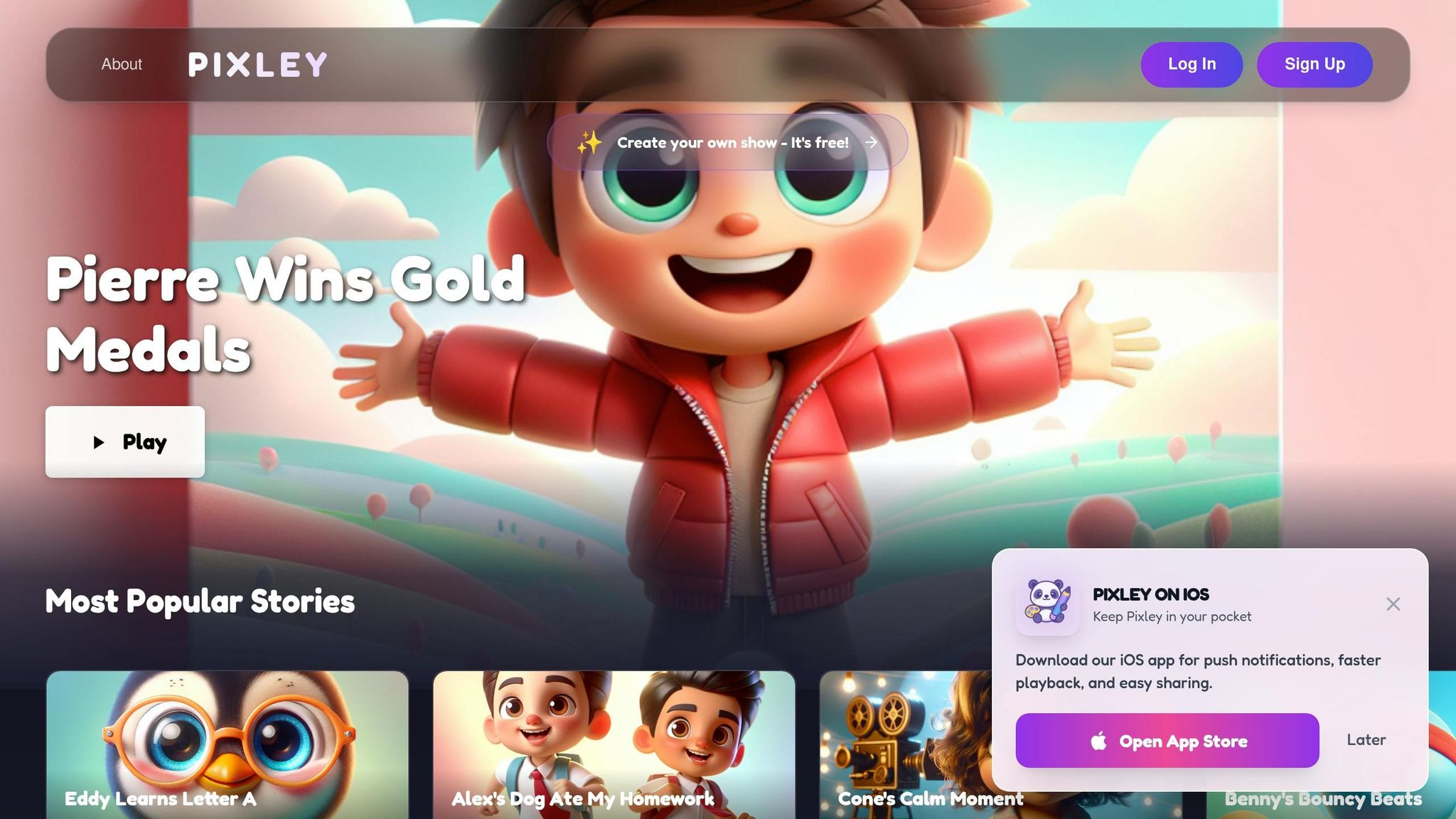
Pixley brings the magic of interactive storytelling to young children, offering a space where creativity and learning come together. With a library of themed stories - ranging from adventure and mystery to unique original series - both parents and educators can find content tailored to their needs. The platform combines AI-powered personalization with tools that let kids actively shape their own stories.
What sets Pixley apart is its ability to engage children in the storytelling process. Kids can pick characters, settings, and even decide how the plot unfolds, turning storytime into an imaginative and problem-solving activity. Using AI, Pixley creates stories that incorporate a child's name and personal interests, making the experience even more engaging.
A standout feature of Pixley is its focus on seamless multimedia integration. Animations, sound effects, and music are carefully designed to enhance the narrative rather than distract from it. This thoughtful design ensures that the interactive elements support comprehension and vocabulary development, rather than pulling attention away from the story itself.
Parents can access Pixley through its website or by downloading the iOS app for added convenience. The well-organized library makes it simple to find age-appropriate stories that align with a child's interests or learning objectives, offering a personalized and enriching storytelling experience.
Conclusion
Interactive storytelling has become a dynamic way to support young children’s development, influencing everything from their language skills to their emotional intelligence. It goes beyond simple entertainment by turning kids into active participants, laying the groundwork for cognitive, emotional, and social growth.
Research backs this up: people are 20 times more likely to remember facts when they’re embedded in a story. Technology-enhanced storytelling further boosts comprehension and expressive vocabulary, while interactive features promote focused cognitive engagement through sustained brain activity.
What sets interactive storytelling apart is its ability to connect with diverse learning styles. By blending animations, narration, and touch-based interactions, these stories cater to visual, auditory, and kinesthetic learners all at once. This multi-sensory approach not only strengthens parent-child relationships but also helps kids develop social skills, improve focus, and extend their attention spans in today’s fast-paced world. Platforms like Pixley leverage these strengths, turning every story into a chance for well-rounded development.
As education evolves with technology, interactive storytelling bridges the gap between classic storytelling traditions and modern innovations. Tools like Pixley make it easier for families and educators to access engaging, themed adventures that entertain while nurturing growth. The key is selecting stories where interactive features enhance the narrative rather than overwhelm it, ensuring children gain the most from the experience.
Whether it’s a bedtime story or a digital tale explored during the day, interactive storytelling transforms everyday moments into opportunities for learning and connection. By placing kids at the heart of the story, these experiences ignite creativity, build self-confidence, and create memories that last a lifetime.
FAQs
How do interactive stories help children develop problem-solving skills?
Interactive stories are a fantastic way for children to build problem-solving skills. By actively engaging with the narrative and making decisions that shape its direction, kids are encouraged to think critically. They learn to analyze situations, anticipate outcomes, and tackle challenges - all within the context of the story.
Take features like puzzles, decision-making moments, or tasks that require recalling story details. These elements push children to think strategically and adjust their approach based on what’s happening. This process doesn’t just sharpen their reasoning; it also boosts their confidence and sparks creativity when they face new obstacles. By stepping into the role of active participants, kids develop cognitive skills in a way that feels both enjoyable and rewarding.
How does AI personalization enhance interactive storytelling on platforms like Pixley?
AI-driven personalization is transforming interactive storytelling on platforms like Pixley by customizing stories to align with a child's specific interests, learning speed, and developmental milestones. This tailored approach not only keeps kids engaged but also helps boost essential skills like critical thinking, emotional understanding, and cognitive development.
By adjusting the complexity of stories, interactive elements, and questions based on how a child responds, AI ensures the content stays both enjoyable and meaningful. This method encourages vocabulary development, improves story comprehension, and helps maintain focus, making learning an exciting and rewarding experience for young minds.
How do interactive stories help parents and children connect?
Interactive stories offer a fantastic way for parents and children to connect through shared experiences that are both enjoyable and meaningful. When parents take part in storytelling with their kids, it creates moments of emotional closeness, builds trust, and shows children that their thoughts and feelings matter. These shared moments go a long way in strengthening the parent-child relationship, offering kids a sense of security and belonging.
What makes interactive storytelling even more special is how it encourages kids to actively participate - making choices, solving problems, and engaging deeply with the story. This collaborative approach not only boosts cognitive and language skills but also turns storytelling into a team effort. The result? Unforgettable memories that deepen the emotional connection between parents and their children.
Keep Reading
- Age-Appropriate Digital Stories for Kids: Parent Guide
Learn how to choose age-appropriate digital stories for kids, with tips for story length, pacing, safety, co-viewing, and creative screen time.
- Cartoon Pacing for Kids: Why Slower Stories Help
Learn how cartoon pacing affects kids' attention, comprehension, and screen time quality, plus what parents should look for in healthier animated content.
- Teaching Visual Metaphors With Cartoons: A Parent and Teacher Guide
Learn how to teach visual metaphors to kids using cartoons, comic panels, drawings, and personalized stories. Help children connect images to feelings and ideas in simple steps.
- All parenting & screen-time guides →