Teaching Visual Metaphors With Cartoons: A Parent and Teacher Guide
Learn how to teach visual metaphors to kids using cartoons, comic panels, drawings, and personalized stories. Help children connect images to feelings and ideas in simple steps.
 Pixley Team
Teaching Visual Metaphors With Cartoons: A Parent and Teacher Guide
Kids often understand pictures before they can explain abstract ideas in words.
That is what makes visual metaphors such a useful teaching tool. A storm cloud over a character's head can stand for sadness. A tiny mouse trying to climb a huge mountain can show that something feels overwhelming. A bright light bulb can suggest a new idea. A color shift from gray to yellow can hint that hope is returning.
In all of those examples, the picture is doing more than showing a scene. It is standing for a feeling, idea, or change.
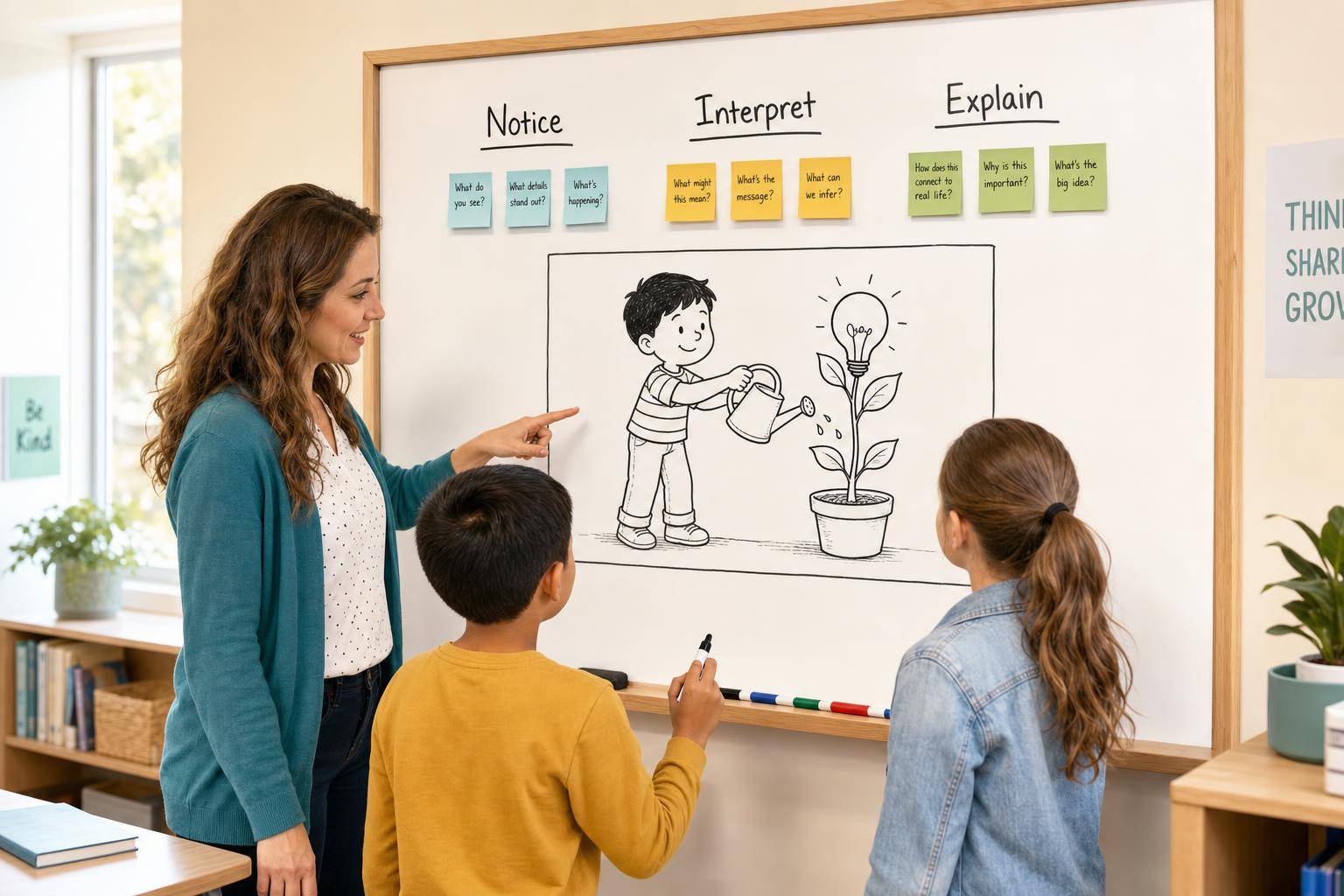
The good news is that children do not need a formal lesson in literary analysis to start understanding this. With the right cartoon, comic panel, or child-made drawing, you can teach visual metaphors with one simple routine:
Notice. Interpret. Explain.
That means:
- Notice what is in the picture
- Interpret what it might mean
- Explain why that meaning makes sense
This guide shows parents and teachers how to use that routine with cartoons, drawings, comic strips, and personalized stories so kids can build visual literacy in a way that feels playful and age-appropriate.
Quick Takeaways
- Visual metaphors help kids connect pictures to feelings, traits, and big ideas.
- Cartoons work well because children can quickly spot facial expressions, colors, objects, and changes in a scene.
- The easiest teaching routine is: notice, interpret, explain.
- Simple emotion-based examples are often the best place to start.
- Drawing or animating a child's own metaphor helps deepen understanding.
- Pixley can help families turn a child's drawing or idea into a personalized animated story that reinforces the lesson.
What Is a Visual Metaphor?
A visual metaphor is a picture that represents something more than what it literally shows.
For example:
- A volcano can represent anger
- A storm cloud can represent sadness or worry
- A bridge can represent courage, growth, or moving forward
- A balloon floating away can represent letting go
- A heavy backpack can represent stress or emotional weight
Children do not need to use the phrase "visual metaphor" right away. For many kids, it is enough to begin with a question like:
"What do you think this picture is trying to show us?"
That question helps children understand that an image can carry meaning beyond the surface.
Why Cartoons Work So Well for Teaching Visual Metaphors
Cartoons are often easier for young children to read than more complex visual media.
That is because cartoons tend to use:
- Clear facial expressions
- Exaggerated emotions
- Simple colors and shapes
- Short scenes
- Easy-to-follow cause and effect
A child may not be able to explain "symbolism," but they can often say:
"The dark cloud means he feels sad."
That is the foundation of visual literacy.
Cartoons also slow things down in helpful ways. A character's expression, the background color, or a repeated object can all become clues. When an adult pauses and asks a few questions, children begin to see that images tell a deeper story.
Start With Simple, Easy-to-Read Examples
When teaching visual metaphors, the best examples are usually the simplest ones.
Look for scenes with:
- One clear emotion
- One obvious visual clue
- Minimal dialogue
- A short, self-contained moment
- A clear link between the image and the feeling or idea
Good starter examples often revolve around emotions because they are easier for children to recognize.
Here are a few beginner-friendly ideas:
- A character with a rain cloud overhead
- A shy character hiding in a shell
- A character glowing like a sun when they feel proud
- A mountain in front of a character who feels overwhelmed
- A seedling growing after a character learns something new
Avoid scenes that are too crowded, too fast, or too abstract at the beginning. If there are too many visual details, children may struggle to see which clue matters most.
The Notice, Interpret, Explain Routine
Once you choose a cartoon or drawing, use the same three-step routine every time.
That repetition helps children focus on the meaning rather than on figuring out the activity.
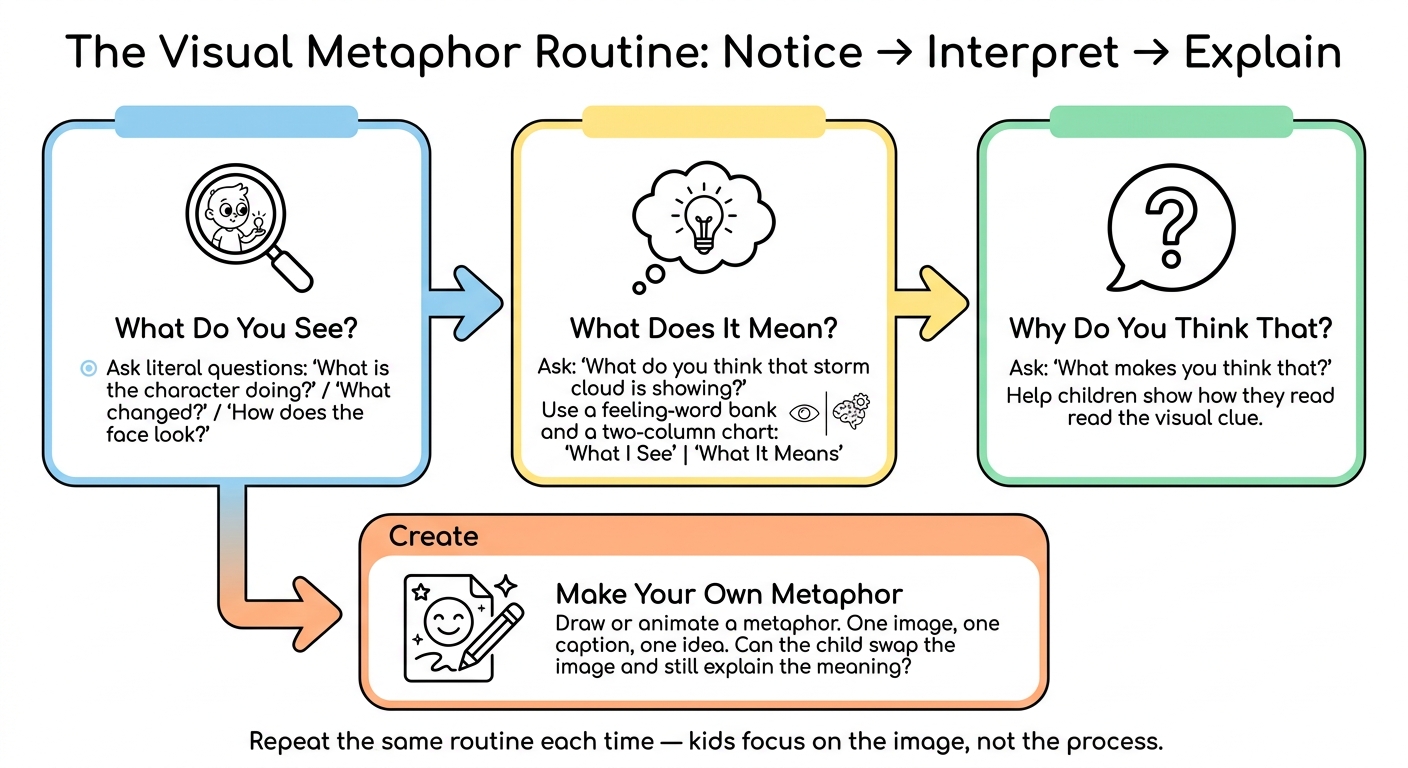
Repeat the same routine each time so kids focus on the image, not the process.
Step 1: Notice
Start with literal observation.
Ask:
- "What do you see?"
- "What changed?"
- "What stands out first?"
- "What is the character doing?"
- "What colors or objects do you notice?"
The goal here is not to jump straight to the answer. It is to help children pay attention.
For younger kids, you can keep it very concrete:
"I see a cloud over her head."
For older kids, you can ask them to describe the visual clue in more detail:
"The whole background turned gray and the character got very small in the frame."
Step 2: Interpret
Once children can name what they see, ask what they think it means.
Questions like these work well:
- "What do you think that means?"
- "How do you think the character feels?"
- "What idea is the picture showing us?"
- "Why do you think the artist used that object or color?"
This is where children begin to move from observation to meaning.
For example:
- "The storm cloud means he is upset."
- "The mountain means the problem feels really big."
- "The glowing light means she had a new idea."
A simple feelings word bank can help younger children if they get stuck.
Step 3: Explain
The final step is the most important: ask the child to explain why they think that meaning fits.
You can ask:
- "What makes you think that?"
- "How does the picture show that feeling?"
- "Why is that object a good match for the idea?"
This step helps you see whether the child really understands the image-to-idea connection.
It also helps children practice reasoning, not just guessing.
A Simple Two-Column Strategy
A quick tool that works well at home or in class is a two-column chart:
| What I See | What It Means |
|---|---|
| Dark cloud | Sadness or worry |
| Bright yellow glow | Pride or happiness |
| Heavy backpack | Stress or feeling overwhelmed |
| Broken bridge | Trouble connecting or moving forward |
This kind of visual organizer gives kids a concrete way to connect image clues to meaning.
For younger children, you can fill it out together. For older children, they can complete it independently after a short scene or comic panel.
Best Formats for Teaching Visual Metaphors
Different media types support visual metaphor learning in different ways.
Cartoons and Short Animations
Cartoons are great for introducing the concept because they combine expression, movement, color, and story.
Best for:
- Modeling one clear feeling
- Pausing on emotional moments
- Showing change over time
Limitations:
- Some animations move too quickly
- The message can get buried if the scene is visually busy
Comic Strips and Panels
Comic strips help children slow down and inspect one image at a time.
Best for:
- Looking closely at one moment
- Comparing panels
- Discussing visual clues without time pressure
Limitations:
- Less motion and sound
- Sometimes less emotionally vivid than animation
Child-Made Drawings
A child's own drawing is often the best way to test understanding.
Best for:
- Personal connection
- Creative ownership
- Seeing whether the child can build an image-to-idea link themselves
Limitations:
- Some children need adult prompting
- The metaphor may need clarification through conversation
Personalized Animated Stories
Personalized stories can make the lesson feel even more meaningful because the child's own character or idea becomes part of the story.
Best for:
- Reinforcing a specific emotional or literacy theme
- Reusing a child's favorite character
- Revisiting the same metaphor across multiple stories
Limitations:
- Requires a tool or platform to create the story
Comparison Table: Teaching Formats
| Format | Best Use | Main Strength | Main Limit |
|---|---|---|---|
| Short animations | Introduce a clear visual metaphor | Easy to model feelings and changes | Themes are fixed |
| Comic strips | Slow down one scene | Easy to inspect panel by panel | Less motion and sound |
| Child's own drawings | Test understanding | Highly personal and creative | May need adult support |
| Personalized stories with Pixley | Reinforce a lesson through custom storytelling | Personalized, memorable, and reusable | Requires creating the story |
Help Children Create Their Own Visual Metaphors
Once kids can spot a visual metaphor, the next step is to help them create one.
This is where the idea often "clicks."
Instead of only identifying meaning, children begin to build it.
Start With a Feeling or Idea
Pick one simple starting point:
- Anger
- Worry
- Jealousy
- Calm
- Courage
- Patience
- Friendship
- Growth
Then ask:
"What could show that feeling in a picture?"
A child might say:
- "Anger is a volcano."
- "Worry is a rain cloud."
- "Calm is a lake."
- "Courage is a bridge."
There is no single perfect answer. What matters is whether the child can explain the connection.
Turn the Metaphor Into a Drawing or Sequence
One drawing is enough to start. But a short sequence can make the metaphor easier to understand.
For example:
- Panel 1: A turtle hides in its shell
- Panel 2: The turtle peeks out
- Panel 3: The turtle steps forward and smiles
Now the child is not just drawing "shyness." They are showing a character move through it.
That kind of sequence helps children understand that metaphors can show change, not just a static emotion.
If needed, use a simple frame:
- Who is the character?
- What feeling or idea are they showing?
- What image represents that idea?
- What changes by the end?
Keep the Text Light
If children are making a cartoon or comic, keep the written language simple.
One short caption per panel is usually enough.
Examples:
- "Milo felt like a storm cloud."
- "The mountain looked too big."
- "Then the bridge appeared."
The image should carry most of the meaning.
How Pixley Can Support This Skill
Pixley can help families turn a child's drawing or idea into a personalized animated story.
That can be especially helpful when you want to:
- Reinforce one emotional theme
- Reuse a favorite character
- Build a simple story around a child's own metaphor
- Give children another way to explain what their image means
For example, a child might draw a dragon with smoke coming out of its ears to show frustration. A parent can use that drawing as the basis for a short animated story about the dragon learning a calming strategy.
That makes the metaphor easier to remember because the child sees their own idea come to life in story form.
If your family uses Pixley, try keeping each story focused on:
- One clear feeling or idea
- One strong visual clue
- One simple coping step or lesson
That structure works especially well for younger children.
How to Check Understanding
After a child watches a scene or creates their own visual metaphor, do a quick understanding check.
You do not need a formal quiz. A short conversation is enough.
Ask questions like:
- "What does that image stand for?"
- "Why did you choose that object?"
- "How do you know the character feels that way?"
- "Can you show the same feeling with a different picture?"
That last question is especially powerful.
If a child can switch the image and still explain the meaning, they likely understand the concept.
For example:
"If the shy dragon became a shy turtle, would the idea still work? Why?"
That shows whether the child understands the underlying meaning, not just the first example.
A Good Weekly Routine
You do not need a long lesson to build visual literacy.
A short, repeatable routine works best.
Here is one easy format:
Day 1: Watch or read one short example
Pause and use the notice, interpret, explain routine.
Day 2: Fill out a "What I See / What It Means" chart
Talk through one or two examples.
Day 3: Draw one visual metaphor
Choose one feeling and turn it into an image.
Day 4: Turn the drawing into a short story or comic
Add one or two frames to show change.
Day 5: Retell or explain the metaphor out loud
Have the child explain what their image means and why they chose it.
That kind of repetition helps children build confidence without feeling overwhelmed.
Why This Matters for Literacy and Communication
Teaching visual metaphors is not just about art.
It supports broader literacy skills too.
When children learn that images can stand for bigger ideas, they are also building:
- Vocabulary
- Inference skills
- Perspective-taking
- Story comprehension
- Creative expression
- Flexible thinking
Those are all useful skills for reading, writing, discussion, and emotional learning.
In other words, helping kids interpret a cartoon more thoughtfully can support much bigger learning goals over time.
Watch: Teaching Kids to Read Images
For more on helping children look closely and interpret what they see, watch this short video:
Final Thoughts
Visual metaphors can feel like a big concept, but they do not need a complicated lesson.
Start with one image. Ask what the child notices. Ask what it might mean. Ask why.
Then let them draw one of their own.
That simple habit helps children learn that pictures can do more than show a scene. They can represent feelings, ideas, and changes in a way that children can see, talk about, and eventually create for themselves.
The goal is not perfect analysis. The goal is building the habit of looking closely and thinking deeply.
FAQs
What age is best for teaching visual metaphors?
Many children can start exploring simple visual metaphors in early childhood, especially around ages 4 to 8. Younger children can still participate when the examples are concrete and emotion-based.
How do I know if a child understands a visual metaphor?
A child likely understands a visual metaphor when they can explain what the image stands for and why it fits. A strong sign is when they can create a different image for the same idea and still explain the connection.
What are good first examples of visual metaphors for kids?
Good beginner examples include a storm cloud for sadness, a volcano for anger, a bridge for courage, a seedling for growth, or a heavy backpack for stress.
Should I use books, cartoons, or drawing activities?
All three can work well. Cartoons are useful for modeling clear visual clues, books and comics help children slow down and look closely, and drawing activities help children create their own meanings.
How can Pixley help with visual metaphor learning?
Pixley can help families turn a child's drawing or idea into a personalized animated story. That can make a visual metaphor feel more memorable because the child sees their own image become part of a story.
Keep Reading
- How Stories Build Emotional Intelligence in Kids
Learn how stories build emotional intelligence in kids by helping them name feelings, practice empathy, and build calm responses through reading, role-play, and Pixley.
- Interactive Bedtime Stories for Kids: 5 Creative Ideas Parents Can Try
Practical tips to make bedtime stories more interactive for kids. Personalize plots, invite participation, use props and sound effects, and turn drawings into animated tales with Pixley.
- Age-Appropriate Digital Stories for Kids: Parent Guide
Learn how to choose age-appropriate digital stories for kids, with tips for story length, pacing, safety, co-viewing, and creative screen time.
- All parenting & screen-time guides →